"When Mary holds you up, you do not fall; when she protects you, you need not fear; when she leads you, you do not tire; when she is favorable to you, you arrive at the harbor of safety."
-- St. Louis de Montfort quoting St. Bernard in True Devotion to Mary, p. 111
Some strong words from our holy saint:
"If any critic who reads this shall take it into his head that I speak here exaggeratedly, and with an extravagance of devotion, alas! He does not understand me - either because he is a carnal man who has no relish for spiritual things; or because he is a worldling who cannot receive the Holy Ghost; or because he is proud and critical, condemning and despising whatever he does not understand himself. But the souls which are not born of blood, nor of flesh, nor of the will of man (Jn. 1:13), but of God and Mary, understand me and relish me - and it is for these that I also write."
-- True Devotion to Mary, p. 115
Of Mary's "charitable duty... toward her faithful servants":
"She gives them to eat of the most exquisite meats of the table of God; for she gives them to eat of the bread of life, which she herself has formed" (Sirach [Ecclesiasticus] 24:26)
-- T.D.M., p. 130-131
Of the "wonderful effects of this devotion" is "deliverance from scruples, cares, and fears":
"This Mother of fair love (Sirach[Eccles.] 24:24) will take away from your heart all scruple and all disorder of servile fear... If, unfortunately, you offend Him, you will at once humble yourself before Him. You will ask His pardon with great lowliness, but at the same time you will stretch your hand out to Him with simplicity, and you will raise yourself up lovingly, without trouble and disquietude, and go on your way to Him without discouragement."
-- T.D.M., p. 139
de Montfort (T.D.M., p. 140) quotes St. Bonaventure with the now-famous "I am altogether yours" that I believe is the source of our late Holy Father Pope John Paul the Great's motto: "Totus Tuus." Please, someone correct me if I'm wrong or if you know more accurately the reference. JPII did say this though:
"Totus Tuus. This phrase is not only an expression of piety, or simply an expression of devotion. It is more. During the Second World War, while I was employed as a factory worker, I came to be attracted to Marian devotion. At first, it had seemed to me that I should distance myself a bit from the Marian devotion of my childhood, in order to focus more on Christ. Thanks to Saint Louis of Montfort, I came to understand that true devotion to the Mother of God is actually Christocentric, indeed, it is very profoundly rooted in the Mystery of the Blessed Trinity, and the mysteries of the Incarnation and Redemption".
-- John Paul II in Crossing the Threshold of Hope, Arnoldo Mondadori Editori, 1994
"When we praise her, love her, honor her or give anything to her, it is God who is praised, God who is loved, God who is glorified, and it is to God that we give, through Mary and in Mary."
-- T.D.M., p. 145
Hooo-rah!!

Thursday, April 27, 2006

Wednesday, April 26, 2006
funny!
Haha! I stumbled on the greatest post today! It's from an Irish guy in the U.K. and for some reason I thought it was totally hilarious! I found it because I did a Google search for the phrase "Surrexit Dominus Vere," which, I'm ashamed to say I didn't know how to translate (and you should be too). Well... I could have translated it... but yunno how it is, when you just wanna find something really quick Google is a click away. Sorry Dr. Seaton, I know you taught me better! Anyway, read his post for a good dose of Irish humor!
Tuesday, April 25, 2006
de Montfort quotes 3
"She also gives her whole self, and gives it in an unspeakable manner, to him who gives all to her."
-- True Devotion to Mary, p. 91
"If we give to her, we give necessarily to Jesus"
-- True Devotion to Mary, p. 93-94
"If this devotion to our Blessed Lady makes the road to Jesus easier, how is it then that they who follow it are the most despised of men?"
-- T.D.M., p. 97
"We make more progress in a brief period of submission to and dependence on Mary than in whole years of following our own will and of relying upon ourselves"
-- T.D.M., p. 98
"he who wishes to have in himself the operation of the Holy Ghost must have His faithful and inseparable spouse, the divine Mary"
-- T.D.M., p. 105
In speaking of the life of Mother Agnes of Jesus, "a Domincan nun of the convent of Langeac, in Auvergne, who died there in the odor of sanctity in the year 1634," St. Louis de Montfort notes that she taught this devotion to "many persons who made great progress in it - among others, Father Olier, the founder of St. Sulpice, as well as many priests and ecclesiastics of the same seminary." Fr. Olier also founded the Society of St. Sulpice, or the Sulpicians, who run my seminary, St. Mary's in Baltimore, and have since 1791.
And another:
Let me remind you again of the dependence shown by the three divine Persons on our Blessed Lady. Theirs is the example which fully justifies our dependence on her. The Father gave and still gives his Son only through her. He raises children for himself only through her. He dispenses his graces to us only through her. God the Son was prepared for mankind in general by her alone. Mary, in union with the Holy Spirit, still conceives him and brings him forth daily. It is through her alone that the Son distributes his merits and virtues. The Holy Spirit formed Jesus only through her, and he forms the members of the Mystical Body and dispenses his gifts and his favours through her.
With such a compelling example of the three divine Persons before us, we would be extremely perverse to ignore her and not consecrate ourselves to her. Indeed we would be blind if we did not see the need for Mary in approaching God and making our total offering to him
-- T.D.M., p. 89
prayer request
Please pray for a friend of mine back home who is struggling greatly from mental disorders. His name is Tom.
St. Dymphna, pray for us
St. Dymphna, pray for us
How our Holy Father discerned his vocation
"Pope's Q&A With Young People (Part 2)
"It Was Not Enough to Love Theology in Order to Be a Good Priest"
VATICAN CITY, APRIL 24, 2006 (Zenit.org).- Here is the second part of the translation of the question-and-answer session Benedict XVI had with young people of the Latium region of Italy
on April 6.
The event, in St. Peter's Square, was in preparation for the diocesan-level World Youth Day. Part 1 appeared Sunday.
* * *
4. Your Holiness, My name is Vittorio, I am from the Parish of St. John Bosco in Cinecittà. I am 20 years old and am studying educational sciences at the University of Tor Vergata.
Once again, in your message you invite us not to be afraid to respond to the Lord with generosity, especially when he suggests following him in the consecrated or priestly life. You tell us that if we are not afraid, if we trust in him, then we will not be deceived.
I am convinced that many of us, here or among those at home who are watching us this evening on television, are thinking of following Jesus in a life of special consecration, but it is not always easy to understand if this is the right path.
Can you tell us how you yourself came to understand your vocation? Can you give us some advice so that we can really understand whether the Lord is calling us to follow him in the consecrated or priestly life? Thank you.
Benedict XVI: As for me, I grew up in a world very different from the world today, but in the end situations are similar.
On the one hand, the situation of "Christianity" still existed, where it was normal to go to church and to accept the faith as the revelation of God, and to try to live in accordance with his revelation; on the other, there was the Nazi regime which loudly stated: "In the new Germany there will be no more priests, there will be no more consecrated life, we do not need these people; look for another career."
However, it was precisely in hearing these "loud" voices, in facing the brutality of that system with an inhuman face, that I realized that there was instead a great need for priests.
This contrast, the sight of that anti-human culture, confirmed my conviction that the Lord, the Gospel and the faith were pointing out the right path, and that we were bound to commit ourselves to ensuring that this path survives. In this situation, my vocation to the priesthood grew with me, almost naturally, without any dramatic events of conversion.
Two other things also helped me on this journey: Already as a boy, helped by my parents and by the parish priest, I had discovered the beauty of the liturgy, and I came to love it more and more because I felt that divine beauty appears in it and that heaven unfolds before us.
The second element was the discovery of the beauty of knowledge, of knowing God and sacred Scripture, thanks to which it is possible to enter into that great adventure of dialogue with God which is theology. Thus, it was a joy to enter into this 1,000-year-old work of theology, this
celebration of the liturgy in which God is with us and celebrates with us.
Of course, problems were not lacking. I wondered if I would really be able to live celibacy all my life. Being a man of theoretical and not practical training, I also knew that it was not enough to love theology in order to be a good priest, but that it was also necessary to be always available to young people, the elderly, the sick and the poor: the need to be simple with the simple.
Theology is beautiful, but the simplicity of words and Christian life is indispensable. And so I asked myself: Will I be able to live all this and not be one-sided, merely a theologian, etc.?
However, the Lord helped me and the company of friends, of good priests and teachers especially helped me.
To return to the question, I think it is important to be attentive to the Lord's gestures on our journey. He speaks to us through events, through people, through encounters: It is necessary to be attentive to all of this.
Then, a second point, it is necessary to enter into real friendship with Jesus in a personal relationship with him and not to know who Jesus is only from others or from books, but to live an ever deeper personal relationship with Jesus, where we can begin to understand what he is asking of us.
And then, the awareness of what I am, of my possibilities: On the one hand, courage, and on the other, humility, trust and openness, with the help also of friends, of Church authority and also of priests, of families: What does the Lord want of me?
Of course, this is always a great adventure, but life can be successful only if we have the courage to be adventurous, trusting that the Lord will never leave me alone, that the Lord will go with me and help me.
Sunday, April 23, 2006
de Montfort quotes 2
"For she is not like other creatures who, if we should attach ourselves to them, might rather draw us away from God than draw us near him."
-- True Devotion to Mary, p. 46
"It is more perfect, because it is more humble, not to approach God of ourselves without taking a mediator."
-- True Devotion to Mary, p. 51
"A true client of Mary does not serve that august Queen from a spirit of lucre and interest, nor for his own good, whether temporal or eternal, corporal or spiritual, but exclusively because she deserves to be served, and God alone in her. He does not love Mary just because she obtains favors for him, or because he hopes she will, but solely because she is so worthy of love."
-- T.D.M., p. 67
"Now, Mary being the most comformed of all creatures to Jesus Christ, it follows that, of all devotions, that which most consecrates and conforms the soul to Our Lord is devotion to His holy Mother, and that the more a soul is consecrated to Mary, the more it is consecrated to Jesus."
-- T.D.M., p. 77
"We consecrate ourselves at one and the same time to the most holy Virgin and to Jesus Christ; to the most holy Virgin as to the perfect means which Jesus Christ has chosen whereby to unite Himself to us, and us to Him; and to Our Lord as to our Last End, to whom, as our Redeemer and our God, we owe all we are."
-- T.D.M., p. 80
de Montfort quotes 1
"The world was unworthy, says St. Augustine, to receive the Son of God directly from the Father's hands. He gave Him to Mary in order that the world might receive Him through her."
-- True Devotion to Mary, p. 12
"... the Holy Ghost, the more He finds Mary, His dear and inseparable spouse, in any soul, the more active and mighty He becomes in producing Jesus Christ in that soul, and that soul in Jesus Christ."
-- True Devotion to Mary, p. 14
"He who has not Mary for his Mother has not God for his Father"
-- T.D.M., p. 18
"Jesus Christ our Saviour, true God and true Man, ought to be the last end of all our other devotions, else they are false and delusive."
-- T.D.M., p. 37
"If, then, we establish solid devotion to our Blessed Lady, it is only to establish more perfectly devotion to Jesus Christ, and to provide an easy and secure means for finding Jesus Christ."
-- T.D.M., p. 38
And the humdinger:
In view of this, my dear Master, is it not astonishing and pitiful to see the ignorance and short-sightedness of men with regard to your holy Mother? I am not speaking so much of idolaters and pagans who do not know you and consequently have no knowledge of her. I am not even speaking of heretics and schismatics who have left you and your holy Church and therefore are not interested in your holy Mother. I am speaking of Catholics, and even of educated Catholics, who profess to teach the faith to others but do not know you or your Mother except speculatively, in a dry, cold and sterile way.
These people seldom speak of your Mother or devotion to her. They say they are afraid that devotion to her will be abused and that you will be offended by excessive honour paid to her. They protest loudly when they see or hear a devout servant of Mary speak frequently with feeling, conviction and vigour of devotion to her. When he speaks of devotion to her as a sure means of finding and loving you without fear or illusion, or when he says this devotion is a short road free from danger, or an immaculate way free from imperfection, or a wondrous secret of finding you, they put before him a thousand specious reasons to show him how wrong he is to speak so much of Mary. There are, they say, great abuses in this devotion which we should try to stamp out and we should refer people to you rather than exhort them to have devotion to your Mother, whom they already love adequately.
If they are sometimes heard speaking of devotion to your Mother, it is not for the purpose of promoting it or convincing people of it but only to destroy the abuses made of it. Yet all the while these persons are devoid of piety or genuine devotion to you, for they have no devotion to Mary. They consider the Rosary and the Scapular as devotions suitable only for simple women or ignorant people. After all, they say, we do not need them to be saved. If they come across one who loves our Lady, who says the rosary or shows any devotion towards her, they soon move him to a change of mind and heart. They advise him to say the seven penitential psalms instead of the Rosary, and to show devotion to Jesus instead of to Mary.
Dear Jesus, do these people possess your spirit? Do they please you by acting in this way? Would it please you if we were to make no effort to give pleasure to your Mother because we are afraid of offending you? Does devotion to your holy Mother hinder devotion to you? Does Mary keep for herself any honour we pay her? Is she a rival of yours? Is she a stranger having no kinship with you? Does pleasing her imply displeasing you? Does the gift of oneself to her constitute a deprivation for you? Is love for her a lessening of our love for you?
Nevertheless, my dear Master, the majority of learned scholars could not be further from devotion to your Mother, or show more indifference to it even if all I have just said were true. Keep me from their way of thinking and acting and let me share your feelings of gratitude, esteem, respect and love for your holy Mother. I can then love and glorify you all the more, because I will be imitating and following you more closely.
As though I had said nothing so far to further her honour, grant me now the grace to praise her more worthily, in spite of all her enemies who are also yours. I can then say to them boldly with the saints, "Let no one presume to expect mercy from God, who offends his holy Mother."
-- T.D.M., p. 39-41
Easter and on
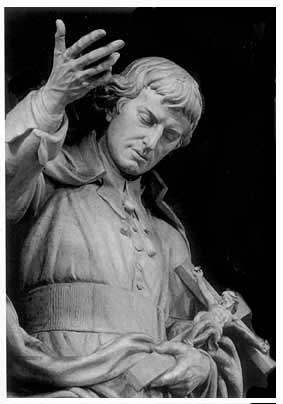 Easter was a little awkward this year... sometimes my prayer life gets nudged off its fragile balance when I leave seminary for a while... so it didn't feel the same... but no matter, that doesn't negate the awesome fact of our Lord's Passion, Death, & Resurrection - all to draw our broken hearts into his Most Sacred Heart.
I do remember waking up early Easter morning, glancing at my watch, and thinking, "ah, thank God, its Easter... *deep breath*
Now I'm looking foward to this Friday, the Optional Memorial of St. Louis de Montfort. As you all know, he is the great Marian Saint and instructor of the Total Consecration to Jesus through Mary. One of the first things I did when I got to seminary (along with my d.b.) was prepare for and accomplish this Consecration. When I knelt at the same pew as our late Holy Father, Pope John Paul the Great, in our beautiful chapel here at St. Mary's and received a blessing from one of our deacons, I handed my formation over to our most Blessed Mother. I told her I couldn't do this without her help and intercession.
To prepare for the preparation (!) for the Consecration, I read The Secret of the Rosary and then True Devotion to Mary, both by St. Louis de Montfort. Each day up to and including the Optional Memorial I'll post two or three quotes from True Devotion that particularly touched me as I was reading.
Sedes Sapientiae, ora pro nobis!
Saturday, April 22, 2006
on God or the girl

I've been watching God or the Girl and there were numerous times when I thought "Man, I can't believe I'm NOT watching EWTN!" This is an excellent show! It is a little overly dramatic. They aren't considering that seminary is discernment as well, it's like they gotta decide on the priesthood TOMORROW. Knowing that most approach the first two years of seminary as further discernment really helped me make my decision to enter. It almost seems like the producers of the show are the ones setting the deadline! Also, at one point... I think Joe's his name (?)... the 28 year old, blonde guy, said he was attracted to the priesthood because people put you on a pedastal. This is attractive, like he said, but it's not the purest motivation... but at the same time, we all have impure motives at first, then they get purified as we move thru seminary. Overall, I think it's a great show! I like the curly-haired guy's story the best - the guy that carried a cross 20+ miles to help him discern. Sweet!
Other thoughts: I gotta admit this show made me a little anxious! It brought back all the thoughts and worries I had when I was discerning! But it was good because one of the guys would have an insight on something and I'm thinking "yeah man, I thought that too!" and I found myself cheering them on! hehe It's been good. It's reminded me of the insights I came too that helped me decide to take the plunge. I've pre-ordered the series on DVD from the show's website. I hope to watch them again and then blog the insights that I shared with the guys so that I don't forget 'em.
Wednesday, April 19, 2006
toward a more natural science
Here is my fourth paper this semester: "Kass on Descartes and toward a More Natural Science"
It seems that in no other field has man made more progress than in modern science.[1] The species he has chronicled, the heights he has scaled, the diseases he has conquered, the lives he has saved all work together to paint a triumphant and heroic picture of modern science. But like all things in which man has invested such a large part of his time and energy, it has its critics. For example, Dr. Leon R. Kass, M.D., former chairman of the President’s Council on Bioethics, writes, “The teachings of science, however gratifying as discoveries to the mind, throw icy waters on the human spirit.”[2] But, how can he possibly say this? With all the aforementioned progress, should we not assume that the human spirit has been lifted higher than ever before? Modern science is all around us; we’ve all either played major parts in it or have been affected by it in many ways. Because of this, Kass’ critique can seem absurd. But, much to our surprise, if we take a closer look at modern science, if we peek behind the veil, with Kass as our guide, we find much with which to call its progress into doubt.
In his major work on the philosophy and meaning of modern science and its view of and affect on humanity, Toward a More Natural Science, Kass gives us a very eye-opening look indeed. He shows us that during most of our modern experience of science, we have viewed the world and ourselves through squinted eyes. And he shows us that we can engage in a science that more rightly approaches nature[3] and man by properly analyzing the intentions of its architects, Francis Bacon and René Descartes. In this essay we will focus on the contributions of the latter of the two.
First, what does Kass mean when he says that science has thrown “icy waters on the human spirit?” What do Descartes’ contributions to modern science have to do with the human spirit in the first place? Aren’t the two distinct and unrelated, the former being unconcerned with the latter? But, as we will see, modern science has much to do with the human spirit. In the name of progress and the mastery of nature, modern science has made a concerted effort to bring all human aspiration, longing, and hope into doubt and, ultimately, oblivion.
For example, Descartes begins his Discourse on Method by stating that of the “various actions and enterprises of all men, there is hardly one of them that does not seem to me vain and useless.”[4] This is a telling comment on man’s ability and achievement. On the other hand, he believes man has been given too much credit by the classical traditions of Socrates, Aristotle, Aquinas, and the like. Descartes wants to lower man from the peaks of classical philosophy, theology, and morals so that he can build him up again his way, through a novel, methodical science of mathematical physics[5]. The awe and wonder that were the foundation and beginning of philosophy and wisdom for the ancient philosophers – and which still animate man today – are simply explained away in terms of “stimulus and response, of input and output, and neurotransmitters and end-plate potentials, and… [relegated to oblivion are] human inwardness, purposiveness, and consciousness.”[6] So much for our icy water.[7]
But what is this science of mathematical physics? It can be looked at as a theoretical attitude and as a practical enterprise.[8] But first a definition is necessary. Descartes explained it this way:
* Is opposed to ordinary experience and to speculative philosophy;
* “Redefined what it means to know something, in terms of the standards of certainty and clarity possessed by symbolic mathematics and through the rigorous application of a universal method”;
* Is “neutral to the large human and metaphysical questions that dominated ancient philosophy and which human beings still ask and will always ask” and
* Studies man’s political and moral life scientifically “not the way it is lived, but abstractly and amorally, like a mere physical phenomenon.”
This theoretical attitude is clearly seen in a few real-world examples, the first one concerning the human mind.
One of the more disturbing developments on the horizon of modern science is its attempt to construct a “peace of mind” that before was accomplished by old fashioned discipline and experience.[11] Kass tells us of the experiments of neurophysiologist Jose Delgado to place electrodes on certain areas of the brain in order to stimulate feelings of pleasure in the patient. He was even able to outfit the patent with a portable device – leaving the electrodes implanted – that she could then use to stimulate the feelings of pleasure herself. No longer tied to the doctor’s lab, and cleverly concealing the wires of the contraption, Dr. Delgado’s subject could now freely experience pleasure at her every whim. So much for experience.
A second example broadens our scope a bit, from science in the interest of peace of mind to science in the public interest and the mastery and possession of life itself. But as we said before, modern science is neutral to the ultimate questions, those of “meaning, being, ultimate causes, the eternity or noneternity of the world, justice and injustice, the good, the true, and the beautiful.”[12] So how can it possibly speak for what is in the public’s best interest? This neutrality, rather than liberating modern science, has actually enslaved it in standardless, limitless experimentation. In one particular case of misguided zeal for the public interest, “On June 16, 1980, the Supreme Court of the United States ruled that a living microorganism was patentable matter, under the provision of patent laws enacted by Congress in 1952.”[13] Here microbiologist Ananda Chakrabarty was given a patent on bacteria that he produced in a lab to breakdown oil spills. This has profound implications and tells us many things about modern science’s view of life:[14]
* It is no longer concerned with what living things are but how they work;
* Knowledge of life is not a good in itself but a means to some sort of power;
* “A living organism is no more than a composition of matter”;
* “All forms are but accidents of underlying matter: Matter is what truly is”;
* All of living nature, our own included, is absent of any special dignity; and
* “There is nothing in the nature of a being, no, not even in the human patenter himself, that makes him immune to being patented”
Returning to Chakrabarty’s new bacteria, we are justified in feeling a certain uneasiness, to say the least, at the concept of human ownership of an entire species. Kass, making this even clearer, warns us that “It is one thing to own a mule; it is another to own mule”! And he asks an important question: “What is the principled limit to this beginning extension of the domain of private ownership and dominion over living nature?” It seems to be nowhere in sight, but Kass gives us a brilliant piece of advice:
Our final example returns to the human person and his encounter with modern medicine. Kass explains that like our laboratory science, medicinal science lacks the character it needs to give it necessary guidance and purpose. Indeed, the motivation of the physician’s art, rather than lying in the healthy human being, is in several false goals:[16]
* Happiness, pleasure, and contentment or convenience rather than health;
* The redefinition of health as “a state of complete physical, mental, and social well-being”;
* Social adjustment and obedience or civil and moral virtue;
* The alteration of human nature;[17]
* Research not for the immediate benefit on and for the patient but rather in a way that uses him as a means to a scientific end;[18] and finally
* The prolongation of life or the prevention of death rather than health, per se[19]
A look at the word “health” itself can help us stay focused on its true meaning and the proper goal of medicine: the healthy human being. “Health” literally means “wholeness” and so “to be whole is to be healthy, and to be healthy is to be whole.” Ancient Greek has two words for “health:” hygieia [“hygiene”], meaning “living well” or “a well way of living;” and euexia, meaning “well-habited-ness” or “good habit of body.” This reminds us of Aristotle’s treatment of virtue. “Just as courage is the cause of courageous action and hence also of courage, so ‘living well’ is health, is the cause of health, and is caused by health.”[20] And speaking of virtue in turn reminds us of the soul, the oft-forgotten harbinger of health and wholeness. Socrates criticizes this forgetfulness in the Platonic dialogue Charmides: “just as one must not attempt to curve the eyes without the head or the head without the body, so neither the body without the soul.”[21]
In the three examples above, we have seen how Descartes’ vision has had a strong influence on modern science. To clarify, it would be incorrect to equate 17th century thought and science with our modern science today; many later modern thinkers have deepened and furthered Descartes. But, one cannot deny the key role he played in establishing the present motivations and goals of modern science. On the other hand, Kass has been one of many key figures that have gotten us out from under and away from these modern formulations and that have been thoughtful of a new post-modern science.[22] He advises that, first and foremost, we must “awaken the sense of awe and wonder, itself more human than even the desire for mastery.”[23] And “we must ponder the full range of questions raised by the relation between knowledge and human life, or between science and the broader community.”[24] Finally, “If we are sober in our practice and mindful in our thought, it is given to us human beings to learn our place in the natural whole and to discover something of its distinctive beauty and mysterious ground.”[25]
[1] Notice I say, “It seems.” We will discover reason to doubt if we have made true progress after taking a closer look at modern science here.
[2] All quotes from Kass are from Toward More Natural Science: Biology and Human Affairs, by Leon R. Kass, M.D., The Free Press, ©1985 – hereafter referred to as “Kass”. Here: Kass, p. 6
[3] A science that more rightly approaches nature is the “more natural science” that Kass argues we need to return to. And he states: “ ‘Natural’ and ‘more natural’ mean here only ‘true (or truer) to life as found and lived’ ” – Kass, p. xii
[4] All quotes from Descartes are from Discourse on Method and Meditations on First Philosophy, translated by Donald A. Cress, Hackett Publishing Company, Inc., ©1998 – hereafter referred to as “Descartes”. Here: Descartes, p. 2
[5] From notes given by Dr. Paul Seaton, History of Philosophy II, 1-27-06
[6] Kass, p. 6
[7] Sorry, I couldn’t resist (cf. Aristotle, Nicomachean Ethics, II-5, para. 10.)
[8] Comment on draft by Dr. Paul Seaton
[9] Kass, p. 130-131 quoting Descartes, p. 34-35.
[10] Kass, p. 5
[11] Descartes expresses this desire as well, noting “the tranquility I esteem above all things” and the “perfect peace of mind I am seeking” in the context of a discussion on if he should go public with his new method of mathematical physics. Descartes, p. 42
Note: Our Holy Father is aware of this: “If it is true…that in the 19th and 20th centuries, technology has gone through an amazing growth, at the beginning of the 21st century further steps have been taken: Technological development has taken over, thanks to information technology, even a part of our mental activities, with knowledge that affects our way of thinking and can condition our freedom itself.” – Zenit April 4, 2006
[12] Kass, p. 5
[13] p. 128
[14] p. 149-150
[15] All quotes in this paragraph, p. 151-152
[16] p. 160-162
[17] “New biomedical techniques provide vastly greater powers to alter directly and deliberately the bodies and minds of human beings, as well as many of the naturally given boundaries of human life… [T]he possible and likely uses [of these powers] extend beyond the traditional medical goals of healing; they promise – or threaten – to encompass… ultimately, perhaps, new human beings and ways of being human.” – Kass, p. 1-2
“For the mind depends so much on the temperament and disposition of the bodily organs that, if it is possible to find a means of rendering men wiser and cleverer than they have hitherto been, I believe that it is in medicine that it must be sought.” – Kass, p. 130-131 quoting Descartes, p. 35.
[18] Again, Our Holy Father: In this context, "it is necessary to say forcefully that the human being cannot and must not be sacrificed ever for the sake of science and technology," the Holy Father stressed. "This is the reason why," he added, "the issue is so important of the so-called anthropological question which for us, heirs of the humanistic tradition founded on Christian values, must be addressed in the light of principles that inspired our civilization." – Zenit April 4, 2006
[19] “To be alive and to be healthy are not the same, though the first is both a condition of the second and, up to a point, a consequence… If medicine takes aim at death prevention, rather than at health, then the medical ideal, ever more closely to be approximated, must be bodily immortality.” – Kass, p. 162
“No other area of present biomedical research promises such profound alterations of our way of life, not to say of our condition.” – p. 300
[20] p. 170
[21] Plato, Charmides, 156d-157a
[22] Just as Aristotle, always our example, can help us “get out from under Kant and away from his formulations of moral terms and alternatives.” – The God of Faith and Reason: Foundations of Christian Theology by Robert Sokolowski, ©1995 The Catholic University of America Press, Ch. 6, p. 54-55
[23] Kass, p. xii
[24] p. 8
[25] p. 153
It seems that in no other field has man made more progress than in modern science.[1] The species he has chronicled, the heights he has scaled, the diseases he has conquered, the lives he has saved all work together to paint a triumphant and heroic picture of modern science. But like all things in which man has invested such a large part of his time and energy, it has its critics. For example, Dr. Leon R. Kass, M.D., former chairman of the President’s Council on Bioethics, writes, “The teachings of science, however gratifying as discoveries to the mind, throw icy waters on the human spirit.”[2] But, how can he possibly say this? With all the aforementioned progress, should we not assume that the human spirit has been lifted higher than ever before? Modern science is all around us; we’ve all either played major parts in it or have been affected by it in many ways. Because of this, Kass’ critique can seem absurd. But, much to our surprise, if we take a closer look at modern science, if we peek behind the veil, with Kass as our guide, we find much with which to call its progress into doubt.
In his major work on the philosophy and meaning of modern science and its view of and affect on humanity, Toward a More Natural Science, Kass gives us a very eye-opening look indeed. He shows us that during most of our modern experience of science, we have viewed the world and ourselves through squinted eyes. And he shows us that we can engage in a science that more rightly approaches nature[3] and man by properly analyzing the intentions of its architects, Francis Bacon and René Descartes. In this essay we will focus on the contributions of the latter of the two.
First, what does Kass mean when he says that science has thrown “icy waters on the human spirit?” What do Descartes’ contributions to modern science have to do with the human spirit in the first place? Aren’t the two distinct and unrelated, the former being unconcerned with the latter? But, as we will see, modern science has much to do with the human spirit. In the name of progress and the mastery of nature, modern science has made a concerted effort to bring all human aspiration, longing, and hope into doubt and, ultimately, oblivion.
For example, Descartes begins his Discourse on Method by stating that of the “various actions and enterprises of all men, there is hardly one of them that does not seem to me vain and useless.”[4] This is a telling comment on man’s ability and achievement. On the other hand, he believes man has been given too much credit by the classical traditions of Socrates, Aristotle, Aquinas, and the like. Descartes wants to lower man from the peaks of classical philosophy, theology, and morals so that he can build him up again his way, through a novel, methodical science of mathematical physics[5]. The awe and wonder that were the foundation and beginning of philosophy and wisdom for the ancient philosophers – and which still animate man today – are simply explained away in terms of “stimulus and response, of input and output, and neurotransmitters and end-plate potentials, and… [relegated to oblivion are] human inwardness, purposiveness, and consciousness.”[6] So much for our icy water.[7]
But what is this science of mathematical physics? It can be looked at as a theoretical attitude and as a practical enterprise.[8] But first a definition is necessary. Descartes explained it this way:
So soon as I had acquired some general notions concerning Physics… they caused me to see that it is possible to attain knowledge which is very useful in life, and that, instead of that speculative philosophy which is taught in the Schools, we may find a practical philosophy by means of which, knowing the force and the action of fire, water, air, the stars, heaven and all the other bodies that environ us, as distinctly as we know the different crafts of our artisans, we can in the same way employ them in all those uses to which they are adapted, and thus render ourselves the masters and possessors of nature.[9]Descartes’ 17th-century vision for science is today its primary goal. Therefore, Kass explains that modern science:[10]
* Is opposed to ordinary experience and to speculative philosophy;
* “Redefined what it means to know something, in terms of the standards of certainty and clarity possessed by symbolic mathematics and through the rigorous application of a universal method”;
* Is “neutral to the large human and metaphysical questions that dominated ancient philosophy and which human beings still ask and will always ask” and
* Studies man’s political and moral life scientifically “not the way it is lived, but abstractly and amorally, like a mere physical phenomenon.”
This theoretical attitude is clearly seen in a few real-world examples, the first one concerning the human mind.
One of the more disturbing developments on the horizon of modern science is its attempt to construct a “peace of mind” that before was accomplished by old fashioned discipline and experience.[11] Kass tells us of the experiments of neurophysiologist Jose Delgado to place electrodes on certain areas of the brain in order to stimulate feelings of pleasure in the patient. He was even able to outfit the patent with a portable device – leaving the electrodes implanted – that she could then use to stimulate the feelings of pleasure herself. No longer tied to the doctor’s lab, and cleverly concealing the wires of the contraption, Dr. Delgado’s subject could now freely experience pleasure at her every whim. So much for experience.
A second example broadens our scope a bit, from science in the interest of peace of mind to science in the public interest and the mastery and possession of life itself. But as we said before, modern science is neutral to the ultimate questions, those of “meaning, being, ultimate causes, the eternity or noneternity of the world, justice and injustice, the good, the true, and the beautiful.”[12] So how can it possibly speak for what is in the public’s best interest? This neutrality, rather than liberating modern science, has actually enslaved it in standardless, limitless experimentation. In one particular case of misguided zeal for the public interest, “On June 16, 1980, the Supreme Court of the United States ruled that a living microorganism was patentable matter, under the provision of patent laws enacted by Congress in 1952.”[13] Here microbiologist Ananda Chakrabarty was given a patent on bacteria that he produced in a lab to breakdown oil spills. This has profound implications and tells us many things about modern science’s view of life:[14]
* It is no longer concerned with what living things are but how they work;
* Knowledge of life is not a good in itself but a means to some sort of power;
* “A living organism is no more than a composition of matter”;
* “All forms are but accidents of underlying matter: Matter is what truly is”;
* All of living nature, our own included, is absent of any special dignity; and
* “There is nothing in the nature of a being, no, not even in the human patenter himself, that makes him immune to being patented”
Returning to Chakrabarty’s new bacteria, we are justified in feeling a certain uneasiness, to say the least, at the concept of human ownership of an entire species. Kass, making this even clearer, warns us that “It is one thing to own a mule; it is another to own mule”! And he asks an important question: “What is the principled limit to this beginning extension of the domain of private ownership and dominion over living nature?” It seems to be nowhere in sight, but Kass gives us a brilliant piece of advice:
[T]o respect art [of science] without respect for life is finally self-contradictory. For human art depends on the human artificer, whose inventive mind depends on his living body, not only to sustain it that he might practice its cleverness, but also because the ends of his artfulness emerge from the inner needs and aspirations of his embodied life.And at the end of the day, as much as Mr. Chakrabarty and the Supreme Court believe he has created this new living organism from his own power and creativity, let them and modern science in general be reminded that “nature is commanded only as she is obeyed.”[15] Chakrabarty put the necessary conditions in place, but ultimately it was Nature who was in control.
Our final example returns to the human person and his encounter with modern medicine. Kass explains that like our laboratory science, medicinal science lacks the character it needs to give it necessary guidance and purpose. Indeed, the motivation of the physician’s art, rather than lying in the healthy human being, is in several false goals:[16]
* Happiness, pleasure, and contentment or convenience rather than health;
* The redefinition of health as “a state of complete physical, mental, and social well-being”;
* Social adjustment and obedience or civil and moral virtue;
* The alteration of human nature;[17]
* Research not for the immediate benefit on and for the patient but rather in a way that uses him as a means to a scientific end;[18] and finally
* The prolongation of life or the prevention of death rather than health, per se[19]
A look at the word “health” itself can help us stay focused on its true meaning and the proper goal of medicine: the healthy human being. “Health” literally means “wholeness” and so “to be whole is to be healthy, and to be healthy is to be whole.” Ancient Greek has two words for “health:” hygieia [“hygiene”], meaning “living well” or “a well way of living;” and euexia, meaning “well-habited-ness” or “good habit of body.” This reminds us of Aristotle’s treatment of virtue. “Just as courage is the cause of courageous action and hence also of courage, so ‘living well’ is health, is the cause of health, and is caused by health.”[20] And speaking of virtue in turn reminds us of the soul, the oft-forgotten harbinger of health and wholeness. Socrates criticizes this forgetfulness in the Platonic dialogue Charmides: “just as one must not attempt to curve the eyes without the head or the head without the body, so neither the body without the soul.”[21]
In the three examples above, we have seen how Descartes’ vision has had a strong influence on modern science. To clarify, it would be incorrect to equate 17th century thought and science with our modern science today; many later modern thinkers have deepened and furthered Descartes. But, one cannot deny the key role he played in establishing the present motivations and goals of modern science. On the other hand, Kass has been one of many key figures that have gotten us out from under and away from these modern formulations and that have been thoughtful of a new post-modern science.[22] He advises that, first and foremost, we must “awaken the sense of awe and wonder, itself more human than even the desire for mastery.”[23] And “we must ponder the full range of questions raised by the relation between knowledge and human life, or between science and the broader community.”[24] Finally, “If we are sober in our practice and mindful in our thought, it is given to us human beings to learn our place in the natural whole and to discover something of its distinctive beauty and mysterious ground.”[25]
[1] Notice I say, “It seems.” We will discover reason to doubt if we have made true progress after taking a closer look at modern science here.
[2] All quotes from Kass are from Toward More Natural Science: Biology and Human Affairs, by Leon R. Kass, M.D., The Free Press, ©1985 – hereafter referred to as “Kass”. Here: Kass, p. 6
[3] A science that more rightly approaches nature is the “more natural science” that Kass argues we need to return to. And he states: “ ‘Natural’ and ‘more natural’ mean here only ‘true (or truer) to life as found and lived’ ” – Kass, p. xii
[4] All quotes from Descartes are from Discourse on Method and Meditations on First Philosophy, translated by Donald A. Cress, Hackett Publishing Company, Inc., ©1998 – hereafter referred to as “Descartes”. Here: Descartes, p. 2
[5] From notes given by Dr. Paul Seaton, History of Philosophy II, 1-27-06
[6] Kass, p. 6
[7] Sorry, I couldn’t resist (cf. Aristotle, Nicomachean Ethics, II-5, para. 10.)
[8] Comment on draft by Dr. Paul Seaton
[9] Kass, p. 130-131 quoting Descartes, p. 34-35.
[10] Kass, p. 5
[11] Descartes expresses this desire as well, noting “the tranquility I esteem above all things” and the “perfect peace of mind I am seeking” in the context of a discussion on if he should go public with his new method of mathematical physics. Descartes, p. 42
Note: Our Holy Father is aware of this: “If it is true…that in the 19th and 20th centuries, technology has gone through an amazing growth, at the beginning of the 21st century further steps have been taken: Technological development has taken over, thanks to information technology, even a part of our mental activities, with knowledge that affects our way of thinking and can condition our freedom itself.” – Zenit April 4, 2006
[12] Kass, p. 5
[13] p. 128
[14] p. 149-150
[15] All quotes in this paragraph, p. 151-152
[16] p. 160-162
[17] “New biomedical techniques provide vastly greater powers to alter directly and deliberately the bodies and minds of human beings, as well as many of the naturally given boundaries of human life… [T]he possible and likely uses [of these powers] extend beyond the traditional medical goals of healing; they promise – or threaten – to encompass… ultimately, perhaps, new human beings and ways of being human.” – Kass, p. 1-2
“For the mind depends so much on the temperament and disposition of the bodily organs that, if it is possible to find a means of rendering men wiser and cleverer than they have hitherto been, I believe that it is in medicine that it must be sought.” – Kass, p. 130-131 quoting Descartes, p. 35.
[18] Again, Our Holy Father: In this context, "it is necessary to say forcefully that the human being cannot and must not be sacrificed ever for the sake of science and technology," the Holy Father stressed. "This is the reason why," he added, "the issue is so important of the so-called anthropological question which for us, heirs of the humanistic tradition founded on Christian values, must be addressed in the light of principles that inspired our civilization." – Zenit April 4, 2006
[19] “To be alive and to be healthy are not the same, though the first is both a condition of the second and, up to a point, a consequence… If medicine takes aim at death prevention, rather than at health, then the medical ideal, ever more closely to be approximated, must be bodily immortality.” – Kass, p. 162
“No other area of present biomedical research promises such profound alterations of our way of life, not to say of our condition.” – p. 300
[20] p. 170
[21] Plato, Charmides, 156d-157a
[22] Just as Aristotle, always our example, can help us “get out from under Kant and away from his formulations of moral terms and alternatives.” – The God of Faith and Reason: Foundations of Christian Theology by Robert Sokolowski, ©1995 The Catholic University of America Press, Ch. 6, p. 54-55
[23] Kass, p. xii
[24] p. 8
[25] p. 153
Friday, April 14, 2006
Good Friday

For Holy Thursday, yesterday, and Good Friday, today, I'm helping out Fr. David Naylor because he invited me to stay with him a while ago, during my Easter break. I'm excited about M.C.'ing the service (Good Friday is the one day of the year where there is not a Mass) tonight. Look for pictures of his newly-renovated parish soon. It's one of the most beautiful Vatican II parishes I've seen in the Archdiocese of Louisville!
St. Mary's Diaconate April 06
Here is a photo album I put together for the April 2006 Diaconate Ceremony celebrated at St. Mary's. Please pray for these two new Deacons and seminary brothers of mine from the Diocese of Syracuse, NY! Michael Galuppi and Gregory Kreinheder

St. Stephen, first Deacon, and first martyr, pray for us!
St. Stephen, first Deacon, and first martyr, pray for us!
thoughts on the first year of blogging
As promised, here are my thoughts on the first year of blogging:
A friend of mine got me started blogging, a year ago, and I was embarrassed to not have one already! I was at the climax of my discernment (at least my discernment of seminary) and thought it would be a good idea to blog my thoughts during the application process. I thought it would be good to be able to look back, down the road, and see if/where I've grown and changed.
Hehe, I remember vividly the whole process! It seemed like so much and I was very anxious! Work was increasingly unfulfilling and I was miserable at my job. Well, to be clear, the job itself was awesome: awesome people, awesome pay, awesome company, good family values, high-paced, high-tech, high-rise! But I just couldn't do it anymore and I was thinking more and more of the priesthood. This blog has been great for getting my thoughts off my chest and it's also been a good place to store all the neat little prayers and other finds I've come across over the year... things that have inspired and motivated me. Now I can always have them to look back on. I also hope that this has been a good means for all of you, friends, and family to keep up with how I'm doing. Lastly, I hope that this has encouraged others to prayerfully discern God's call for their life as well.
Some memorable posts, in chronological order:
- My first post, where I described my purposes for this blog
- On joining the Knights of Columbus
- My post on a rough time during the process and on the interviews
- On meeting Scott Hahn
- On adventures on God's green earth
- A low point at work
- The log of an IM chat with a co-worker on my meeting with and acceptance by the Archbishop of Louisville!
- My essays during the application process on: Ministry of the Word; Ministry of the Sacraments and Shepherding; Prayer, Celibacy, and Obedience; and Justice and Simplicity
- Meeting Jeff Cavins
- On the Archdiocese end-of-summer retreat for seminarians
- Stress at the end of the applicaton process
- On the first day at seminary!
- Thoughts on discernment at St. Mary's
- Tips on how to pray the rosary, from St. Louis de Montfort
- On my first time at the local abortion clinic
- On the last words of Pope John Paul II (and here)
- On my first time wearing clerics!
- My first paper in Seminary, on Plato's Phaedo
- My second paper on belief in Jesus Christ
- My third paper on Plato's Euthyphro
- My fourth paper on "Rational Animal/Political Animal" by Laurence Berns
- On the start of preparing for St. Louis de Montfort's Total Consecration to Jesus through Mary. I still haven't posted the reflections for each day, I intend to back-post these at some point just so I can have them here. Here are the three major parts at least: Part 1, Part 2, Part 3)
- My fifth paper on The Courts and the Church on Gay "Marriage"
- My sixth paper on St. Thomas Aquinas on the human person
- My seventh paper on Leo Kass's The Hungry Soul
- My eighth paper on Descartes and Nietzsche on the human person
- The artwork of my good friend Dave
- On My trip to El Salvador
- On a week with my old spiritual director and witnessing my first death
- On the 33rd annual Pro-Life Mass and March (and here and here)
- Receiving the Ministry of Lector
- Winter Break Retreat
- My first paper of my second semester: Machiavelli and Aquinas on virtue
- My second paper: Aristotle on god (small "g")
- My third paper: Sokolowski on natural virtue
- On the Latin Mass at St. Alphonsus
So...wow! It's been a very eventful and exciting year! It's been very hard too... but as I told some seventh graders recently: It should be. Becoming a holy and learned priest should be through hard work. But I've struggled alot over this past year with procrastination and doubts. But our Blessed Lord won't let me stop thinking about the priesthood and throughout it all, and despite myself, he's been sending me little affirmations here and there that have helped me persevere. And that's what I'm trying to focus on during this second year of blogging: Praying, in times of trial, not for consolation or favors, but simply for perseverence to endure the trials and downtimes of discernment that Our Lord desires that I go through, according to his most Loving and Holy Will. Jesus, I trust in you.
Sacred Heart of Jesus, have mercy on us.
Immaculate Heart of Mary, pray for us.
God or the girl
"God or the Girl": Vocational Struggles on TV
Interview With Father Brian Bashista
Interview With Father Brian Bashista
ARLINGTON, Virginia, APRIL 13, 2006 (Zenit.org).- Four young men struggling with discerning their vocation to the priesthood give a glimpse into their real-life journey on national television in a five-part series starting this Easter Sunday.
The series, "God or the Girl," captures the tension and triumph of Joe, Mike, Steve and Dan, four men in their 20s who are at a crossroads in their lives. Over the course of this series they decide whether or not to enroll in the seminary.
The series on A&E Television includes one of the mentors, Father Brian Bashista, vocations director for the Diocese of Arlington. The diocese has 24 seminarians studying for the priesthood.
Father Bashista shared with ZENIT his impressions of the A&E series and the state of vocational discernment in the United States.
Q: What is the main purpose of this series on vocational discernment?
Father Bashista: I do not believe the producers claimed to have created a show specifically on vocation discernment.
As I understand, they were just trying to present the real-life struggles of four young men who are considering the very important life decision of whether or not they are being called to the priesthood, and to share these struggles with a wide and -- as the producers discovered -- a very curious secular audience.
The series does, however, provide good examples of individuals who are being faithful to their responsibility to seriously discern their God-given vocation, and gives a very frank presentation of the various aspects of discernment.
From my perspective, as a vocation director, the producers did an incredible job of capturing a snapshot into the reality of this discernment with all of its twists and turns, ups and downs, highlights and lowlights.
Q: What are the most common struggles that young men have today in discerning their vocation to the priesthood or marriage?
Father Bashista: In general, many of our youth have not built the habit of prayer through which the Lord disposes them to hear and respond to his vocation invitation.
Most just "happen" into the married life without being sincerely open to the possibility that
Christ might be inviting them to follow him as a priest or consecrated religious. Without prayer, it is extremely difficult, if not impossible, to receive the grace one needs to realize and embrace their vocation with trusting faith and reasonable conviction.
The struggles of young people discerning their vocation are illustrated best in Jesus' parable of the sower and the seed. Sometimes the call falls on souls who are hurrying about on the path of a busy world. The apprehension of making a lifelong commitment coupled with a fear of losing one's independence means the call goes unheeded and is thus trampled underfoot.
Some souls are more open to the call, but are like the rocky ground. They sense the initial call,
but the unrealistic expectation of immediate clarity or a "sure sign" that this is God's will means that the call is never really nurtured either by themselves or, more often than not, by friends and family, particularly parents.
The call also falls among souls enmeshed in the thorny dangers of the riches and inordinate pleasures of life. They fail to cherish the call by reforming their lives in harmony with the Gospel, or in fully appreciating the great gift of chaste living, whether as a celibate priest or as a married man. Therefore, the call is choked and eventually dies.
But others are like the good and fertile soil. They are souls who are prepared to properly receive the Lord's call through the watering of prayer, the tilling of hard work, the warmth of their humble generosity, and the light of their sacrificial lives.
These souls welcome the possibility of whatever vocation the Lord may be calling them to. They are thus able to follow his voice by either entering the seminary for further discernment or to seek confirmation of their vocation elsewhere, perhaps on the road to marriage.
Q: What advice would you give to young men in the midst of this struggle?
Father Bashista: I would advise them to focus on these virtues of prayer, hard work, generosity and sacrifice.
They provide the active, practical means of countering the temptations against the Lord's call,
especially the false humility of a sense of unworthiness, the difficulty of choosing and living celibacy for the sake of the Kingdom, and the need for objective certitude before answering
the call.
"Fear is useless, what is needed is trust," says the Lord. And that is especially true in vocation discernment.
Q: Do you think that this television program will help those who are struggling with their vocation and also help those who don't understand what a vocation to the priesthood is about?
Father Bashista: Absolutely. This series shows how these four faithful Catholic men grapple with their strengths and weaknesses in responding to the Lord.
Their sincerity is contagious and will be a source of insight, challenge and encouragement to those who watch.
The pastoral, priestly example of the missionary, Father Jorge, will go a long way in clarifying the essence of priesthood as a life of loving, sacrificial service for others.
In a wider context -- and contrary to popular opinion -- the series will also reveal to its viewers what many in the Church have already know for years, namely, that numerous outgoing, affable, balanced and intelligent young men are seriously considering a call to serve Christ and his Church as a future Roman Catholic priest.
As we see in these four men, many others like them are well on their way to become highly successful in the eyes of the world … but are willing to give up everything for a life which points to a reality beyond this world.
Despite what their friends, family, classmates or co-workers might think, they are willing to
seriously explore this road less traveled.
Despite their mixed motives and normative questions, fears and doubts, they will be admired for their courage and faithful witness in taking serious note of the Lord's invitation to "Come follow me" … and will no doubt inspire others to do the same.
Q: What do you think is the current situation of priestly vocations in the United States today?
Father Bashista: It is a new springtime of hope for priestly vocations.
I believe that we are experiencing a time of purification which will produce the lasting fruit
of strong, courageous responses on the part of those men Christ is calling to tend "his flock."
His people are hungry for holiness and truth. Through persevering prayer, that hunger will
indeed be satisfied by faithful, sacramental and pastoral care on the part of future priests and consecrated religious.
A close priest friend of mine commented after viewing this series that "We are indeed entering into exciting times if men like these are the future husbands, fathers and priests of the Church."
Q: How can we help young people to consider the priesthood and to discern wisely?
Father Bashista: Families must pray for and encourage their children's vocation responses. They must begin to give their children the tools with which to uncover each child's unique vocation.
Parishes must pray for and support vocations from the young people in their midst.
Priests, religious and educators must be attentive to the qualities of the youth to whom they minister and invite those who seem to have the disposition and qualities of a potential priest to consider a vocation to the priesthood.
If young people see that we, as a Church, value and esteem all vocations and the importance of their individual discernment, they will themselves give it the attention and prayerful consideration necessary for its discovery.
I also believe that faithfully living of our own vocation will go a long way in helping others to discover, fully embrace and faithfully live their vocation as well.
day of prayer for vocations
Message for 43rd Day of Prayer for Vocations
"Weaknesses and Human Limits Do Not Present Obstacles …"
"Weaknesses and Human Limits Do Not Present Obstacles …"
VATICAN CITY, APRIL 12, 2006 (Zenit.org).- Here is the full text of Benedict XVI's message for the 43rd World Day of Prayer for Vocations, to be observed May 7.
* * *
Vocation in the Mystery of the Church
Venerable Brethren in the Episcopate,
Dearest Brothers and Sisters,
The celebration of the coming World Day of Prayer for Vocations gives me the opportunity to invite the entire People of God to meditate the theme Vocation in the mystery of the Church. The Apostle Paul writes: "Blessed be God and Father of our Lord Jesus Christ ... even as he chose us in him before the foundation of the world ... He destined us in love to be his sons through Jesus Christ" (Ephesians 1:3-5). Before the creation of the world, before our coming into existence, the heavenly Father chose us personally, calling us to enter a filial relationship with Him, through Jesus, the Incarnate Word, under the guidance of the Holy Spirit. Dying for us, Jesus introduced us into the mystery of the Father's love, a love which completely embraces his Son and which He offers to all of us. In this way, united with Jesus, the Head, we form a sole body, the Church.
The weight of two millennia of history makes it difficult to grasp the novelty of this wonderful mystery of divine adoption, which is at the center of St. Paul's teaching. The Father, as the Apostle reminds us, "has made known to us the mystery of his will ..., as a plan to unite all things in him" (Ephesians 1:9-10). And he adds, with enthusiasm: "In everything God works for good with those who love him, who are called according to his purpose. For those whom he foreknew he also predestined to be conformed to the image of his Son, in order that he might be the firstborn among many brethren" (Romans 8:28-29).
The concept is indeed wonderful: We are called to live as brothers and sisters of Jesus, to feel that we are sons and daughters of the same Father. This is a gift that overturns every merely human idea and plan. The confession of the true faith opens wide our minds and hearts to the inexhaustible mystery of God, which permeates human existence. What should be said therefore of the temptation, which is very strong nowadays, to feel that we are self-sufficient to the point that we close ourselves to the mysterious plan of God for us? It is the love of the Father, which is revealed in the person of Christ, which puts this question to us.
In order to answer the call of God and start on our journey, it is not necessary to be already perfect. We know that the awareness of his own sin allowed the prodigal son to start on his return journey and thus feel the joy of reconciliation with the Father. Weaknesses and human limits do not present obstacles, as long as they help us to make us more aware of the fact that we need the redeeming grace of Christ. This is the experience of St. Paul who confessed: "I will all the more gladly boast of my weaknesses, that the power of Christ may rest upon me" (2 Corinthians 12:9). In the mystery of the Church, the mystical Body of Christ, the divine power of love changes the heart of man, making him able to communicate the love of God to his brethren. Down the centuries many men and women, transformed by divine love, have consecrated their own existences to the cause of the Kingdom.
Already on the shores of the Sea of Galilee, many allowed themselves to be conquered by Jesus: They were in search of healing in body or spirit, and they were touched by the power of his grace. Others were chosen personally by Him and became his apostles. We also find persons, like Mary Magdalene and other women, who followed him on their own initiative, simply out of love. Like the disciple John, they too found a special place in his heart. These men and women, who, through Jesus, knew the mystery of the love of the Father, represent the variety of vocations which have always been present in the Church. The model of one who is called to give witness in a particular manner to the love of God, is Mary, the Mother of Jesus, who, in her pilgrimage of faith, is directly associated with the mystery of the Incarnation and Redemption.
In Christ, the Head of the Church, which is his Body, all Christians form "a chosen race, a royal priesthood, a holy nation, God's own people, that you may declare the wonderful deeds of him" (1 Peter 2:9). The Church is holy, even if her members need to be purified, in order that holiness, which is a gift of God, can shine in them with its full splendor. The Second Vatican Council highlights the universal call to holiness, when it affirms: "The followers of Christ are called by God, not because of their works, but according to his own purpose and grace. They are justified in the Lord Jesus, because in the Baptism of faith they truly become sons of God and sharers in the divine nature. In this way, they are really made holy" ("Lumen Gentium," No. 40).
Within the framework of this universal call, Christ, the High Priest, in his solicitude for the Church, then calls, in every generation, persons who are to take care of his people; in particular, he calls to the ministerial priesthood men who are to exercise a fatherly role, whose source is the very fatherhood of God (cf. Ephesians 3:14). The mission of the priest in the Church cannot be substituted. Therefore, even if in some regions there is a scarcity of clergy, it should never be doubted that Christ continues to raise up men who, like the Apostles, leaving behind all other work, dedicate themselves completely to the celebration of the sacred mysteries, to the preaching of the Gospel and to the pastoral ministry.
In the apostolic exhortation "Pastores Dabo Vobis," my venerated Predecessor John Paul II wrote in this regard: "The relation of the priest to Jesus Christ, and in him to his Church, is found in the very being of the priest by virtue of his sacramental consecration/anointing and in his activity, that is, in his mission or ministry. In particular, 'the priest minister is the servant of Christ present in the Church as mystery, communion and mission. In virtue of his participation in the "anointing" and "mission" of Christ, the priest can continue Christ's prayer, word, sacrifice and salvific action in the Church. In this way, the priest is a servant of the Church as mystery because he actuates the Church's sacramental signs of the presence of the risen Christ'" (No. 16).
Another special vocation, which occupies a place of honor in the Church, is the call to the consecrated life. Following the example of Mary of Bethany who "sat at the Lord's feet and listened to his teaching" (Luke 10:39), many men and women consecrate themselves to a total and exclusive following of Christ. Although they offer different kinds of services in the field of human formation and the care of the poor, in teaching or in assisting the sick, they do not consider these activities as the principal aim of their life, since, as the Code of Canon Law well underlines, "The first and foremost duty of all religious is to be the contemplation of divine things and assiduous union with God in prayer" (Canon 663 §1).
Moreover, in the apostolic exhortation "Vita Consecrata" John Paul II noted: "In the Church's tradition religious profession is considered to be a special and fruitful deepening of the consecration received in Baptism, inasmuch as it is the means by which the close union with Christ already begun in Baptism develops in the gift of a fuller, more explicit and authentic configuration to him through the profession of the evangelical counsels" (No. 30).
Remembering the counsel of Jesus: "The harvest is plentiful, but the laborers are few; pray therefore the Lord of the harvest to send out laborers into his harvest" (Matthew 9:37), we acknowledge the great need to pray for vocations to the priesthood and to the consecrated life. It is not surprising that, where people pray fervently, vocations blossom. The holiness of the Church depends essentially on union with Christ and on being open to the mystery of grace that operates in the heart of the Christians.
Therefore, I should like to invite all the faithful to nurture an intimate relationship with Christ, the Teacher and Pastor of his people, imitating Mary who kept the divine mysteries in her heart and meditated them diligently (cf. Luke 2:19). Together with her, who occupies a central position in the mystery of the Church, we pray:
O Father, raise up among Christians
numerous and holy vocations to the priesthood, to keep the faith alive and guard the gracious memory of your Son Jesus through the preaching of his word and the administration of the Sacraments, with which you continually renew your faithful.
Give us holy ministers of your altar,
who are careful and fervent guardians of the Eucharist, the sacrament of the supreme gift of Christ for the redemption of the world.
Call ministers of your mercy,
who, through the sacrament of Reconciliation, spread the joy of your forgiveness.
Grant, O Father, that the Church may welcome with joy numerous inspirations of the Spirit of your Son and, docile to His teachings, may she care for vocations to the ministerial priesthood and to the consecrated life.
Sustain the Bishops, priests and deacons, consecrated men and women, and all the baptized in Christ, so that they may faithfully fulfill their mission at the service of the Gospel.
This we pray You through Christ our Lord. Amen.
Mary, Queen of Apostles, pray for us.
From the Vatican, March 5, 2006
Benedict XVI
© Copyright 2006 -- Libreria Editrice Vaticana
Saturday, April 08, 2006
prayer request
Please pray for me as my PT class and the 1T class go on our Spring Retreat together. It's from Saturday to Wednesday. Please pray that God might grant me perseverence and purity of mind and heart so that I might grow in holiness as a seminarian and model more closely the virtues of the Sacred Heart of Jesus and the Immaculate Heart of Mary.


Friday, April 07, 2006
checking-in
It's been a while since I've posted so I thought I'd check in. I've been very busy with papers and other stuff so it's been impossible to post.
I told you I'd give a review of the Baltimore Pro-Life Conference but it may be too late for that - to make a long story short, it was good :)
I also said I'd share my thoughts on the last year of blogging - I haven't scratched that idea yet.
There was a Diaconate Ordination here at St. Mary's last weekend that was beautiful to say the least. I took some great pictures that I hope to share here too.
And some good news: I finally did my "Kass on Descartes" paper! Look for that soon... I know you'll be waiting with bated breath ;) Does anyone read my papers?
Finally, this weekend the PT and 1T classes are going on a retreat till Wednesday and then I'll be off on Easter break till April 22! I'm not sure how much I'll be able to post over the break but look for some pics of these too.
C-Ya! Gotta finish another paper, this time on "Sokolowski's Treatment of Aquinas on Being and Essence"... Good stuff!
Thursday, March 30, 2006
prayers for vocations
Benedict XVI Urges Prayers for Vocations On Occasion of a World Day
VATICAN CITY, MARCH 30, 2006 (Zenit.org).- Benedict XVI is appealing to all Catholics to intensify their prayer for vocations for a Church in need of more priests and consecrated persons.
"The priest's mission in the Church is irreplaceable," the Pope wrote in a message for the upcoming World Day of Prayer for Vocations.
"Therefore, despite the fact that in some regions there is a decrease of the clergy, the certainty must never be lost that Christ will continue to inspire men who, as the Apostles, putting all concerns aside, dedicate themselves totally to the celebration of the sacred mysteries, the preaching of the Gospel and pastoral ministry," the Holy Father wrote.
The 43th World Day of Prayer for Vocations will be observed May 7. The Vatican press office published the Pope's message today.
Reflecting on the World Day's theme, "Vocation in the Mystery of the Church," Benedict XVI also analyzed the call to the consecrated life, namely, the vocation of men and women who consecrate themselves to "the total and exclusive following of Christ."
After recalling Jesus' recommendation: "The harvest is plentiful but the laborers are few. Pray therefore to the Lord of the harvest to send laborers to his harvest," the Pope added: "We experience intensely the need to pray for vocations to the priesthood and the consecrated life."
"It is no surprise that wherever there is prayer, vocations flower," he said, as "the holiness of the Church depends essentially on union with Christ and openness to the mystery of grace that acts in the hearts of believers."
pics from v.d.'s visit
Here are some pics I took during my vocation director's visit to St. Mary's on Tuesday and Wednesday. It was good to see him and catch up on things and he gave me a lot of really good advice. We also had a meeting with my mentor that I think went well.
I get to walk through this scene on my way to the chapel every day... and I thought this closeup was cool:


And here is a pic of the three of us: Mike Wimsatt, my diocesan brother, Fr. Bill Bowling, my vocation director, and me

I get to walk through this scene on my way to the chapel every day... and I thought this closeup was cool:


And here is a pic of the three of us: Mike Wimsatt, my diocesan brother, Fr. Bill Bowling, my vocation director, and me
world day of prayer for vocations
Following is Pope Benedict XVI's message for the upcoming World Day of Prayer for Vocations. I like how he points out that Mary is the model of religious life. Emphasis below is mine:
MESSAGE FOR WORLD DAY OF PRAYER FOR VOCATIONS
VATICAN CITY, MAR 30, 2006 (VIS) - Made public today was the Holy Father's Message for the 43rd World Day of Prayer for Vocations, which is due to be celebrated on May 7, fourth Sunday of Easter, on the theme: "Vocation in the mystery of the Church."
"The weight of two millennia of history makes it difficult to perceive the novelty of the fascinating mystery of divine adoption which lies at the center of St. Paul's teaching," writes the Holy Father in his Message, which is dated March 5. "We are called to live as brothers and sisters of Christ, to consider ourselves as sons and daughters of the same Father. This a gift that overturns all exclusively human ideas and projects."
"What, then, must we say," Benedict XVI asks, "of the temptation, so strongly felt in our own time, to think ourselves so self-sufficient as to shut ourselves off from the mysterious plan God has for us? The love of the Father, revealed in the person of Christ, calls out to us."
Down the centuries, the Pope writes, many men and women, "transformed by divine love, have consecrated their lives to the cause of the Kingdom," and "through Christ have known the mystery of the Father's love." These people, the Pope goes on, "represent the multiplicity of vocations that have always been present in the Church."
Referring then to Vatican Council II's universal call to sanctity, the Holy Father affirms that, in each generation, Christ "calls individuals to take care of His people; in particular He calls men to the priestly ministry to exercise a paternal function. ... The priest's mission in the Church is irreplaceable. Therefore, even though some areas suffer a shortage of clergy, we must not lose the conviction that Christ continues to call men" to the priesthood.
"Another special vocation occupying a place of honor in the Church is the call to consecrated life. ... Although they undertake various forms of service in the field of human formation and care for the poor, in education and in assistance to the sick, [consecrated people] do not consider these activities as the principle aim of their lives because, as the Code of Canon Law says: 'Contemplation of divine things and assiduous union with God in prayer is to be the first and foremost duty of all religious'."
Benedict XVI concludes his Message with a call to pray "for vocations to the priesthood and the consecrated life. ... The Church's sanctity depends essentially on her union with Christ and her openness to the mystery of grace at work in the hearts of believers. For this reason, I would like to invite all the faithful to cultivate an intimate relationship with Christ, Master and Pastor of His people, imitating Mary who guarded the divine mysteries in her heart and contemplated them assiduously."
Wednesday, March 29, 2006
on virtue
Virtue is nothing without the trial of temptation, for there is no conflict without an enemy, no victory without strife.
– Pope St. Leo the Great
– Pope St. Leo the Great
Lectio Divina
Here is my reflection for my Lectio Divina study group on Jeremiah 31:31-34
While this passage from the Prophet Jeremiah may seem like just a simple description of the old and the new Covenant, there is much here we can find, upon deeper reflection, to prepare us for the upcoming Holy Week and the Passion of our Blessed Lord. And in this preparation we can even arrive at a newfound appreciation for the life of our Holy Father, Pope John Paul II, whose death we so fittingly remember at this time.
First it is important to note the language with which Jeremiah speaks of the Old Covenant between God and his chosen people. Jeremiah says that God “took them by the hand,” a phrase exclusive to his prophecy, to “bring them out of the land of Egypt” and that he “was their husband.” Of all the nations, it was Israel’s hand that God took so that she would be his spouse, the one he would favor and set apart from the rest.
But, alas, Israel was not faithful and by her sins broke the special bond between herself and God. But, as is always the case, God always keeps up his side of the covenant: he has not stopped loving Israel and never will. But since one party has broken the covenant, a new one must be made, this time with similar but different terms. “Its content did not change, but [the] people will know it in a different way.” The special bond that was shared, the special knowledge the Israelites had of God, was protected, before, by His law, written on tablets of stone and expressed as obligations and commands. But, in the new covenant, says the Lord: “I will put my law within them, and I will write it upon their hearts” and, we might add, in their very being. In doing so, he made the bond between Himself and His people even stronger. If man were to break this law, he would not only be divorcing himself from God, but would be divorcing himself from his very identity. Only by repenting and returning to God would man be able to reclaim his identity and be most human and most himself.
This law of God, engraved on man’s heart, is what is referred to as natural law, or man’s participation in God’s Eternal Law. It is through faithful adherence to this natural law that man can live up to his side of the demands of the new Covenant. But, he is not left solely to his own devices in this discernment. At that most holy moment, when the terms of this covenant were finally established, God, through his only Son, Jesus Christ, formed the Catholic Church to rightly instruct man in the formation of his conscience and the following of natural law. But, what was this holy moment? When was Jeremiah’s prophecy fulfilled?
“When the hour came, Christ sat at table, and the apostles with him. And he said to them, ‘I have earnestly desired to eat this Passover with you before I suffer.’ See how our Lord desires to be in close union with his chosen people again? “And he took bread, and when he had given thanks he broke it and gave it to them saying, ‘This is my body which is given for you. Do this in remembrance of me.’ And likewise the cup after supper, saying, ‘This cup which is poured out for you is the new covenant in my blood.’” And the Angelic Doctor adds that it is also “from the side of Christ sleeping on the Cross [that] the Sacraments flowed-namely, blood and water-on which the Church was established.”
So it is here that we meditate on the Passion of our Blessed Lord, the sharing of his Precious Blood at the Last Supper, its spilling through his torture, and its flowing from the cross, to establish a new covenant once and for all, to restore the bond man once enjoyed with his Creator, and to give life to the Church in order to protect that bond.
But, finally, here we also meditate on another Passion, of another Christ, another servant of the servants of God, called by many: Pope John Paul the Great. A new book, released a couple of weeks ago in Italy, describes his last moments:
Archbishop Dziwisz recalls the moment on Easter Sunday, 2005, when Pope John Paul II appeared at the window of his apartment in the apostolic palace, but found himself unable to speak… It was at that moment… that the Polish Pope realized he could no longer carry out his work. He prayed: "Your will be done,"… Realizing that he was approaching death, the Pope decided against a return to the Gemelli hospital… "He wanted to suffer at home, staying close to the tomb of Peter the apostle,"… During the last day of his life, April 2, Pope John Paul took his final leave of his associates… He prayed with them during the early part of the day, despite a raging fever and extreme fatigue brought on by a complete physical collapse. In the afternoon he uttered his last words: "Let me go to the house of the Father." Early in the evening, after a last glimpse of an image of the Virgin of Czestochowa at his bedside, he closed his eyes for the last time.
What more could we do to live a life worthy of the ultimate sacrifice of God’s only Son and the constant dedication of his holy vicar on earth, than to keep the new covenant always before us? By learning from the Church how to follow this covenant more and more, we can better appreciate our human dignity that Christ died to restore and raise up and that our Holy Father died to disclose to the world.
Monday, March 27, 2006
one day, God-willing, I'll be a Father too
From Amy at Refusal to Grasp:
"Spiritual parenthood, as a sign of the inner maturity of the person, is the goal which in diverse ways all human beings, men and women alike, are called to seek within or outside matrimony. This call fits into the gospel summons to perfection of which the father is the supreme model. So then, human beings will come particularly close to God when this spiritual parenthood, of which God is the prototype, takes shape in them." Karol Wojtyla Love and Responsibility

"Spiritual parenthood, as a sign of the inner maturity of the person, is the goal which in diverse ways all human beings, men and women alike, are called to seek within or outside matrimony. This call fits into the gospel summons to perfection of which the father is the supreme model. So then, human beings will come particularly close to God when this spiritual parenthood, of which God is the prototype, takes shape in them." Karol Wojtyla Love and Responsibility
Friday, March 24, 2006
respect life conference
Tomorrow I'll be attending the Archdiocese of Baltimore Respect Life Conference which I'm looking forward too. I'll be serving at the Mass and then there are several really good speakers:
Paul Mulligan: Director of Project Gabriel (How to Save Lives: Starting a Direct Outreach Program for Pregnant Women in your Community)
Bishop Mitchell T. Rozanski, D.D., V.G.: Auxiliary Bishop of Baltimore (chat during Lunch)
Drs. Theresa and Kevin Burke (You are Not Alone; Hope and Healing after Abortion and How Abortion Hurts Men)
and the Keynote Speaker - Dr. Alveda King, niece of Dr. MLK Jr. (The Civil Rights Movement, The Pro-Life Movement)
and others!
I'm really excited about going to this because the speakers are top-notch... and I get to wear my clerics! hehe ;)
I'll let you know how it went tomorrow
... and don't forget tomorrow is the Solemnity of the Annunciation of the Lord!
Thursday, March 23, 2006
1 year anniversary!
nerdy seminarian humor
Here is why my Philosophy professor, Dr. Paul Seaton, is awesome:
In my paper on Kass & Descartes (which stiiiiiiiiillllllll isn't done), in an attempt to be clever, I mimicked a line from Aristotle. In his Nicomachean Ethics, Book II, Article 5, paragraph 10, after defining virtue he says "So much for the genus of virtue." What he means is "This concludes our discussion of virtue" but I always thought this line was funny because we say "So much for x" today to mean "Well, that went down the tubes fast!"
So in my paper I noted how Kass comments that modern science "throws icy water on the human spirit." I explained that at length and then said, "So much for our icy water" along with a footnote saying "Sorry, I couldn't resist" and citing Aristotle.
But, Dr. Seaton left a note on my draft saying he didn't get the joke and didn't have a copy of the Nicomachean Ethics around.
So I sent him an email saying that I was scandalized that he didn't.
His reply: "Imagine how I felt! Empoverished, naked, violated, dark night of the soul, empty, …"
I thought that was LOL funny!
There's some nerdy seminarian humor for ya!
all will go better
We need never fear that the Mass hinders us in the fulfillment of our temporal affairs; it is altogether the other way around. We may be sure that all will go better and that even our business will succeed better than if we have the misfortune not to assist at Mass.
– St. John Vianney
Monday, March 20, 2006
St. Joseph, ora pro nobis

See my previous post here on St. Joseph, Encouragement on the Path to the Priesthood.
Also this from a sermon by Saint Bernadine of Siena, priest (from the Office of Readings for March 19):
There is a general rule concerning all special graces granted to any human being. Whenever the divine favor chooses someone to receive a special grace, or to accept a lofty vocation, God adorns the person chosen with all the gifts of the Spirit needed to fulfill the task at hand.Saint Joseph, ora pro nobis
This general rule is especially verified in the case of Saint Joseph, the foster-father of our Lord and the husband of the Queen of our world, enthroned above the angels. He was chosen by the eternal Father as the trustworty guardian and protector of his greatest treasures, namely, his divine Son and Mary, Joseph's wife. He carred out this vocation with complete fidelity until at last God called him, saying: Good and faithful servant, enter into the joy of your Lord.
What then is Joseph's position in the whole Church of Christ? Is he not a man chosen and set apart? Through him and, yes, under him, Christ was fittingly and honorably introduced into the world. Holy Church in its entirety is indebted to the Virgin Mother because through her it was judged worthy to receive Christ. But after her we undoubtedly owe special gratitude and reverence to Saint Joseph.
In him the Old Testament finds its fitting close. He brought the noble line of patriarchs and prophets to its promised fulfillment. What the divine goodness had offered as a promise to them, he held in his arms.
Obviously, Christ does not now deny Joseph that intimacy, reverence and very high honor which he gave him on earth, as a son to his father. Rather we must say that in heaven Christ completes and perfects all that he gave at Nazareth.
Now we can see how the last summoning words of the Lord appropriately apply to Saint Joseph: Enter into the joy of our Lord. In fact, although the joy of eternal happiness enters into the soul of a man, the Lord preferred to say to Joseph: Enter into joy. His intention was that the words should have a hidden spiritual meaning for us. They convey not only that this holy man possesses an inward joy, but also that it surrounds him and engulfs him like an infinite abyss.
Remember us, Saint Joseph, and plead for us to your foster-child. Ask your most holy bride, the Virgin Mary, to look kindly upon us, since she is the mother of him who with the Father and the Holy Spirit lives and reigns eternally. Amen.
Sunday, March 19, 2006
pics from full day
Douglas Brinkley signs my three copies of Parish Priest:

Picture of me and the ladies at the Pregnancy center:


Picture of me and the ladies at the Pregnancy center:

Saturday, March 18, 2006
full day
Today was a full day. This morning I got up and prayed at the abortion clinic from 9-10am... it was pretty uneventful. Then from 10am-1pm at the seminary, Douglas Brinkley was doing a book-signing for Parish Priest: Father Michael McGivney and American Catholicism . This is one of very few stops he's making to promote the book. I was a underdressed for the event because I had just gotten back from the clinic. He gave an interesting little talk to about the adversity Fr. McGivney went through in establishing the Knights of Columbus admist vehement early-American Anti-Catholicism.
There were tons of Knights there (including yours truly) which was cool to see. I bought a couple copies for "Cookie" Harris, the lady I've been working with to organize various pro-life activities. She publicizes our prayer vigils to her parish, volunteers at a Pregnancy Center, is involved with the Gabriel Project, and several other things. She's also the wife of Pro-Life Maryland State Senator, Andrew Harris (and here).
I then went to Mass at 11:30am and afterwards met "Cookie" at the Pregnancy Center to give her the books I got for her. I was able to help out a little bit which was cool. If anyone tries to tell you pro-lifers only care about babies in the womb, they're wrong. This particular center had tons of supplies of everything: formula, toys, beds, strollers, maternity clothes, everything. One woman came in wanting some supplies for a friend of hers who was actually so overweight that she didn't know she was pregnant! That gives a whole new meaning to "surprise pregnancy"... but anyway, the Center gave her a supplies kit that consisted of a baby carrier thing filled with a large assortment of different things... I helped her carry it to her car.
There was also a Chinese woman there who was studying to become a Doctor in China and was there for an internship. She was very sweet and pleasant to talk to while we were sitting together in the waiting room. I felt like congratulating her for even being alive... being a Chinese woman and all... we all know how much the Chinese hate their own women, let alone their own babies... grrrrrr.... anyway, she asked me some peculiar questions. She asked me why someone would want a baby? I replied that there's several reasons but ususally because they want a family. She said she had heard that people want to have a child because they think it would bring them happiness. I agreed wholeheartedly but was a little worried because her tone indicated that was a foreign concept to her. She also asked me why someone would not want to have a baby. I replied that some think it would be an inconvenience or too expensive. She just nodded her head.
She really came alive in response to the lady who had come for the supplies. She had had three of her own children with her. The Chinese woman was so excited to see them, she kept saying over and over "You're so lucky! You're so lucky!" I felt bad for her but I couldn't really put my finger on it... I wished I could have gotten to know her better.
The Center closed at 1pm so Cookie and I went to Panera Bread and had a nice lunch and great conversation. We talked until 4:30pm about pro-life stuff, our faith, the culture, politics, my "conversion" into a more serious faith, hers as well, my vocation story, our families, etc. It was great :)
I came back to "the house" took a nap, dinner at 5:30pm, and then continued to put my paper off and off and off and off and off and off........... ad infinitum.........
Note: Blogger's photo-uploader-divis is all scrogged up so I'll post pics later
. This is one of very few stops he's making to promote the book. I was a underdressed for the event because I had just gotten back from the clinic. He gave an interesting little talk to about the adversity Fr. McGivney went through in establishing the Knights of Columbus admist vehement early-American Anti-Catholicism.There were tons of Knights there (including yours truly) which was cool to see. I bought a couple copies for "Cookie" Harris, the lady I've been working with to organize various pro-life activities. She publicizes our prayer vigils to her parish, volunteers at a Pregnancy Center, is involved with the Gabriel Project, and several other things. She's also the wife of Pro-Life Maryland State Senator, Andrew Harris (and here).
I then went to Mass at 11:30am and afterwards met "Cookie" at the Pregnancy Center to give her the books I got for her. I was able to help out a little bit which was cool. If anyone tries to tell you pro-lifers only care about babies in the womb, they're wrong. This particular center had tons of supplies of everything: formula, toys, beds, strollers, maternity clothes, everything. One woman came in wanting some supplies for a friend of hers who was actually so overweight that she didn't know she was pregnant! That gives a whole new meaning to "surprise pregnancy"... but anyway, the Center gave her a supplies kit that consisted of a baby carrier thing filled with a large assortment of different things... I helped her carry it to her car.
There was also a Chinese woman there who was studying to become a Doctor in China and was there for an internship. She was very sweet and pleasant to talk to while we were sitting together in the waiting room. I felt like congratulating her for even being alive... being a Chinese woman and all... we all know how much the Chinese hate their own women, let alone their own babies... grrrrrr.... anyway, she asked me some peculiar questions. She asked me why someone would want a baby? I replied that there's several reasons but ususally because they want a family. She said she had heard that people want to have a child because they think it would bring them happiness. I agreed wholeheartedly but was a little worried because her tone indicated that was a foreign concept to her. She also asked me why someone would not want to have a baby. I replied that some think it would be an inconvenience or too expensive. She just nodded her head.
She really came alive in response to the lady who had come for the supplies. She had had three of her own children with her. The Chinese woman was so excited to see them, she kept saying over and over "You're so lucky! You're so lucky!" I felt bad for her but I couldn't really put my finger on it... I wished I could have gotten to know her better.
The Center closed at 1pm so Cookie and I went to Panera Bread and had a nice lunch and great conversation. We talked until 4:30pm about pro-life stuff, our faith, the culture, politics, my "conversion" into a more serious faith, hers as well, my vocation story, our families, etc. It was great :)
I came back to "the house" took a nap, dinner at 5:30pm, and then continued to put my paper off and off and off and off and off and off........... ad infinitum.........
Note: Blogger's photo-uploader-divis is all scrogged up so I'll post pics later
hoc est corpus meum

Since Christ Himself has said, "This is My Body" who shall dare to doubt that It is His Body?
– St. Cyril of Jerusalem
Friday, March 17, 2006
me too
If I am worthy, I am ready to give up my life, without hesitation and most willingly, for Christ's name.
– St. Patrick
When you have fallen or when you find yourself overwhelmed by the weight of your wretchedness, repeat with a firm hope: Lord, see how ill I am; come and heal me, Lord, you who died on the Cross for love of me.
Be full of confidence. Keep on calling out to his most loving Heart. He will cure you, as he cured the lepers we read about in the Gospel.
– St. Josemaria Escriva, The Forge, #213
St. Patrick, pray for us!

This day is not all about leprechauns, shamrocks and green beer. This is a day to honor and pray to St. Patrick. He was an influential saint who, 1,500 years ago, brought Christianity to the little country of Ireland. He was born about 385 in the British Isles, was carried off while still very young during a raid on England by the Irish and sold as a slave. At the end of six years he contrived to escape to Europe, became a monk and was ordained; he then returned to Ireland to preach the Gospel. During the thirty years that his missionary labors continued he covered the Island with churches and monasteries; in 444 he founded the metropolitan see of Armagh. St. Patrick died in 461. After fifteen centuries he remains for all Irishmen the great bishop whom they venerate as their father in the Faith.
Read more here...
Also, of interest today: The Irish Madonna of Hungary
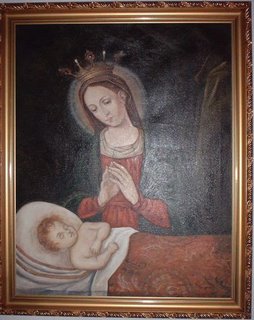
The veneration of Our Lady unites men all over the world in love, homage and supplication. It is not surprising therefore that an image of her which is dear to the hearts of one nation calls forth a sense of brotherhood and reverence in a far distant land. It is almost as if these images formed the material links in a vast chain of prayer. So the Irish Madonna of Hungary has joined two nations.
Read more here...
And Our Lady in Old Irish Folklore and Hymns
The tradition and literature of the Gael provide ample evidence that early Christian Ireland was in a very marked way devoted to the Mother of God. Of these sources of evidence, the most telling and fascinating seem to be folklore and hymns.Read more here... for example, this hymn:
Safe from the rugged thorn springs up the tender rose
In honour hidden the parent stem, in beauty's softness grows;
So from the sinful stem of Eve all sinless Mary came,
To cover and to expiate her mother's deed of shame.
God our Father, you sent St. Patrick to preach your glory to the people of Ireland.
By the help of his prayers, may all Christians proclaim your love to all men.
Grant this through our Lord Jesus Christ, your Son, who lives and reigns with you and the Holy Spirit, one God, for ever and ever.
Amen.
St. Patrick, ora pro nobis!
Subscribe to:
Posts (Atom)