Wednesday, March 15, 2006

new book on the last weeks of the life of JPII

A new book is out that describes in detail the last weeks and moments of our late Holy Father, Pope John Paul II:

Archbishop Dziwisz recalls the moment on Easter Sunday, 2005, when Pope John Paul II appeared at the window of his apartment in the apostolic palace, but found himself unable to speak. The Pope's frustration was evident, and his secretary remarks that the "display of powerlessness, of suffering, and of paternal love" left "an indelible impression in the hearts of men throughout the world."

Pope John Paul was also moved by the incident, Archbishop Dziwisz recalls. It as at that moment, his longtime aide says, that the Polish Pope realized he could no longer carry out his work. He prayed: "Your will be done," his secretary reports. Realizing that he was approaching death, the Pope decided against a return to the Gemelli hospital, the book indicates. "He wanted to suffer at home, staying close to the tomb of Peter the apostle," Archbishop Dziwisz discloses. During the last day of his life, April 2, Pope John Paul took his final leave of his associates, the Polish archbishop reports. He prayed with them during the early part of the day, despite a raging fever and extreme fatigue brought on by a complete physical collapse. In the afternoon he uttered his last words: "Let me go to the house of the Father." Early in the evening, after a last glimpse of an image of the Virgin of Czestochowa at his bedside, he closed his eyes for the last time.
Read the entire article here.

John Paul the Great, ora pro nobis!

Tuesday, March 14, 2006

fishers of men

Vocations Film Aims to Boost Priests Too
U.S. Bishops to Show "Fishers of Men"

WASHINGTON, D.C., MARCH 14, 2006 (Zenit.org).- "Fishers of Men," an 18-minute film aimed at promoting priestly vocations, will be premiered this week by the U.S. bishops' conference.

The film, as part of a wider project, Priestly Life and Vocation Summit: Fishers of Men, intended to renew priests' sense of fulfillment in their vocation and to encourage them to draw on that
satisfaction to invite other men to pursue the priesthood. The project was developed by the bishops' Committee on Vocations.

The film, produced by Grassroots Films of New York, is a fast-paced video which shows many of the facets of a priest's daily life.

Several priests provide testimony to the importance they place on their own vocation. A dramatic re-enactment portrays how a priest can inspire a vocation through his service to someone in need of priestly ministry.

The video is accompanied by questions for discussion among priests who view the film together at their diocesan vocation summit.

One question asks, "Reflecting upon your own vocation and reasons for becoming a priest, are they similar to those presented in the film?"

Another asks, "What part of the film do you think will most inspire young men in your parish to consider priesthood as a possible vocation?"

"A hero"

The film is also intended to be used by priests in discussions with men considering the priesthood.

Men who saw an advance screening of the film have praised it highly.

"It appeals to the desire in every man to be a hero, to stand up for something great," said Kevin Kimtis of New Jersey.

"It is by far the best vocation video I have ever seen," said Brandon Macadaeg of California. "It will touch the hearts and minds of many across the country."

"'Fishers of Men' goes beyond what any person could expect of a vocations film," observed Chad Eckles of Utah. "This film touched my heart and soul."

Joseph Campo, producer of Fishers of Men, said, "I speak for everyone on the Grassroots Films
staff when I say that we have always had a positive view and appreciation of the Catholic priesthood throughout the world, and we are grateful for the opportunity to portray in the film what it means to be a priest."

Monsignor David Malloy, general secretary of the U.S. bishops' conference, said, "I thought 'Fishers of Men' was extremely moving. It reminds us why we became priests. I would love for my nephews to see it."

Father Edward Burns, executive director of the bishops' Secretariat for Vocations and Priestly Formation, said, "With the release of the 'Fishers of Men' DVD, all the elements are in place for the Priestly Life and Vocation Summit project."

"Through workshops for priests, the goal of this is project is to renew and regenerate the priesthood in the United States," said Father Burns.

The "Fishers of Men" trailer can be viewed at
www.usccb.org/vocations.
My Comments:
This video is pretty good! Grassroots Films is a solid group and very talented. I still like their vocation video that they made for the Archdiocese of New York better ("God in the Streets of New York" here and here). I get teary-eyed every time I watch it. I highlighted it here a while back. They also have a very good video for female religous life and several others as well.

Monday, March 13, 2006

statement to Catholic Democratic politicians

On Responsibilities of Catholics in Public Life
"Must Act Seriously and Responsibly on Many Important Moral Issues"

WASHINGTON, D.C., MARCH 12, 2006 (Zenit.org).- Here is the "Statement on Responsibilities of Catholics in Public Life" issued Friday by the U.S. bishops' conference.
* * *
A recent public statement by 55 Catholic and Democratic members of the House of Representatives offers an opportunity to address several important points about the responsibilities of Catholics in public life.

We welcome this and other efforts that seek to examine how Catholic legislators bring together
their faith and their policy choices. As the Catholic bishops of the United States said in our June 2004 statement, "Catholics in Political Life": "We need to do more to persuade all people that human life is precious and human dignity must be defended. This requires more effective dialogue and engagement with all public officials, especially Catholic public officials. We welcome conversation initiated by political leaders themselves."

Therefore, we welcome the representatives' recognition that Catholics in public life must act seriously and responsibly on many important moral issues. Our faith has an integral unity that calls Catholics to defend human life and human dignity whenever they are threatened. A priority for the poor, the protection of family life, the pursuit of justice and the promotion of peace are fundamental priorities of the Catholic moral tradition which cannot be ignored or neglected. We encourage and will continue to work with those in both parties who seek to act on these essential principles in defense of the poor and vulnerable.

At the same time, we also need to reaffirm the Catholic Church's constant teaching that abortion is a grave violation of the most fundamental human right -- the right to life that is inherent in all human beings, and that grounds every other right we possess.

Pope John Paul II's apostolic exhortation on the vocation and mission of the laity, "Christifideles Laici," which the representatives' statement cites, declares: "The inviolability of the person which is a reflection of the absolute inviolability of God finds its primary and fundamental expression in the inviolability of human life. Above all, the common outcry, which is justly made on behalf of human rights -- for example, the right to health, to home, to work, to family, to culture -- is false and illusory if the right to life, the most basic and fundamental right and the condition for all other personal rights, is not defended with maximum determination…. The human being is entitled to such rights, in every phase of development, from conception until natural death; and in every condition, whether healthy or sick, whole or handicapped, rich or poor" (38).

While it is always necessary to work to reduce the number of abortions by providing alternatives and help to vulnerable parents and children, Catholic teaching calls all Catholics to work actively to restrain, restrict and bring to an end the destruction of unborn human life.

As the Church carries out its central responsibility to teach clearly and to help form consciences, and as Catholic legislators seek to act in accord with their own consciences, it is essential to remember that conscience must be consistent with fundamental moral principles. As members of the Church, all Catholics are obliged to shape our consciences in accord with the moral teaching of the Church.

As bishops, we too are bound by our own consciences to teach faithfully and to recommit ourselves to continued reflection and discussion on how Catholic faith and public service can work together to promote human life and dignity and advance the common good. Through dialogue, especially the irreplaceable dialogue between Catholic political leaders and their own bishops, we hope to promote a better understanding of how the Church's teaching on human life and dignity challenges us all.

Cardinal William Keeler
Chairman, USCCB Committee on Pro Life Activities

Cardinal Theodore McCarrick
Chairman, USCCB Task Force on Catholic Bishops and Catholic Politicians

Bishop Nicholas DiMarzio
Chairman, USCCB Committee on Domestic Policy

dazzled

You owe such a great debt to your Father-God! He has given you life, intelligence, will... He has given you his grace –the Holy Spirit; Jesus, in the Sacred Host; divine sonship; the Blessed Virgin, the Mother of God and our Mother. He has given you the possibility of taking part in the Holy Mass; and he grants you forgiveness for your sins. He forgives you so many times. He has given you countless gifts, some of them quite extraordinary...

Tell me, my son: how have you corresponded so far to this generosity? How are you corresponding now?
– St. Josemaria Escriva, The Forge, #11

...

Sunday, March 12, 2006

great day today

Ah, today was a great day :) Four other guys and I went to a Latin Mass this morning at St. Alphonsus in downtown Baltimore becaue a couple of them hadn't seen one before. Larger pic here


Saint John Neumann lived in the present rectory as rector, master of novices, and vice-provincial. Another rector was Blessed Francis X. Seelos, C.SS.R. If he is canonized, Saint Alphonsus will be the only parish church in this country, and perhaps in the world, to boast of two former pastors as canonized saints.


Then we went to the Inner Harbor for lunch at the Cheesecake Factory and a quick trip to Barnes & Noble to pick up one of those laminated Latin charts for class. Overall, it was a great day indeed. Deo Gratias!

Saturday, March 11, 2006

get off me!

the abortion clinic

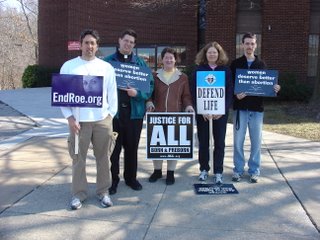
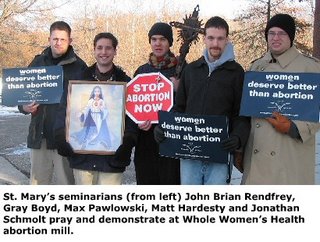
This morning, three other seminarians and I protested at the nearby abortion clinic only about 4 miles from St. Mary's here in Baltimore.

It's alarming to me how nonchalant this thing is. Roland Park, the area of Baltimore City that St. Mary's is in, is a pretty nice part of town and this abortion clinic is right in the middle of it... I mean post office across the street, dentist office and pharmacy in the same building, Northern Parkway running alongside of it... nobody knows its there.

Usually clinics are established in minority neighborhoods and poor parts of town mostly to target the African American community. The few but fervant pro-lifers in Maryland always protest the clinic downtown but nobody does anything about this one in Roland Park... Nobody! I guess I'm used to back home in Louisville where you can count on pro-lifers praying and protesting in front of the abortion clinic downtown every Saturday, and often during the week. Now, I must clarify, there is a pro-life group at one of the local parishes that has prayed at the Roland Park clinic several times over the years. But they like to plan their prayer vigils around the seminarians here at St. Mary's and our schedules are so off and on. I really want to make this a more regular thing though so I've agreed to take over the prayer vigil part of St. Mary's Pro-Life subcommittee activities. I hope we can rally the community to become more regularly involved.

Again, I found it alarming how few people know that this abortion clinic even exists right under their noses in their community. Since they only perform abortions every other Saturday, we happen to be there when they were closed. We could tell because the escorts they ususally have weren't there. But, that didn't stop us from praying anyway for an end to abortion and the closing of the clinic. Cookie Harris, wife of pro-life State Senator Andy Harris joined us and brought a young lady from her parish. One guy approached us this morning and told us he was unaware that there was a clinic there and that he supported our cause... so that was cool.

I was sad to hear from her that this clinic, Seneca Women's "Health Care," was under new managment, Whole Woman's Health, that owns four abortion clinics in Texas. They're dedicated to bolstering its business and making it a stronger clinic: They've hired four new "doctors" since coming under new management. They also now offer second trimester abortions and student discounts... how nice of them...

Anyway, below is a picture of our little group: I'm on the far right

And here's an article about our last visit that I mentioned here from the Defend Life Jan-Feb '06 Newsletter:

SEMINARIANS PRAY AT ABORTION MILL
Seven enthusiastic young men from St. Mary’s Seminary in Baltimore braved frigid temperatures to pray the rosary and demonstrate outside an abortion mill on Northern Parkway December 10.
The gravity of their purpose did not preclude them from exuding good cheer and poking a little fun at the two “pro-choice escorts” who had retreated inside the glass-enclosed lobby of the professional building housing the abortion mill to keep warm.

“We talked to them one time,” Max Pawlowski, a third-year theology student from Erie, Pa., confided with a grin.

“We said, ‘Why can’t we just forget all about this and go out to lunch together? After all, you don’t want to be involved with this – it’s killing babies!’ But they wouldn’t do it.”

Seminarians belonging to a pro-life subcommittee that is part of the seminary’s peace and justice committee have been coming to the prayer vigils at the abortion mill for over a year.

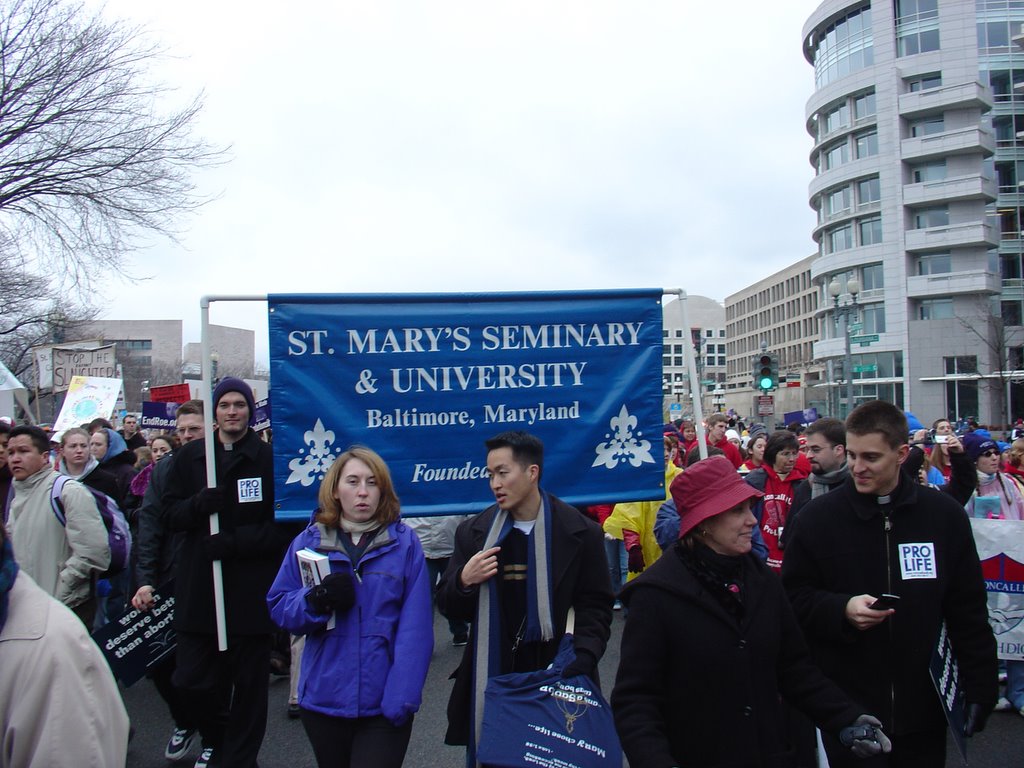
John Brian Rendfrey is chairman of the pro-life group, which meets every other Wednesday, prays the rosary for pro-life intentions every first Friday, and has mustered 50 seminarians to go to the annual March for Life in Washington, D.C.

On December 8 State Senator Andy Harris gave a talk to the group on embryonic stem cell research.

The Respect Life group of St. Joseph’s Church in Cockeysville began the prayer vigils at Seneca Women’s Health Care in December 2003.

The mill has since changed its name to Whole Woman’s Health of Baltimore, and is affiliated with Whole Woman’s Health, which has four abortion mills in Texas.

According to its website, Whole Woman’s Health affiliates perform second trimester abortions and offer student discounts. The Northern Parkway mill is located 1 ½ blocks from Mercy High School.

Cookie Harris, chairperson of St. Joseph’s Respect Life, said that the prayer vigils have a two-fold purpose.

One aim is “to be a presence to the community”: to inform passers--by and the people entering the offices within the professional building of the abortion mill’s existence.

The second purpose, said Harris, is “to be a prayer force to close it.”

The prayer vigils are held every other Saturday from 9:00 to 10:00 a.m.

For more information call Cookie Harris, 410-666-9411.

St. Gianna Beretta Molla, pray for us!

Friday, March 10, 2006

powerful

Two powerful Lenten reflections for today:

Every priest who preaches the Word of God in times of persecution has no escape; he will die like Jesus on the Cross, with arms tied.
– Bl. Elias Nieves

May I give you some advice for you to put into practice daily? When your heart makes you feel those low cravings, say slowly to the Immaculate Virgin: "Look on me with compassion. Don't abandon me, my Mother." And recommend this prayer to others.
– St. Josemaria Escriva, Furrow, #849

what a woman

Since I like to post, in this blog, Marian stuff I come across, I had to excerpt a beautiful post from my good and dear friend Amy over at The Refusal to Grasp. It's part of a larger context on the proper role of men and women in a relationship. Please read the whole thing here.

Woman's role is not to be Adam. It's also not to let Adam know what his role is. Relationship's are like chinese finger cuffs in this way. The more you try to let the other know what his/her role is the worse it gets. The more you focus on being what you are, the more free you become.

Hey, I didn't make the rules, I've just lost at the game enough times to know what they are.

Somehow, even if you are dead on convinced that you are right (which we always are aren't we?) and he is wrong, the minute you point a finger, accuse, or even politely say "just move out of the way and let me do it" you can pretty much throw in the towel. It's like a chain reaction. One of you does it, then the other reacts, and it all keeps spiraling down until somebody is crying, aggrivated or just shuts down completely. On the contrary, if you recognize the small, oh so painful opportunity to die to yourself in a moment preceeding one of these conflicts, an amazing thing happens. One little death will do it and it will open the door for the other to be who they are and suddenly grace is pouring over both of you and the only problem left is how attractive he's just become.

Sounds easy, but let me tell you sista, it aint. To know what this looks like in every situation is so hard, so delicate. Somehow, everytime, it looks like Mary telling Jesus "they need more wine".

What is the fundamental difference between Eve in the garden and Mary at the wedding at Cana?

Mary did not presume to do what it was Jesus' role to do. She was completely and totally receptive to him, as man, in a beautifully, feminine, active way. She did not act for him, she provided the space where his act would be most fruitful. Mary provides space, [but not passively], actively, creatively even.

What a woman.

Amen, Amy. Amen.

help

Anybody feel like comparing and contrasting Descartes and Leon Kass for me? Ugh...

Thursday, March 09, 2006

is natural virtue false virtue?

Disclaimer: Don't get me wrong with this one, I would never advocate dissention from St. Thomas Aquinas and St. Augustine :) I think they would agree with my conclusion. And believe me, my Philosophy teacher is top-notch, he'd tell me if I was going astray. That said...

Sokolowski and the Question of Falsity in the Natural Virtues

Aristotle, in Book II of Nicomachean Ethics, defines moral or natural virtue (or “excellence”) as a “characteristic”[1] that “renders good the thing itself of which it is the excellence” and “causes it to perform its function well.” To be more precise, he adds that “the virtue or excellence of man… will be a characteristic which makes him a good man, and which causes him to perform his own function well.” Furthermore, “to experience [emotions and actions, and pleasure and pain] at the right time, toward the right objects, toward the right people, for the right reason, and in the right manner – that is the median and the best course, the course that is a mark of virtue.”[2] St. Thomas Aquinas also has a definition. It is one that he says “will apply to all virtues in general… [i.e.] Virtue is a good quality of the mind, by which we live righteously, of which no one can make bad use.”[3] It is also “a habit perfecting man in view of his doing good actions.”[4] This phrase, “doing good actions,” helps us see that these natural virtues are acquired through action. Regardless, these two definitions sound to us to be very similar.

But, St. Thomas also makes a stark contrast between natural virtue and other moral virtues that are infused in us by God. He says, “those infused moral virtues, whereby men behave well in respect of their being ‘fellow-citizens with the saints, and of the household of God’ (Eph. 2:19), differ from the acquired virtues, whereby man behaves well in respect of human affairs.”
[5] But the contrast goes even further. He says that “only the infused virtues are perfect, and are to be called virtues [simply] simpliciter… The other virtues, the acquired ones, are virtues [in a restricted sense or “in a way”] secundum quid, but not [simply] simpliciter.” Hence, “[A] gloss of Augustine on the words, ‘For all that is not from faith is sin’ (Rom. 14:23), says: ‘Where there is no recognition of the truth, virtue is false, even in good habits.’”[6] But what becomes of the man who does not know God yet is still a good person, exhibiting well the acquired natural virtues? Are these not virtues after all? Is his seemingly moral life a life of “false virtue”? Indeed, Aquinas’ and Augustine’s treatment here rings sharply in our ear toward inter-religious ecumenism. If their case is true, it has many ramifications in our theological reflection and dialogue, as Christians, with people of non-Christian religions.[7]

To address this matter further, we will turn to Monsignor Robert Sokolowski’s book, The God of Faith and Reason. He provides much material that can aid us in our pursuit of an answer to the question: Is natural virtue false virtue? And he acknowledges our instinct to declare “that it is not fair to natural virtue to call it false” and what this has done to theological reflection. Frankly, he says, theological reflection must face these problems, “the aporiae,” when it “examines ‘actions’ within the Christian setting."

First, the proper distinction must be made, before we can begin to understand what natural virtue even is. Sokolowski is a master of distinctions, shedding light on ideas and realities by looking at their counterparts or by looking at what they are not. He notes, by observing the action of mankind, that we all naturally do this, we all utilize distinctions as we seek to understand the world and everything of and not of it. We understand the living more when we contrast it to what we can know of the nonliving. We understand health more when we contrast it to disease. “Making distinctions is the first step of the exercise of reason” and looking at an object without taking into account its “proper other” only gives us half of our object’s story, half of its “disclosure.”

Sokolowski gives us a proper beginning-distinction in Chapter Seven, “Theological Virtue.” He says that “in order to discuss the integrity of what is and remains good by nature, we must first bring out more fully the differences between the natural and the Christian.” In the “natural” setting, there is a “steady anonymity of the world, in and against which action occurs.” But when this natural setting, the world, is viewed in light of the Christian understanding of the world as created and of God as its creator, “human action, correspondingly, is now obliged in a new way; it must not only bring itself forward in virtue in order to become itself; it must also respond to the generosity of creation and to the still greater generosity of the incarnation and redemption.” Sokolowski informs us that “our involvement in this new setting is cultivated in what have been called the theological virtues of faith, hope, and charity.” So, to both clarify our Aristotle and Aquinas distinction at the beginning and to refine the distinction we’ve made here, we could say that it is now safe to move forward with a distinction between natural virtue and theological virtue.

Sokolowski then, quite helpfully, reinforces what we said in the beginning with clear definitions of each: “natural virtue is acquired by doing good actions, first under the guidance of others and then on our own.” And in the exercise of faith, hope, and charity,
what is being done is, not merely an action within a setting of the world and its necessities, but an involvement with God who is not a part of this world… The differences within which such identifications take place are articulated when the world is taken no longer as the final setting for action, but as the place in which God the creator has intervened to make available his own divine life.
In this new Christian setting, we must keep in mind though that natural virtue isn’t assumed or transformed into theological virtue; it retains its dignity and its own distinctive character. A person, for example, who is weak in the natural virtues of self-control, can, in that struggle still be an example of faith, hope, and charity. He is still weak but at the same time can still receive the grace of the theological virtues. And, the “bonum honestum,” that which is noble and good in the natural setting, remains that which should be done by the Christian agent. “What is good by nature is not set over against what is good by grace but is integrated into it. And what is good by grace is not simply a matter of convention and arbitrary decision; rather it builds on nature and shares in the reasonableness associated with nature.” But, “the truth in this paradox is the theological truth that God’s work is not achieved through human virtue and that God can choose even the weak to make his grace manifest.” The Christian may here ask: “If God’s work is not achieved through human virtue,” what good is it? Can we now answer our question, “Is natural virtue false virtue?” with a “No”?

Sokolowski adds that Aquinas says that natural moral virtue conditions us “only” for civic life and human affairs and “from the point of view of the final end of man, good dispositions that fail to serve the final end [God] do somehow seem to be bleached of their goodness.” Here again we think Sokolowski is going to answer our question with a negative but he digresses to discuss “other shifts in the meaning of virtue between Aristotle and Aquinas.”

In Chapter Eight, “The Theology of Disclosure,” Sokolowski takes up our question again: “Augustine has said, and Aquinas has quoted him as saying, that natural virtue without faith is false virtue… It seems to deny what is obvious. According to every natural measure there were and there are good, prudent men among those who do not share the Christian faith.” So what is the conclusion? Here, a further distinction is needed:

Instead of comparing the theological good with the natural [as we’ve done up to this point], it is necessary to examine how the one comes to light against the other, to show how the theological good becomes differentiated from the natural good… If we wish to clarify what is meant theologically when natural virtue without faith is said to be false virtue, we must… turn to the theology of disclosure.
With this theology, we try to determine how the theological good becomes light; we try to show how the distinction between the natural and the Christian good occurs. “In the way things appear we also have presented to us the way things are in themselves.” Sokolowski makes another digression here so that he can flesh out his theology with examples and more distinctions. Toward the end of the chapter he provides a helpful summary and again we are back to our question. Will there be an answer?

The fact is there is one obstacle keeping us from the answer: our own expectation. Modern philosophy has so permeated our culture that we demand cut-and-dry “Yes” or “No” answers to the questions we have about life. We want “clear and distinct” ideas. There must be no more mystery; we are unsatisfied with conclusions that require further thought or reflection.

[E.g.,]Our way of thinking about moral issues is very much influenced by the way Kant formulated them. Kant was influenced by Christian moral teaching and by currents in modernity that tend toward the overly formal, detached sense of reason… we must get out from under Kant and away from his formulations of moral terms and alternatives; Aristotle can help us do so.
Thankfully, Sokolowski is an Aristotelian.

Remember when we said earlier that Sokolowski notes what “we all naturally do” by “observing the action of mankind”? He accepts wholes as they are presented to him and the being they disclose. He doesn’t see the world as simply full of parts, as modernity does, parts that need to be assembled by man in specific ways so that he can reach the conclusions he desires. Sokolowski sees the natural and the Christian setting as both being full of conclusions already, conclusions that disclose rich meaning and value. In our case, we must not neglect “what we might call the density of the simply natural, the fact that it has its own kind of wholeness on its own kind of terms.” Looking at what the whole of the natural setting (with its natural virtues) discloses grants us much more insight than what we could obtain from merely asking, “Yes or No?” or “True or false?” Placing the natural setting and the Christian setting into a distinction and looking at their disclosures doesn’t require that we necessarily pit the two against each other, as our modern tendencies would have us do. Our ecumenical discussions and theological reflections with non-Christians are much better served if we look honestly at each one and appreciate what each one is and what each one is not:

Natural virtue is what we begin with in human experience. Theological virtue is disclosed in contrast with it, so theological virtue cannot say that natural virtue does not exist or that it is simply false. However, the disclosure of the theological is so special, and the kind of activity it opens for human being is so different, that natural virtue does not render us capable in any way of behaving in the new context. Hence natural virtue comes to light as not able any longer to let us act: from this perspective it changes its color and is “not” virtue.
There is a big difference between appreciating what something is “not” and simply proclaiming it is false. And we’ve already seen above what natural virtue “is”: It renders good; puts us on the median and best course; is a habit perfecting man; by it we behave well in human affairs; and it is unopposed to theological virtue. If we can show non-Christians that we appreciate the contributions of natural virtue then they will be more open to hear our disclosure of the distinct contributions of theological virtue. We wouldn’t say they are equal here. After all, Sokolowski rightly states that “natural virtue does not provide salvation." But by appreciating natural virtue without unduly elevating it and by presenting the disclosure of theological virtue without watering it down, the distinction between the two can serve to strengthen the ecumenical dialogue between Christians and non-Christians rather than deter it.


[1] Bk. II, Art. 5: “Thus, if the virtues are neither emotions nor capacities, the only remaining alternative is that they are characteristics. So much for the genus of virtue.” You gotta love that last sentence.
[2] Bk. II, Art. 6
[3] Summa I II, Q.55, A.4: From Answer: “Lastly, God is the efficient cause of infused virtue, to which this definition applies; and this is expressed in the words ‘which God works in us without us.’ If we omit this phrase, the remainder of the definition will apply to all virtues in general, whether acquired or infused.” This definition, from Objection 1, in its entirety is: “‘Virtue is a good quality of the mind, by which we live righteously, of which no one can make bad use, which God works in us, without us.’”
[4] Summa I II, Q.58, A.2: From Answer. Also defined as “habits of the appetitive faculty”
[5] Summa I II, Q.63, A.4
[6] Here I use the translations Sokolowski provides on p. 78-79.
[7] As Sokolowski notes at the beginning of Ch. 3, p. 21, the distinction between Christians and Atheists doesn’t work as well as the distinction between Christians and Non-Christians. So we will stick to the latter here.

Tuesday, March 07, 2006

that's what I'm talkin about

When you are before the altar where Christ reposes, you ought no longer to think that you are amongst men; but believe that there are troops of angels and archangels standing by you, and trembling with respect before the sovereign Master of Heaven and earth. Therefore, when you are in church, be there in silence, fear, and veneration.
– St. John Chrysostom

Sunday, March 05, 2006

Aristotle on god

Aristotle’s God: First Mover and First Mind

In his masterful work, Aristotle’s Physics: A Guided Study, Joe Sachs closes his commentary on Book VIII with the following line: “Physics discovers, and abandons itself on, the doorstep of first philosophy (prote philosophia or ta meta ta phusika).” With this he implies a deep connection and move forward from Aristotle’s Physics to his Metaphysics. The Physics first “finds itself” in its discussion of god[1], its “Deduction of Motionless First Mover” and “The First Motion.” Then, strictly following this particular discussion, one could find that it “abandons itself” on Book XII of Metaphysics and its discussion of god as the “divine thought” or the First Mind. This essay will provide a synthesis of Sachs’ commentary[2] on Aristotle’s god, presenting a course of its development from the First Mover of Physics to the First Mind of Metaphysics.

In Book VIII of Physics, Aristotle makes his “Deduction of Motionless First Mover” by first pointing out Plato’s error in Timaeus that motion was created, that there was a time when things passed from immobility to mobility. He says, “[H]ow can there be any 'before' and 'after' without the existence of time? Or, how can there be any time without the existence of motion? If, then, time is the number of motion or itself a kind of motion, it follows that, if there is always time, motion must also be eternal.”

He then moves on to look at the transitions from rest (stasis) to motion (kinesis) and asks what governs the transitions from one state to the other. A creature that is resting, given its inner motions of metabolism, heartbeat, circulation, etc., is also privy to external motions – predators, the elements, etc. – that have bearing on his restful state and can move (or “cause”: aitia) him to motion. Aristotle says: “for we observe that there is always some part of the animal's organism in motion, and the cause of the motion of this part is not the animal itself, but, it may be, its environment.” But then what causes the predator, or the rain, or what moves him/it, to cause the motion of our resting-creature? How far back to do we go? Should we even make this journey if motion can be traced back ad infinitum? Sachs states quite clearly that “Where there is an external mover (kinoun) there is a first external mover.” How do we reconcile this with the eternity of motion? Here Sachs is quickly on his way to a complete articulation (logos) of Aristotle’s Physical First Mover. He concludes:

The first mover is not an event but a being, and stands first not in time but in the order of responsibility. Every such first mover must be motionless… not in the sense of being inert, but by being fully at-work, in an activity that is the same and complete at every instant.
Sachs continues by stating that “the mover can touch the moving thing without being touched by it” as in a fleshy apple that arouses our desire (or hunger, or appetite) which in turn causes us to move to pursue the apple. Then he asks, “Is there a single, altogether motionless, first source of all motion in the world?” Life is impossible without “conditions supplied by the being-at-work (energeia) of the cosmos.” But on what does the cosmos rely?

After lengthy arguments for the perpetual reversal of motion on a straight line, and for the existence of a duration of time in which to find this reversal, Aristotle concludes several things:
1. a “single unvarying cause” denotes a primary motion;
[3]
2. “a magnitude, a motion, and a time, because they are continuous, are infinitely divisible but not infinitely divided”;
3. it is the “prior existence of potencies (dunamis
[4]) in beings that holds each motion together as one and continuous”;
4. “only circular motion can be both whole and everlasting”; and
5. “no finite mover has an infinite power, and no infinite magnitude can exist all at once”

So, again, on what does the cosmos rely? Finally, Sachs states Aristotle’s conclusion and the answer to this question: “the first mover can have no magnitude at all. It must be a source outside of nature, in contact with the outermost sphere of the cosmos, responsible by its own constant being-at-work for the unvarying first motion that holds together the world.”

Now that the First Mover has been established, what exactly this might be is “a question that does not belong to physics.” Our discussion is now free to “abandon itself” on the doorstep of Metaphysics and the First Mind.
[5]

Here the cosmos can lead us to our discovery of the First Mind as well. Plants and animals secure their perpetuation through generation and the passing on of an identity held together through thinking. But Sachs points out that the cosmos holds together in a different way: “it seems to be literally and directly eternal by way of ceaseless repetition of patterns of locomotion.” Eternal motion is not created, so what could possibly “cause a motion without undergoing a motion?” Our example of the fleshy apple from Physics is useful here as well and in the same manner as before: “The desired object causes motion only as an object of thought.” Sachs concludes: “Just as the only candidate left to be the source of unity of form among the animals and plants was the activity of thinking, so again the only possible unmoved source for the endless circlings of the stars is an eternal activity of thinking.”

But is this enough to tell us “what exactly this might be,” what this First Mover, this First Mind is? We could conclude at this point that it is this being of the “self-subsisting activity of thinking.” But first, we must attend to Aristotle’s comment that “the subject of Mind involves certain difficulties.”

Aristotle explains that “Mind is to be held of all phenomena the most supernatural; but the question of how we must regard it if it is to be of this nature involves certain difficulties.” He then goes through a series of questions and answers to define how this Mind thinks and what is the object of its thought. He concludes: “Clearly, then, it thinks that which is most divine and estimable, and does not change; for the change would be for the worse, and anything of this kind would immediately imply some sort of motion.” But, Aristotle then adds a very important caveat: “thinking [of certain objects outside of itself] cannot be the supreme good.” Therefore, “Mind thinks itself, if it is that which is best; and its thinking is a thinking of thinking.”
[6] Thankfully, Aristotle then defends his seemingly cumbersome choice of words for the action of the First Mind: “[S]ince thought and the object of thought are not different in the case of things which contain no matter, they will be the same, and the act of thinking will be one with the object of thought.”

At this point, we have worked through Aristotle’s Physics and have found that his First Mover is eternal, motionless, fully-at-work, always causing, and has no magnitude. Moving
[7] to Metaphysics we found that Aristotle’s First Mind is the unmoved source of motion, eternally thinking, the most supernatural, eternally unchanging, and completely self-absorbed in, of, and about thought. After working through the difficulties involved in articulating its nature we arrive at Sachs’ concise statement of what Aristotle’s First Mind/First Mover really is: “It is the pure holding-together of the pure holdable-together, activity active, causality caused.”


[1] I use “god” with a small “g” to differentiate it from the Christian Creator-God.
[2] All quotes from Sachs concerning Aristotle’s Physics are from Aristotle’s Physics: A Guided Study, Masterworks of Discovery: Guided Studies of Great Texts in Science, Harvey M. Flaumenhaft, Series Editor, Rutgers University Press, New Brunswick, New Jersey.
All quotes from Sacks concerning Aristotle’s Metaphysics are from An Outline of the Argument of Aristotle’s Metaphysics, The St. John’s Review, Summer 1981.
[3] “The stone thrown upward rises because of the thrower, but falls because of its own heaviness. Since its reversing motion cannot have a single unvarying cause, it is not the primary motion, and that is all Aristotle takes from the consideration of it.”
[4] Plural?
[5] Focusing on Metaphysics, Book XII, chapter IX.
[6] W. D. Ross uses “on” rather than “of”: it’s thinking is a thinking on thinking
[7] Pun intended

Thursday, March 02, 2006

first paper this semester

Last semester, I posted all of the papers I wrote. One of the purposes of this blog is to promote vocations and I thought it would be helpful for guys to see the material covered in seminary. I also thought friends and family back home might be interested as well. But I also gave the grade I got on each one which I've decided not to do anymore so that it doesn't become (is? was?) a pride issue. That said, here's the first paper this semester. I wrote it a while back. It is for my modern philosophy class and is titled, "The Prince and the Summa on Virtue," comparing Machiavelli's The Prince with St. Thomas Aquinas' Summa Theologiae. Again, my professors always provide many helpful comments and corrections on my papers but those would be difficult to include here. So, you'll just have to take 'em as is, not knowing the grade of course too... so if you decide to use one of them, do so at your own risk, but with a link to this blog.

In his great work of political philosophy, The Prince, Niccolo Machiavelli explains in concrete detail what any prince must do in order to acquire and maintain power. Seemingly in accord with the classical political philosophers and early fathers of the Catholic Church in giving such advice, he writes much about the concept of virtue. But as this essay will show, Machiavelli’s instructions to the prince, Lorenzo de Medici of Florence, are in fact a harsh break from the traditional instructions on how to best acquire and maintain power. We will see how this work defines virtue and as it builds on this definition, separates itself further and further from its classical counterpart. Select chapters from The Prince will be presented to show this development and excerpts from St. Thomas Aquinas’ Summa Theologiae will be given to highlight the departure.

In the first chapter of The Prince, in briefly addressing “How many are the kinds of principalities and in what modes they are acquired,” Machiavelli introduces his notion of virtue as a sort of tool for assuming new dominions to add on to what has already been inherited. With this brief mention of virtue Machiavelli sends a message to the reader that where the “ancients” would have introduced such an important concept with a reasonable argument, case study, or simple definition, Machiavelli is only concerned with its utility. This remains his focus through The Prince and is his first departure from the traditional understandings of virtue and its role in the everyday lives of rulers and their subjects.

St. Thomas Aquinas begins his treatment of virtue with Question 55 in the Summa, “Of the Virtues, As to Their Essence.” Four brief definitions can be found throughout the first article: virtues are “good habits;” virtue “denotes a certain perfection of a power;” “is nothing else than the good use of free-will;” and “is the order or ordering of love.” Aquinas and Machiavelli both start with their fundamental notions of virtue and then build on that foundation. This foundation determines the direction each of their arguments will take.

In chapter six of The Prince, Machiavelli returns to his thoughts on acquiring new principalities and specifically treats those acquired “through one’s own arms and virtue.” Here we get a clearer idea of the extent of Machiavelli’s divergence from traditional virtue. Here he also mentions Aquinas’ cardinal virtue, prudence, but in a context of pessimism and dishonesty. Machiavelli says that a prince should follow in the footsteps of the great rulers that have gone before him and while he will never be able to mirror their greatness, he can at least, out of prudence, try to mimic them as close as possible in order to be equally successful. Here prudence has an air of utility as well. He adds that without the opportunity to acquire and rule a nation, any virtues (including prudence) the prince may have are wasted and without these virtues, opportunities in turn are wasted.

This further development of virtue as both utilitarian and opportunistic contrasts with Aquinas’ further development of virtue as “an ordered disposition of the soul [in which] the powers of the soul are in some way ordered to one another, and to that which is outside.” Machiavelli cannot speak of “dispositions” for he claims that “the nature of peoples is variable.” Ultimately:

[Those] who become princes by the paths of virtue, acquire their principality with difficulty but hold it with ease; and the difficulties they have in acquiring their principality arise in part from the new orders and modes that they are forced to introduce so as to found their state and their security. And it should be considered that nothing is more difficult to handle, more doubtful of success, more dangerous to manage, than to put oneself at the head of introducing new orders.
Here we see that Machiavelli will not entertain the idea of installing new orders and modes of virtue or turning to virtue to aid in “introducing new orders.” Once they have been used to acquire new principalities they are out of the picture.

Aquinas provides further contrast when he notes from Augustine (“No one can doubt that virtue makes the soul exceeding good”) and from Aristotle (“Virtue is that which makes its possessor good, and his work good likewise”). So far we have no mention from Machiavelli of the soul as the seat of virtue or “the good” as its object, both fundamental concepts in a doctrine of virtue.

In chapter 25 of The Prince, Machiavelli compares fortune to a rushing river that floods and destroys a population that can do nothing to stop it. If only they had constructed the necessary structures to divert the river and protect the people before it flooded they would not have been totally at the mercy of cruel (mis)fortune. “It happens similarly with fortune, which demonstrates her power where virtue has not been put in order to resist her and therefore turns her impetus where she knows that dams and dikes have not been made to contain her.” Here virtue is presented as merely a deterrent to bad luck, misfortune, and by extension, God. Is virtue not good in and of itself? Aquinas gives us the answer:

We must, however, observe that, as accidents and non-subsistent forms are called beings, not as if they themselves had being, but because things are by them; so also are they called good or one, not by some distinct goodness or one-ness, but because by them something is good or one. So also is virtue called good, because by it something is good.
Machiavelli goes on in this chapter to develop virtue as being only good for the prince’s character if the times allow for it. Living a virtuous life is never an absolute vocation, regardless of the people the prince acquires and the manner with which he does so. If the prince is virtuous and the “times and affairs” accept him, then he “comes out happy.” If the times and affairs change, “he is ruined because he does not change his mode of proceeding.” Here Machiavelli associates the life of steadfast virtue with one of rigidity, foolishness, and ultimately, ruin. He illustrates how well Pope Julius II was able to manage his affairs through his impetuousness and implicitly states that virtue will never bring success as Machiavelli defines it. Furthermore, through this illustration, prudence is defined as having “firm conclusions and everything in order.” The contrast with Aquinas’ definition is glaring: “prudence is right reason about human acts themselves” and “is necessary to man, that he may lead a good life, and not merely that he may be a good man.”

Chapter 25 of The Prince is a particularly egregious chapter as Machiavelli explicitly states his wish to “depart from the orders of others.” His mischaracterization of virtue expands as well as he makes a mockery of prudence. In this chapter he speaks of “those things for which men and especially princes are praised or blamed.” He says that the classical instructions to rulers on how to lead with virtue are made up of illusions and are “imagined.” “What is true,” is that leaders will be praised or blamed for a wide variety of characteristics. Returning to his pessimism for the faculties of the human person, Machiavelli states that since the prince cannot have positive traits “nor wholly observe them, since human conditions do not permit it” he must use prudence to decide if avoiding vice is in the best interest of his state one day or if avoiding virtue is in his best interest the next! Using prudence to practice vice, to bring about evil in order to maintain the state is a notion Aquinas readily and reasonably counters: “One can make bad use of a virtue objectively, for instance by having evil thoughts about virtue, e.g., by hating it, or by being proud of it: but one cannot make bad use of virtue as principle of action, so that an act of virtue be evil.”

Finally, we come to chapter 28, “In What Mode Faith Should Be Kept by Princes.” Here, Machiavelli mentions Aquinas’ theological virtue of faith in the similar vein he has been using throughout the work:

One sees by experience in our times that the princes who have done great things are those who have taken little account of faith and have known how to get around men’s brains with their astuteness; and in the end they have overcome those who have founded themselves on loyalty.
He explains that in combat, the prince must be like a fox “to recognize snares” and a lion “to frighten the wolves.” He must avoid virtue with courage and cunning if he discerns that it is not in his best interests. He must put on airs and fake virtue to reel the people in for not only is man wicked and quick to turn on him, but gullible too and easy to please. Virtue is all part of a larger scheme of control and manipulation. The prince must be able to appear “merciful, faithful, humane, honest, and religious” whenever it is useful but he must also always be ready to “act against faith, against charity, against humanity, against religion” in order to “maintain his state.” By this time, Machiavelli has developed a doctrine of virtue with a teleology of mere “glories and riches.” Aquinas has a higher end in mind: “Man is perfected by virtue, for those actions whereby he is directed to happiness [and] partakes of the Divine nature.” And through the theological virtues he is “directed aright to God.”

Tuesday, February 28, 2006

Our Holy Father

Today, after our meeting, my spiritual director gave me a portrait of our Holy Father, Pope Benedict XVI, that he purchased in Rome when he went there over the Winter Break. I was so excited to get it because I have all JPII stuff in my room! ;) But rather than take a picture of it or grab a stock photo and put it here so you all can see it, I'll let my friend Dave do the talking.

Winter Break Retreat

Last week St. Mary's had a Winter Break so I decided to spend the week at the Dominican House of Studies in D.C. rather than pay the money to fly home. It was an awesome week as I prayed with their community, caught up on some sleep, and read a ton of Sokolowski.

Here's their Horarium:

Weekday Prayer Schedule:
7:00am Matins & Lauds (Office of Readings & Morning Prayer)
7:30am Breakfast
12:00pm Rosary
12:15pm Middday Prayer & Angelus
12:30pm Lunch
1-2pm Nap (that's my addition :)
5:00pm Mass & Vespers (Evening Prayer)
6:00pm Supper
9:00pm Compline (Night Prayer)
[7:30pm Holy Hour on Friday]

Saturday Prayer Schedule:
8:00am Mass & Lauds
8:45am Breakfast
12:00pm Rosary
12:15pm Matins & Angelus
12:30pm Lunch
5:40pm Vespers
6:00pm Supper

Sunday Prayer Schedule
8:30am Mass & Lauds
11:15am Mass
12:30pm Lunch
5:20pm Rosary
5:40pm Vespers
Private Community Dinner & Recreation
9:00pm Compline

Here's a picture of their chapel:


Also, my good friend Amy is studying at the JPII Institute of Marriage and Family Studies in D.C. We met back in Louisville after I graduated from college and got a job there. She was studying at Spaulding University at the time. She was really the first friend I ever had that really brought me closer to Christ. Don't worry, no "issue" here ;) She's engaged to an awesome guy from her home state of Louisiana.


Anyway, I sat in on a couple of classes with her: One on "The Redemption of Sexuality" with the famous, William May; the other on "Theology of the Body" by a priest (I forget his name) whose mother is up for Beatification! The JPII is so awesome and completely orthodox. There, you can basicly get a Master's, Licentiate, STD, or Ph.D. in Theology with an emphasis in Theology of the Body. They are such a strong force for the conversion of our culture!

Spending time with Amy and at the House made for a very well-rounded week and I came back feeling renewed for Lent and the six weeks till Easter.

Praised be the God and Father of our Lord, Jesus Christ!

St. Dominic, pray for us!

Monday, February 27, 2006

Discernment and Footwear

5 Reasons to Test Your Call

Already dedicated to him through Baptism, the person who surrenders himself to the God he loves above all else thereby consecrates himself more intimately to God's service and to the good of the Church.— Catechism of the Catholic Church, 931
An old fraternity brother of mine who was an avid runner and die-hard wrestler had the strange habit of purchasing dozens of pairs of running shoes online. Nike, Adidas, New Balance — you name it, he had it. Most of us just looked at him and shook our heads because we all know the basic wisdom behind, "Try before you buy." Well, the same goes for discerning the priesthood or consecrated life.

"Are you trying to say that the priesthood is like stinky footwear?" Well, maybe not the stinky part, but... yeah. I know, the metaphor might not impress the Shakespeares out there, but give me a chance to explain why the comparison fits. Here are five reasons why you should test your call if you've got a vocational itch.

Please, read the rest here, this is an excellent article!

Approach Lent with a New Spirit


VATICAN CITY, FEB 26, 2006 (VIS) - At midday today, the Pope appeared at the window of his study overlooking St. Peter's Square to pray the Angelus with thousands of pilgrims gathered below.

In comments before the Marian prayer, Benedict XVI spoke of the forthcoming period of Lent, recalling how the Gospel of St. Mark, "offers a catechumenal itinerary guiding the disciple to recognize in Jesus the Son of God.

"By a happy coincidence," he explained, "today's Gospel text touches on the subject of fasting. ... As Jesus was sitting at table in the house of Levi the publican, the Pharisees and the followers of John the Baptist asked Him why His disciples were not fasting like them. Jesus replied that the wedding guests cannot fast while the bridegroom is with them; when the bridegroom is taken from them, then they will fast.

"With these words, Christ reveals His identity as the Messiah, Bridegroom of Israel, Who has come for the wedding with His people. Those who recognize Him and welcome Him with faith celebrate. However, He must be rejected and killed by His own people: at that moment, during His passion and His death, will come the time of mourning and fasting."

This evangelical episode, anticipating the significance of Lent, "constitutes a great memorial of the Lord's passion, in preparation for the Easter of Resurrection. ... The period of Lent must not be approached with an 'old' spirit, as if it were a heavy and troublesome burden, but with the new spirit of one has found in Jesus and in His mystery the meaning of life, and is aware that everything must now refer to Him."

"On our Lenten journey, may our guide and teacher be Most Holy Mary who, when Jesus set out for Jerusalem to suffer His passion, followed Him with total faith. Like a 'new wineskin,' she received the 'new wine' brought by the Son for the messianic wedding."

St. Joseph, Encouragement on the Path to the Priesthood

VATICAN CITY, FEB 25, 2006 (VIS) - In keeping with an annual tradition of his predecessor John Paul II, this afternoon Benedict XVI visited the major seminary of Rome, on the occasion of the feast of its patroness, Our Lady of Trust.

After listening to a musical composition dedicated to St. Joseph and entitled "Shadow of the Father," the Pope highlighted how the example of this "'just man,' fully responsible before God and before Mary, provides encouragement for everyone on the path to the priesthood. We see him ever-attentive to the voice of the Lord Who guides the events of history, ready to follow His guidance; always faithful, generous and impassive in his service, an effective master of prayer and work in the obscurity of Nazareth.

"I can assure you," the Pope continued in his address to the seminarians, "that the more you progress, with the grace of God, along the path of the priesthood, the more you will experience the rich spiritual fruits [to be gained] by referring to St. Joseph and invoking his support when carrying out your daily duties."

The Holy Father then expressed the hope that the seminarians "learn to repeat the beautiful invocation 'Mater mea, fiducia mea'" of his "venerated predecessor" Benedict XV. "May these words remain impressed on the hearts of each of you and accompany you always during your lives and your priestly ministry. Thus, wherever you may be, you will be able to propagate the fragrance of Mary's own trust, which is trust in the provident and faithful love of God."

The Pope told the seminarians that on his arrival in the seminary he had prayed in the chapel for each of them, and that his thoughts had also gone out to "the many seminarians who have passed through the Roman seminary and who have served with love the Church of Christ. I am thinking, among others, of Fr. Andrea Santoro who was murdered recently in Turkey, as he was praying."

"I also invoked the Mother of the Redeemer, that she may obtain the gift of sanctity for you also. May the Holy Spirit Who formed the priestly Heart of Jesus in the Virgin's womb and then in the house of Nazareth, work in each of you with His grace, preparing you for the future tasks that will be entrusted to you."

Saturday, February 11, 2006

The Ministry of Lector

Wednesday Feb 8, 2006 I had the honor and grace to receive the Ministry of Lector from Most Reverend Michael R. Cote, D.D., Bishop of Norwich, CT here at St. Mary's Seminary & University, Baltimore, MD.

Vested Concelebrants:
Most Revered Paul G. Bootkoski, D.D., Bishop of Metuchen, NJ
Revered Robert F. Leavitt, S.S., President/Rector, St. Mary's Seminary & University

That day was a beautiful day. I woke up refreshed which is quite a rarity and happened to be assigned to read at Morning Prayer which I thought was awesome, given that I would be instituted as a Lector later that same day. I think I did a pretty good job.

That morning at practice for the mass/ceremony we were told in what order we'd approach the bishop. We'd go up in two's and I was happy to see that I'd be kneeling beside one of my best friends here at St. Mary's, Dan, who's been in a couple posts on this blog (here and here). The practice went well and I was excited for the Mass to come. This would be my first step, God-willing, to Ordination in 2010.

During the ceremony I goofed a little bit, I'm always so absent-minded! When we got to the head of the line, we were supposed to bow, approach the bishop, kneel, place our hands on the Bible as he read the words of institution, say Amen, stand up, bow, turn inward and walk to the end of the line. Well, I forgot to bow and started to turn, then I remembered so I kinda threw the "choreography" off a little bit. Oh well :)

Afterwards I got a picture with Bishop Cote and Dan that I hope to get soon and post here.

Here's the rite:
CALLING OF CANDIDATES
After the gospel, the bishop, wearing his miter, sits, and the appointed deacon or priest calls the candidates:
Those to be instituted in the ministry of reader please come forward.
The candidates are called by name, and each one answers: Present, and goes to the bishop, before whom he makes a sign of reverence.
HOMILY
Then all sit, and the bishop gives the homily, which he concludes by speaking to the candidates in these or similar words:

Dear sons in Christ, through his Son, who became man for us, God the Father has revealed the mystery of salvation and brought it to fulfillment. Jesus Christ made all things known to us and then entrusted his Church with the mission of preaching the Gospel to the whole world.

As readers and bearers of God's word, you will assist in this mission, and so take on a special office within the Christian community; you will be given a responsibility in the service of the faith, which is rooted in the word of God. You will proclaim that word in the liturgical assembly, instruct children and adults in the faith, and prepare them to receive the sacraments worthily. You will bring the message of salvation to those who have not yet received it. Thus with your help men and women will come to know God our Father and his Son Jesus Christ, whom he sent, and so be able to reach eternal life.

In proclaiming God's word to others, accept it yourselves in obedience to the Holy Spirit. Meditate on it constantly, so that each day you will have a deeper love of the Scriptures, and in all you say and do show forth to the world our Savior, Jesus Christ.
INVITATION TO PRAYER
Then all stand, and the bishop, whithout his miter, invites the people to pray:
Brothers and sisters, let us ask God our Father to bless these servants who have been chosen for the ministry of reader. Let us pray that they may be faithful to the work entrusted to them, proclaim Christ to the world, and so give glory to our Father in heaven.
All pray in silence for a brief period.
PRAYER
Then the bishop, with hands joined, continues:
Lord God,
source of all goodness and light,
you sent your only Son, the Word of life,
to reveal to mankind the mystery of your love.
Bless + our brothers
who have been chosen for the ministry of reader.
Grand that as they meditate constantly on your word
they may grow in its wisdom
and faithfully proclaim it to your people.
We ask this through Christ our Lord.
R. Amen.
INSTITUTION
Each candidate goes to the bishop, who gives him the Bible, saying:
Take this book of holy Scripture
and be faithful in handing on the word of God,
so that it may grow strong in the hearts of his people.
The reader answers:
Amen.
Meanwhile, Psalm 19 or another appropriate song may be sung, especially if there are many candidates.

O Venerable Bede, patron saint of Lectors and Doctor of the Church, pray for us!

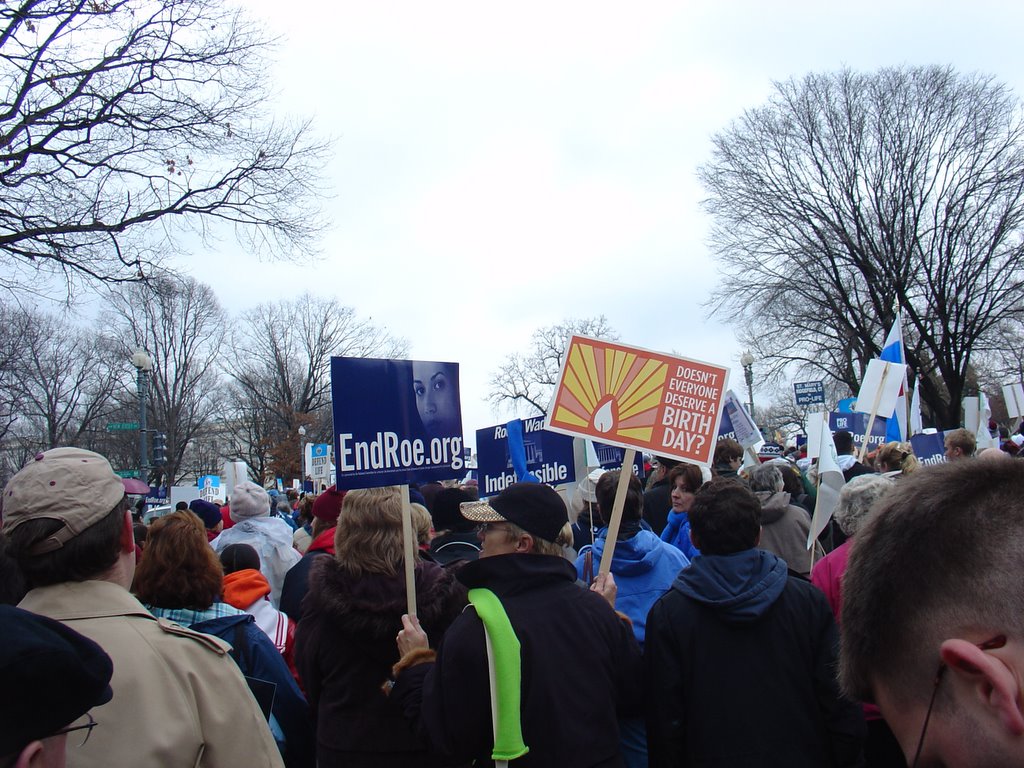
Pics from the March for Life


(l) The youth march outside the MCI Center (r) Our St. Mary's banner at the main march


(l) My d.b. Michael carries the banner (r) Jonathan with a sign that says "women deserve better than abortion" and Dan prays the rosary


(l) Marching alongside brothers from the Dominican House of Studies in D.C. (r) Two signs that say "EndRoe.org" and "Doesn't everyone deserve a birthday?" The one between and behind them says "Roe v Wade: Indefensible"
Wednesday, February 01, 2006

More Pro-Life Pics

Last week was crazy and this week hasn't been very hot so far either. So I'm just now getting around to posting more pics of the Pro-Life weekend in D.C., as I like to call it. I mentioned in my previous post that I wished I could portray better the size of the Basilica to those who haven't been there. Here's a pic I took in Fall '05:


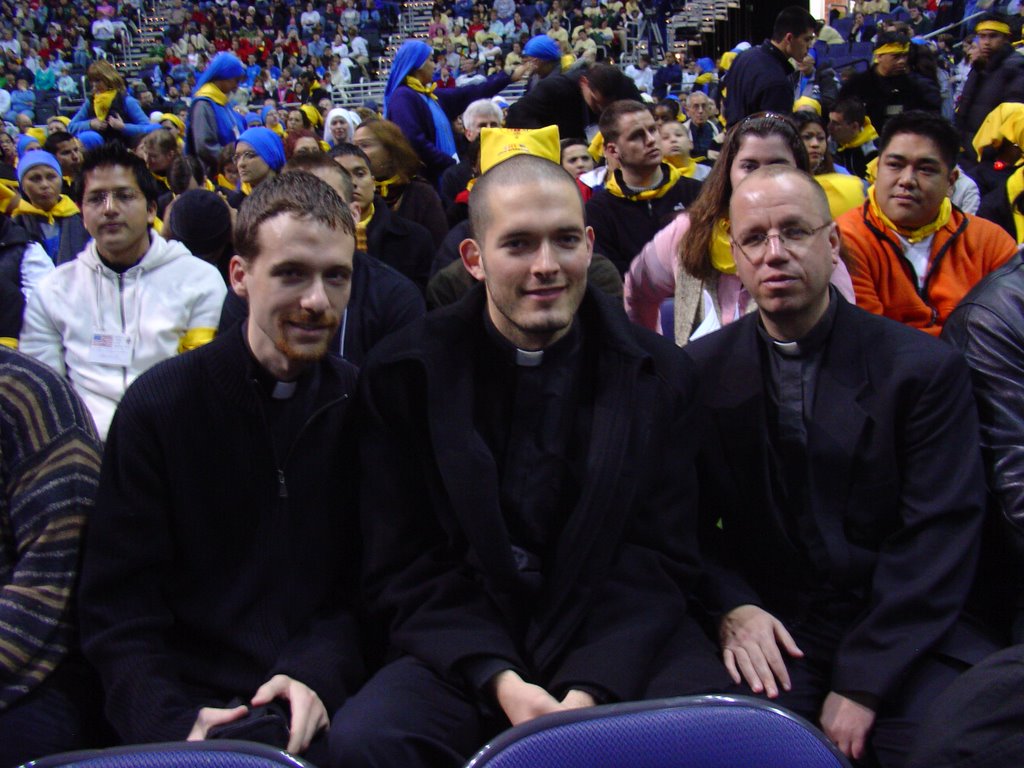
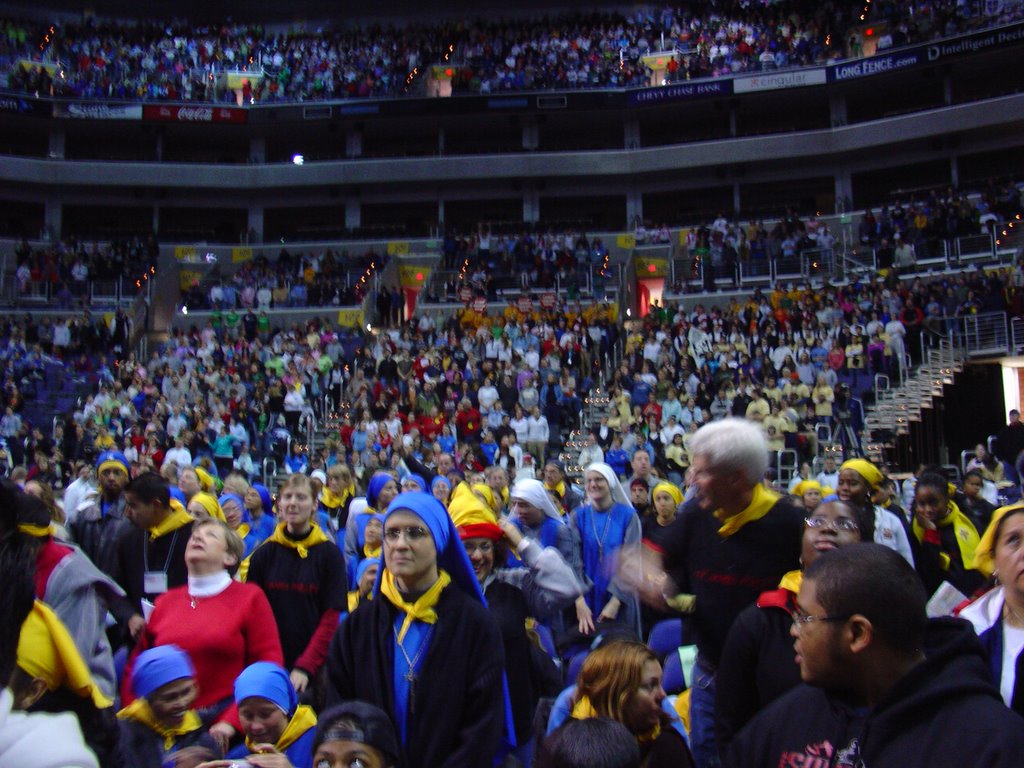
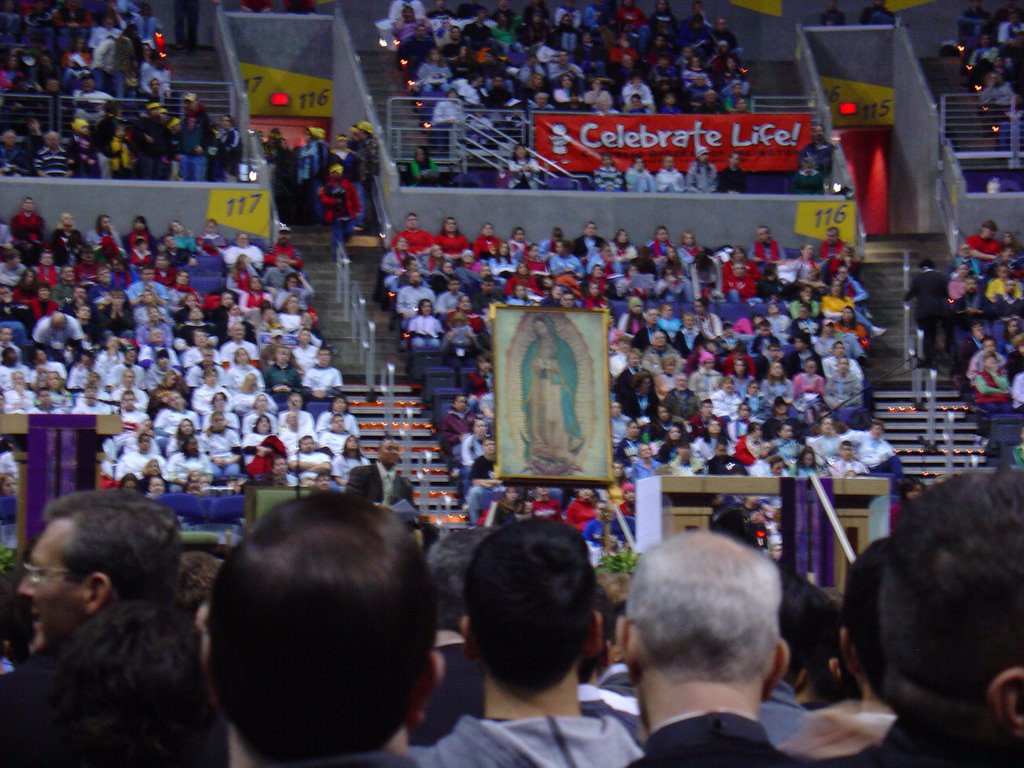
Now, on to the Youth Mass for Life at the MCI Center. This thing was packed too. The floor was packed with seminarians, priests, and religious sisters and brothers while all the seats (20,000 of 'em) in the house were filled with youth and young adults from across the country. The priest in charge of Pastoral Formation and a few others from St. Mary's were part of the unfortunate group of 2000 people who couldn't even get in! It was an awesome Mass. As it was a youth Mass you had a lot of the popular Catholic musicians like Fr. Stan Fortuna et al and the music was typical praise and worship but without being obnoxious. The Mass was still very reverent. They had a wonderful youth gospel choir from one of the local Catholic high schools.

This was my first time going and I was glad to be able to go as a seminarian. One thing I had heard about and was anxious to see is the bit after Mass where Cardinal McCarrick does a little vocation promotion. First he asked all the seminarians to stand up. When we all did we received a very encouraging standing-o. Then he asked any young men who were thinking about or discerning the priesthood to stand up. I was so happy to see guys stand up from all over the place. The seminarians stood up and gave them a long applause with many confirming head-nods, hand-shakes, and waves. Then the Cardinal did the same for the women religious and young ladies. It was great to see so many youth on fire for the pro-life movement, discerning their vocation, and most especially our Blessed Lord in the Mass.

Uh oh...watch out now... I present to you...The Louisville Coalition!

That's me, Michael Wimsatt, and Fr. Gladstone "Bud" Stevens, a Sulpician from the Archdiocese of Louisville. He's been on the faculty for about 4 years or so and is the Dean of Students. I had him last semester for Intro to Catholic Theology and Epistemology. All I can say is the man is top notch in many many ways... and I'm not just saying that because he's the Dean!

It's just Mike and I here at St. Mary's (and we have a couple guys elsewhere), but I have no worries, my prediction still stands ;)

More pics of the faithful:


Coming up: Pics and comments on the March for Life.

St. Gianna Beretta Molla, pray for us.

Wednesday, January 25, 2006

Pope Benedict XVI's New Encyclical

We preempt this series of pics from last weekend to bring you our Holy Father, Pope Benedict XVI's new encyclical, Deus Caritas Est ("God is Love").
ENCYCLICAL LETTER
DEUS CARITAS EST
OF THE SUPREME PONTIFF
BENEDICT XVI
TO THE BISHOPS
PRIESTS AND DEACONS
MEN AND WOMEN RELIGIOUS
AND ALL THE LAY FAITHFUL
ON CHRISTIAN LOVE

INTRODUCTION

1. “God is love, and he who abides in love abides in God, and God abides in him” (1 Jn 4:16). These words from the First Letter of John express with remarkable clarity the heart of the Christian faith: the Christian image of God and the resulting image of mankind and its destiny. In the same verse, Saint John also offers a kind of summary of the Christian life: “We have come to know and to believe in the love God has for us”.
We have come to believe in God's love: in these words the Christian can express the fundamental decision of his life. Being Christian is not the result of an ethical choice or a lofty idea, but the encounter with an event, a person, which gives life a new horizon and a decisive direction. Saint John's Gospel describes that event in these words: “God so loved the world that he gave his only Son, that whoever believes in him should ... have eternal life” (3:16). In acknowledging the centrality of love, Christian faith has retained the core of Israel's faith, while at the same time giving it new depth and breadth. The pious Jew prayed daily the words of the Book of Deuteronomy which expressed the heart of his existence: “Hear, O Israel: the Lord our God is one Lord, and you shall love the Lord your God with all your heart, and with all your soul and with all your might” (6:4-5). Jesus united into a single precept this commandment of love for God and the commandment of love for neighbour found in the Book of Leviticus: “You shall love your neighbour as yourself” (19:18; cf. Mk 12:29-31). Since God has first loved us (cf. 1 Jn 4:10), love is now no longer a mere “command”; it is the response to the gift of love with which God draws near to us.

In a world where the name of God is sometimes associated with vengeance or even a duty of hatred and violence, this message is both timely and significant. For this reason, I wish in my first Encyclical to speak of the love which God lavishes upon us and which we in turn must share with others. That, in essence, is what the two main parts of this Letter are about, and they are profoundly interconnected. The first part is more speculative, since I wanted here—at the beginning of my Pontificate—to clarify some essential facts concerning the love which God mysteriously and gratuitously offers to man, together with the intrinsic link between that Love and the reality of human love. The second part is more concrete, since it treats the ecclesial exercise of the commandment of love of neighbour. The argument has vast implications, but a lengthy treatment would go beyond the scope of the present Encyclical. I wish to emphasize some basic elements, so as to call forth in the world renewed energy and commitment in the human response to God's love.

Tuesday, January 24, 2006

Pro-Life Mass and March

Yesterday marked the 33rd Anniversary of Roe v Wade and the March for Life in Washington, D.C. I had been three times before but this was my first time as a seminarian. It was an amazing experience to participate in this capacity. Seeing the overwhelming numbers and support of seminarians from all over the country was very inspirational. I even got to join the procession of the Vigil Mass for Life in the Basilica of the National Shrine of the Immaculate Conception. The procession alone took 30 minutes! There were hundreds of seminarians, priests, and bishops. One thing that struck me the most was walking the long procession, winding through the crowd and seeing the faces of the thousands of faithful packed into the Basilica. All of their smiles and waves as we processed through were very encouraging and I could really feel the love of the Universal Church for her seminarians. And now...here's some pics:

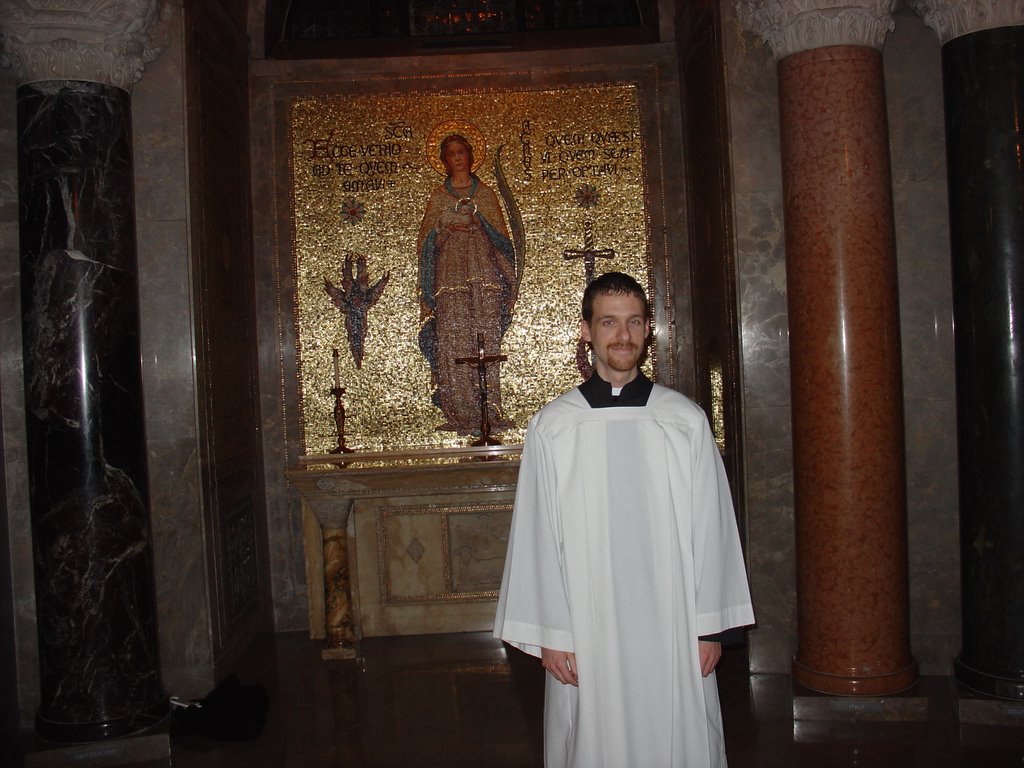
Here is one of my best friends at St. Mary's, Dan Hoffman of the Diocese of Erie, PA, in front of the side altar of St. Agnes in the crypt church of the Basilica............... and me:


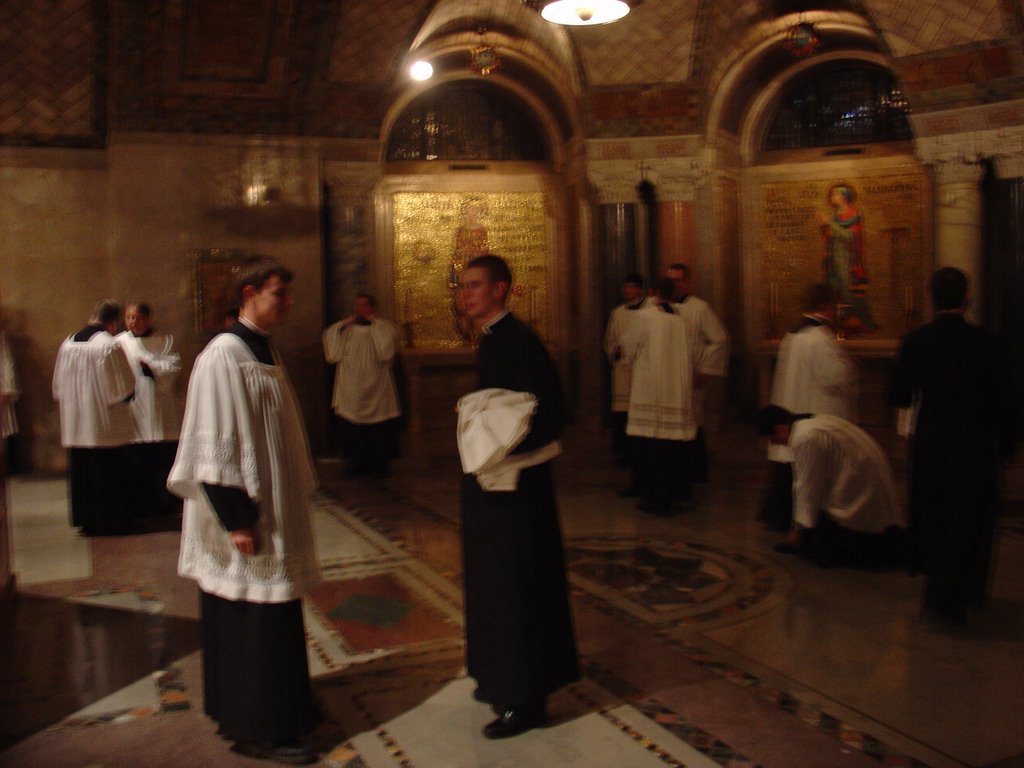
Here are just a few of the hundreds of seminarians who donned their cassocks and surplices to get ready for the procession and Mass..... wait for it.....wait for it.....P.O.D.!!
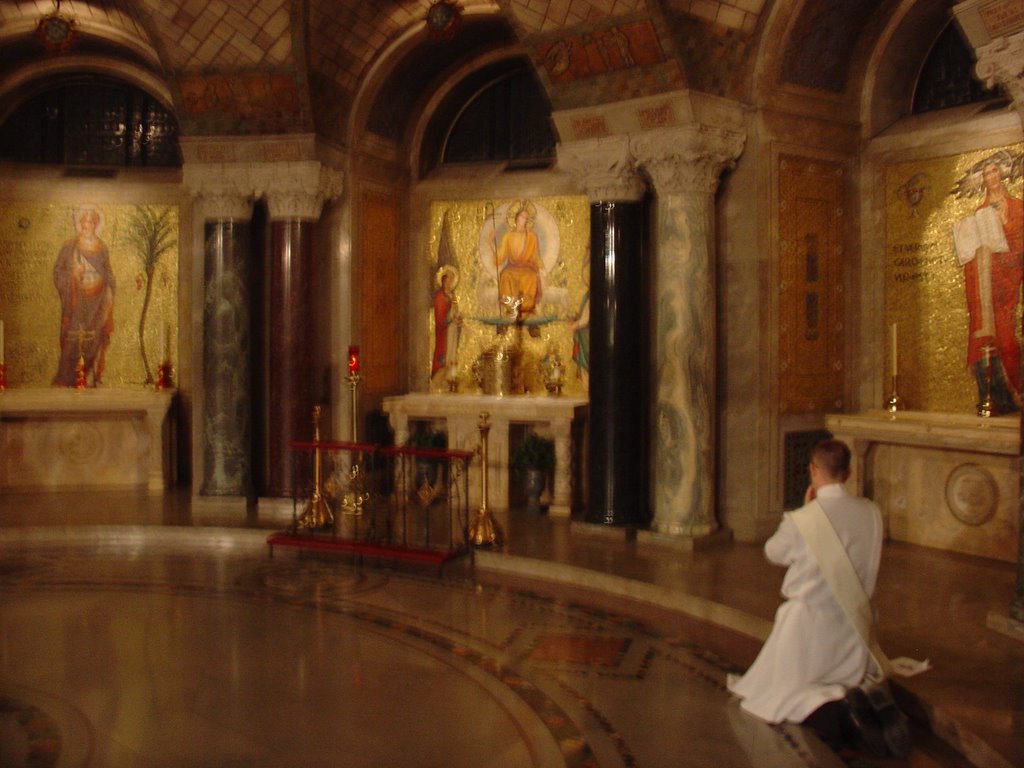
And a deacon prepares for Mass as well, in prayer before the tabernacle of the crypt church.


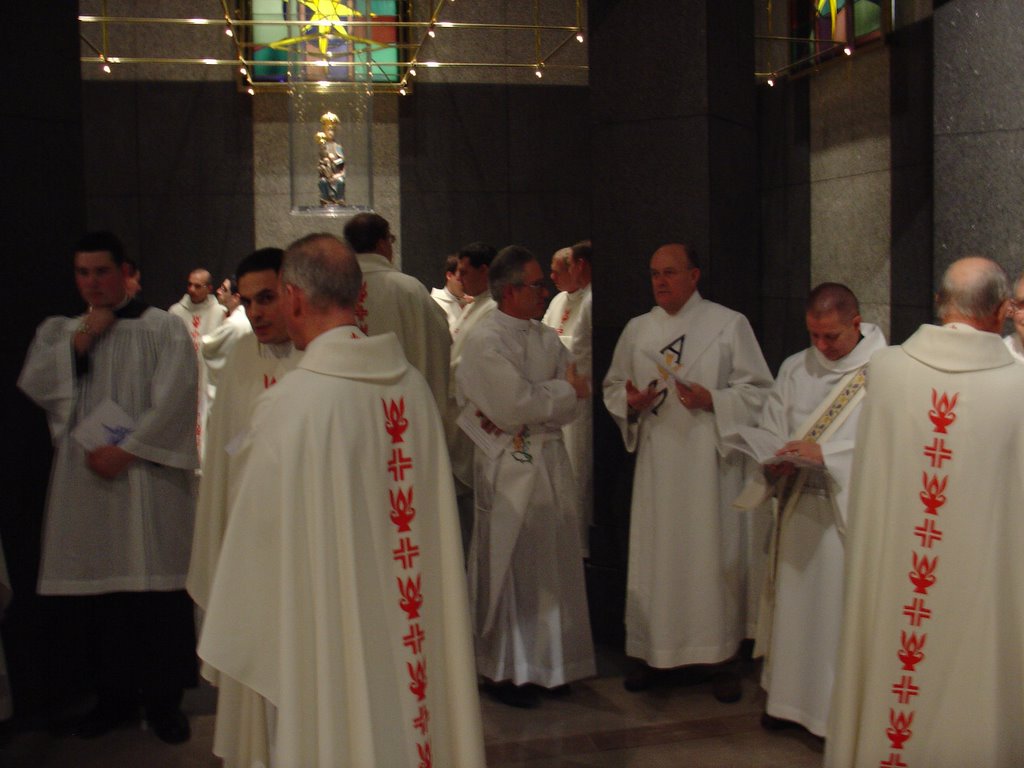
Here's a shot of the many, many priests vesting for Mass and the best shot I could get of Fr. Frank Pavone (I must admit I was a little star-struck!) - he's on the right.


Unfortunately, I didn't get any pictures of the main church. I can't explain well enough how huge the basilica is (largest Catholic Church in the Americas, top 10 largest of any church in the world) and how many thousands of people were packed in for Mass.

In future posts coming soon: Pics from the Youth Mass for Life at the MCI Center, and pics from the March for Life!

St. Gianna Beretta Molla, pray for us!

Tuesday, January 17, 2006

Just in case...

Just so we're clear and to prevent any scandal/formation issues with my seminary brethren, the pics in "My Christmas Break: Part 2" are NOT of me, but of my twin brother Nick... I promise! :)

Monday, January 16, 2006

My Christmas Break: Part 3

The third and final week of my Christmas Break was awesome too. I stayed and worked at Fr. Paul's parish (my old spiritual director). He has St. John the Apostle in Brandenburg and St. Martin of Tours in Flaherty, KY. The whole week was very busy with M.C.'ing daily Mass (with two on Sat and two on Sun), mass at the convent at St. John's, mass at the nursing home, hospital visits, work at the tribunal, and most memorable: An Anointing, death, and funural.

One day Fr. got a call from a lady he didn't recognize, asking him to come over because her neighbor was dying. I had brought my clerics home just in case I needed them... I didn't expect too... but Fr. asked me to put them on because he thought a time like this would be appropriate. So I hurried to change and couldn't find the tab for my collar! I finally had to borrow one from Fr. Paul and then I couldn't find my black dress shoes! I rumaged all through my stuff and in my car, finally found them, and we hurried on to the lady's house. We went down several country roads until we turned on one that led to her house only to find two cars side-by-side in the middle of the road talking to each other! We had to wait a couple minutes for them to finish and then finally go to their house. I was a little nervous because I'd never seen anyone die before. I asked Fr. Paul if there was anything special I should know. As he reached in his glovebox to get his holy oil and prayer book for Anointing of the Sick he said, "Just stand politely off so the side and don't say anything." "I can do that," I replied.

Apparantly the lady was on hospice care. She looked very old, laying in a recliner hooked up to a breathing machine thing, with all her family surrounding her, crying. A couple of the men there shook our hands quietly without saying anything. Fr. said later he didn't recognize any of them from his parishes. He thinks they were fallen-away Catholics because no one he talked to afterward had heard of the family. We knew they were Catholic because they all made the sign of the cross at the beginning of the Rite. Then Fr. Paul began:

Lord Jesus, you healed the sick:
Lord, have mercy.
R. Lord, have mercy

Lord Jesus, you forgave sinners:
Christ, have mercy.
R. Christ, have mercy

Lord Jesus, you give us yourself to heal us and bring us strength:
Lord, have mercy.
R. Lord, have mercy

May almighty God have mercy on us, forgive us our sins, and bring us to everlasting life.
R. Amen

He then did the Laying on of Hands, then anointed her forehead saying:
Through this holy anointing may the Lord in his love and mercy help you with the grace of the Holy Spirit.
R. Amen
And anointed her hands saying:
May the Lord who frees you from sin save you and raise you up.
R. Amen

Let us pray.
Father in heaven, through this holy anointing grant (Anna) comfort in her suffering. When she is afraid, give her courage, when afflicted, give her patience, when dejected, afford her hope, and when alone, assure her of the support of your holy people.
We ask this through our Christ our Lord.
R. Amen

Then we said the Our Father and Fr. Paul gave her a final blessing.

The above is what I can remember, looking at the Rite, that Fr. Paul said when we were there. I know he abbreviated the rite but it's all a little bit of a blur. I remember how profound it was though to be the only one saying the responses because everyone else was crying. I almost got choked up as we said the Our Father but I held it back because I knew I had to be strong for the family. Fr. Paul said later that it was nice having me there to say the responses because no one is ever able to. He also said he gave her the Apostolic Pardon but I don't remember that part.

Two minutes after he anointed her she died. I think I missed it too. When we first got there I noticed she was having the short rattley breathing that you hear about people having before they die. I made a point to listen to her breathing but then I got caught up in the prayers and the whole moment. I just said Hail Mary's over and over.

... "Holy Mary, Mother of God, pray for us sinners, now and at the hour of our death..."

I was standing sort of above and behind her with Fr. Paul and her family standing and kneeling in front and beside her. I didn't hear her final breath. The only reason I knew she died is because after the rite her daughter walked toward her to give her a kiss and then recoiled toward Father. It was then that I knew. I was surprised at how unassuming it was. She died peacefully and quietly with her family surrounding her. Then I glorified God and his Providence. Despite all the delays -- my having to change, find a tab, find my shoes, getting stuck behind two cars -- the timing of Father's anointing was perfect. It's like she was waiting for us to get there. There were some prayers after she died as well.

We stayed with the family for a while and then headed back to the rectory. On the way he got a call from one of his parishioners saying his mother had died earlier in the week. She died in a nursing home and for some reason Father didn't know about it. We went straight to his house to console him. His wife was a wonderful lady, very hospitable. He was on the phone when we got there, talking about arrangements with his brothers who were out of town. When he got off the phone other relatives showed up at the door and we all sat down together. He (I think his name was Joe) choked up a little bit here and there as he talked about what happened. I think he was in his 50's or 60's. He started to share a prayer that his mother had written before she died, but he started crying and couldn't finish it. We stayed with his family a while longer, discussing funeral plans, and then left.

That day we never heard from Anna's family about a funeral or anything. But we were in contact with Joe and the funeral Mass was scheduled for Friday. I got to serve my first funeral Mass. When it was time to insense the coffin I hadn't lit the charcoal well enough so barely any smoke came out... darnit... But, at the meal following the burial Joe's family was very thankful so I felt good about being a part of that too.

God, Father of Mercies, look with favor on Anna Pendleton and Joe's mother. Bring them into your kingdom where you reign forever and ever. Amen.
St. Mary, pray for us.

My Christmas Break: Part 2

The second week of my Christmas break, I spent with my family. It was great to hang out with them again plus I missed mom's cooking... and laundry! :) I saw a ton of my relatives too, which was nice. And also, Nick's new giiiiirlfriend came in town! hehe I was looking forward to meeting her, she's cool. And now, to embarrass Nick, here's some pics!


Monday, January 09, 2006

My Christmas Break: Part 1

Well, I'm back from Christmas break and anxious to update my blog, it's been a while.

I got back Saturday night after a ten hour drive and hit the ground runnin! Classes started back up today!

I have so much to say that I worry about how long this post may be!

During my break I spent one week in El Salvador, one week with the family, and one week working in a parish. It was a break filled with many excellent opportunities and experiences, probably the best Christmas break I've ever had. I have a ton of pictures so I'll share a few here and then maybe setup an online slideshow later.

The trip to El Salvador was awesome. One of our seminarians, Pablo Hernandez, is from San Vicente and wanted his Diaconate Ordination to be in his home town. So my vocation director, a priest-friend of his, his associate, my brother seminarian Michael, and I flew down for it! I got to serve his ordination as the crosier bearer, which was an immense blessing.


Oh...and what's that? A priest in a cassock folks, that's P.O.D.
Here's me:

Now THAT'S a crucifix! I was speechless when I saw it...
My pics of Pablo's nieces and nephews are my favorite of the hundreds I took. Here's two I particularly like:

Here the new Deacon Pablo and Fr. Bill blessing Pablo's family's new house:

Ahhh... the beach, I got to swim in the warm Pacific ocean for the first time:

Living the Corona commercial:

Here is the Cathedral in San Salvador, where Archbishop Oscar Romero's tomb is located:

Finally, dinner at a restaurant at the top of one of the many Salvadoran mountains. Notice the lights of San Salvador below... and one of Pablo's nephews conks out on Fr. Bill's lap during the bus ride back to San Vicente after a long, eventful day...


Next entry I'll talk about Christmas with the family (and Nick and Amy!) and working in a parish (plus witnessing my first death).

In Jesu, per Mariam,
Matt1618