Here's my second paper of the semester, this one for Intro to Catholic Theology, mentioned here.
Around 20 or 30 years after the passion, death, resurrection, and ascension of our Blessed Lord, St. Paul the Apostle wrote a letter to the Roman Church at Philippi, his first and faithful flock.[1] In it he thanks them for sending Epaphroditus to aid him while he was imprisoned and also exhorts them to persevere in the faith.[2] One particular passage of this letter, Phil 2: 5-11, is short but dense with insight. In this essay the revelation of this passage will be combined with the teachings of the Second Vatican Council in Sacrosanctum Concilium and the Catechism of the Catholic Church[3], particularly numbers 456-570. The resulting combination should provide a very important lesson for contemporary American Catholics on the reality of Jesus Christ, his sacrifice on the Cross, and what that means for our pilgrim fellowship of faith.[4]
In understanding Philippians 2:5-11, it is helpful to break down the passage into parts and look at the meaning of each part. This passage begins with the phrase, “Have this mind among yourselves, which was in Christ Jesus (v. 5).” We will see from the following verses that St. Paul is calling the Philippians and us to think, act, and identify with Christ’s humble and obedient death on the cross. St. Paul is not saying we should literally mimic his torture, but rather the virtues displayed in it, with our entire being. We should humble ourselves and die to our pride for the benefit and well-being of others. It is through this Way of the Cross that we too can hope for future glory with the Father.
Continuing further, verses six through eight say, “who, though he was in the form of God, did not count equality with God a thing to be grasped, but emptied himself, taking the form of a servant, being born in the likeness of men. And being found in human form he humbled himself and became obedient to death, even death on a cross.” Here St. Paul gives us a statement of Christ’s divinity when he says Christ was in the “form of God,” for a form is the “external aspect of something and manifests what it is.”[5] This statement seems clear enough, but then what does the Apostle mean when he says Christ “did not count equality with God a thing to be grasped”? The Greek used here, behind the words “equality” and “grasped,” gives us a clue. By equality (isos) he means “equality of rights and status” and by grasped (harpagmos) he means “to be seized upon or to be held fast.”[6] So our Lord, in his divinity, could have demanded to be treated with the dignity and respect that his divinity deserves. But he did not wish to “hold fast” to these rights of his. Instead he “emptied himself”, setting aside his rights and status so he could be in the “form of a servant,” the form of a man, like us in all things but sin (cf. Heb 4:15). He did this so he could suffer with men, as men, for men and thus redeem man’s “likeness” that was distorted after the fall. Finally, in stating that he “humbled himself,” St. Paul teaches that Christ acted of his own free will to obey the Father and submit to his passion. “Debasing oneself when one is forced to do so is not humility; humility is present when one debases oneself without being obliged to do so.”[7]
Finally, verses nine through eleven reveal the goal, purpose, and hope of Christ’s passion: “Therefore God highly exalted him and bestowed on him the name which is above every name, that at the name of Jesus every knee should bow, in heaven and on earth and under the earth, and every tongue confess that Jesus Christ is Lord, to the glory of God the Father.” Now the degree in which Christ humbled himself is the degree in which he is exalted: “highly” and with the glory he deserves. This is the same magnificent glory that blinded the eyes of the Apostles Peter, James, and John at the Transfiguration (cf. Mt 17:1-6; Jn 1:14). Where he was once the “criminal” (cf. Lk 23:2, 5, 32) on the cross, now he has been given the “name which is above every name”[8] and dominion over the entire universe (cf. Dan 7:14). This exaltation demands our praise and our worship (cf. Is 45:23-25). Here also, Christ gives us the perfect example of meaning and purpose in suffering. “If we obey God’s will, the cross will mean our own resurrection and exaltation. Christ’s life will be fulfilled step by step in our own lives.”[9]
Therefore the primary truth of Christ that is revealed in this passage is this: That out of love for mankind the Word took on our human nature to live among us; drew us to himself; taught us the way to salvation; and manifested his love by dying on the cross and restoring us to the Father. But, there is more to be said of this truth that is beneficial for our own Way of the Cross; the Vatican II document, Socrosanctum Concilium[10], contains further insight. SC serves to both briefly expound on the meaning behind the Mass and to decree certain norms and reforms of the Sacred Liturgy and the other elements in the life of the Church. This is not irrelevant in a discussion of the reality of Christ, “For the liturgy,” SC states early on, ‘through which the work of our redemption is accomplished,’ most of all in the divine sacrifice of the eucharist, is the outstanding means whereby the faithful may express in their lives, and manifest to others, the mystery of Christ and the real nature of the true Church (SC 2).”[11]
SC provides further relevance to the Philippians passage by relating the meaning of Christ’s passion, death, resurrection, and ascension not only to the Sacred Liturgy as a whole but to the Mystery of the Eucharist itself in particular. With these SC shows us that the whole liturgical life of the Church and all the elements of her worship (like sacramentals, the Divine Office, the Liturgical Year, and even Sacred Music) are bound up in Christ’s sacrifice on the cross and directed toward our salvation. In the Liturgy, the prayers and responses lift up and point our hearts to the Hill of Calvary, where our Lord says, “Come up hither (Rev 4:1).” In the Memorial Acclamation the faithful say, “Dying, he destroyed our death and, rising, he restored our life (SC 5).”[12] SC, concerning one of the prayers of the priest, also points out that:
We must always bear about in our body the dying of Jesus, so that the life also of Jesus may be made manifest in our bodily frame (cf. 2 Cor. 4:10-11). This is why we ask the Lord in the sacrifice of the Mass that, “receiving the offering of the spiritual victim,” he may fashion us for himself “as an eternal gift” (Secret for Monday of Pentecost Week). (SC 12)
Furthermore, in the Eucharist, the Church constantly celebrates the paschal mystery:
At the Last Supper, on the night when He was betrayed, our Savior instituted the Eucharistic sacrifice of His Body and Blood. He did this in order to perpetuate the sacrifice of the Cross throughout the centuries until He should come again, and so to entrust to His beloved spouse, the Church, a memorial of His death and resurrection: a sacrament of love, a sign of unity, a bond of charity[13], a paschal banquet in which Christ is eaten, the mind is filled with grace, and a pledge of future glory is given to us.[14] (SC 47)
But there is another important part of the Mass that should be mentioned: the Creed, and in particular that part of the Creed which proclaims, “He was conceived by the power of the Holy Spirit and was born of the Virgin Mary.” The Catechism’s treatment of this part in numbers 456-570 completes our task of a fuller understanding of Phil 2:5-11.
Here the Catechism is helpful in explaining further what the Philippians passage means by saying that Jesus was in the “form of God” and in “human form.” The Church has done well, in response to numerous heresies in her history, to refine her understanding of Christ’s dual nature. This can be confusing but the Catechism clearly states: Christ is not part God and part man but wholly each, “inseparably true God and true man (cf. CCC 464, 469).” He is “consubstantial with the Father as to his divinity and consubstantial with us as to his humanity.” He has two natures “without confusion, change, division, or separation and the distinction between these natures was never abolished by their union (cf. 467).”[15] Christ also assumed not only a human nature but a human soul with human knowledge that was finite. This is how he was able to “increase in wisdom and in stature” (Lk 2:52) and learn the skills of a carpenter from his foster-father, St. Joseph. The things of a lower order, skills, techniques, and what we only learn through experience, our Blessed Lord had to learn as well. But things of a higher order, his Father’s will, the state of our souls and hearts, and the thoughts on our minds, our Blessed Lord knew by being in union with the eternal Word (cf. 473-474).[16]
Of the other many truths revealed in this section of the Catechism, one in particular gives special insight into the reality of Christ, namely, that the mystery of redemption was at work in Christ’s entire life, culminating with what is revealed in Philippians and enlivening the teachings in SC. Through his Incarnation he enriches us with his poverty. Through his submission to the direction of his parents in his hidden life, silent in the gospel, he atones for our disobedience. In his public ministry, “his word purifies its hearers” and his healings and exorcisms “took our infirmities and bore our diseases.” Finally in his Resurrection he justifies us (cf. CCC 517).[17] Throughout, he humbled himself to be our example, his prayer draws us to pray, and his poverty calls us to accept freely our persecutions (cf. CCC 520).[18]
In our contemporary society, we must have an explanation for everything; we’ve taken the mystery out of life and reduced its events to reasonable, scientific occurrences with definite causes and effects. This has permeated American Catholicism as well and has hindered our ability to properly understand suffering, penance, and healing. We want to know why we are suffering, where it comes from, how long it lasts, and what we must do to “fix it.” Most of all we want to know God’s reasons for our suffering and why a Good and Loving God would “do this to us.” We put God on trial and we do not even look to His Son for the real answers, or rather, the real meaning. This is where St. Paul’s letter to the Philippians (2:5-11) and the wisdom of the Church in Sacrosanctum Concilium and the Catechism (456-570) teach us a valuable lesson. Christ did not ask his Father to defend his Will to Him. Instead he willingly obeyed him, trusting in the Father’s love for Him (cf. Jn 6:38; Mt 26:39). SC reminds us that the graces of our Lord’s entire life and sacrifice flow through the Sacred Liturgy for our perpetual assistance and sanctification. And the Catechism helps us relate to Christ who was one like us and who, empowered by grace and love, was able to persevere to the end.
[1] The Navarre Bible: St. Paul’s Captivity Epistles in the Revised Standard Version, Catholic Edition with commentary by members of the Faculty of Theology of the University of Navarre (hereafter referred to as “the Navarre commentary”). Page 103 explains that the period of 20 or 30 years depends on if you date St. Paul’s letter to his first imprisonment in Rome or his imprisonment in Ephesus during his third journey, respectively. Also, the mention of Philippi as his “first” flock is from page 101.
[2] I was directed to this idea from the Navarre commentary, on page 102 under the subtitle, “The Reason for the Letter.”
[3] Hereafter, the Catechism of the Catholic Church will be referred to as “Catechism” or “CCC.”
[4] “pilgrim fellowship of faith” is also the title of a book by then-Cardinal Ratzinger in which he answers the question: “How does the Church go about remembering and atoning for sins?” This is an important question as we journey as a Church together to our true home in heaven. I thought the play on words was appropriate here.
[5] This definition is from the Navarre commentary on page 126.
[6] The meaning of the Greek words for “equality” and “grasped” was found using the website: http://www.greekbible.com
[7] This quote is from the Navarre commentary on page 128, which is in turn quoting St. John Chrysostom in “Hom. On Phil, ad loc.”
[8] The Navarre commentary states on page 128: “For the Jews the ‘name that is above every name’ is the name of God (Yahweh), which the Mosaic Law required to be held in particular awe.”
[9] Here, the Navarre commentary, on page 129, quotes St. Josemaria Escriva in Christ is passing by, number 21.
[10] Hereafter, the document Sacrosanctum Concilium will be referred to as “SC.”
[11] In this quote from SC2, “through which the work of our redemption is accomplished” is a quote from “Secret of the ninth Sunday after Pentecost.”
[12] SC 5 quotes the “Easter Preface of the Roman Missal.”
[13] Up to this point, cf. St. Augustine, Tractatus in Ioannem, VI, n. 13
[14] From “a paschal banquet” to “given to us” cf. Roman Breviary, feast of Corpus Christi, Second Vespers, antiphon to the Magnificat.
[15] CCC 467 quotes Council of Chalcedon (451): DS 301,302
[16] CCC 473-474 cf. St. Maximus the Confessor, Qu. Et dub. 66: PG 90, 840A; Mt 11:27; Mk 2:8; 8:31; 9:31; 10:33-34; 14:18-20, 26-30, 36; and Jn 1:18; 2:25; 6:61; 8:55
[17] CCC 517 cf. 2 Cor 8:9; Lk 2:51; Jn 15:3; Mt 8:17; Is 53:4; and Rom 4:25
[18] CCC 520 cf. Jn 13:15; Lk 11:1; and Mt 5:11-12

Monday, October 10, 2005

Saturday, October 08, 2005
Our Lady of the Rosary

This feast was instituted by Pope St. Pius V in thanksgiving for the great naval victory over the Turks at the battle of Lepanto on this day in the year 1570, a favor due to the recitation of the Rosary. This victory saved Europe from being overrun by the forces of Islam.
Lepanto, perhaps the most complete victory ever gained over the Ottoman Empire, on October 7, 1571, is commemorated by the invocation "Help of Christians," inserted in the Litany of Loretto. At Belgrade the Turks were defeated on the Feast of Our Lady ad Nives in 1716. A second victory gained that year on the Octave of the Assumption determined Pope Clement XI to command the Feast of the Rosary to be celebrated by the universal Church. Leo XIII added the invocation "Queen of the most Holy Rosary, pray for us," to the Litany of Loretto. The Feast is in reality a great festival of thanksgiving for the signal and countless benefits bestowed on Christendom through the Rosary of our blessed Queen.
In modern times successive popes have urged the faithful to pray the rosary. It is a form of contemplative prayer, mental and vocal prayer, which brings down God’s blessing on the Church. It is a biblically inspired prayer which is centered on meditation on the salvific mysteries of Christ in union with Mary, who was so closely associated with her Son in his redeeming activity.
Read Pope John Paul the Great's encyclical, On the Most Holy Rosary (Rosarium Virginis Mariae)
Thursday, October 06, 2005
paper for Epistemology
Choose one of the following dialogues:
Plato: Euthyphro, Meno, or Symposium
OR
St. Augustine: Concerning the Teacher, The Profit of Believing, or Soliloquies
1. What does the author have to say about the range and content of human knowledge?
2. How does the text explain the process by which one comes to knowledge?
3. What role is God accorded in the process?
6-8 pages, typed, double-spaced.
Tuesday, October 04, 2005
paper for Intro to Catholic Theology
Belief in Jesus Christ:
A. First, provide a brief exegesis of Philippians 2:5-11. What is the primary truth of Christ that is being revealed in this passage?
B. Next, provide a brief summary of what the Vatican II document Sacrosanctum Concilium teaches about the reality of Christ. In what way does it elaborate upon what is revealed in the Philippians passage?
C. Offer a brief summary of numbers 456-570 in The Catechism. What is being affirmed in this section? How does it connect with what was treated in "A" and "B"?
D. Tie all of this together by reflecting on what contemporary American Catholics need to hear most about Jesus Christ from these sources.
6 pages, double-spaced
I could have picked "Belief in God" which would require Exodus 3:1-4:17, Dei Verbum, and CCC #205-231 or "Belief in the Holy Catholic Church" which would require Acts 2:1-42, Lumen Gentium, and CCC #781-945. But, I chose "Belief in Jesus Christ" because he is sort of the bridge between the two. I came to this conclusion BEFORE I realized that the passages required were shorter than the rest ;)
I'll post the paper when I'm done, it's due Mon Oct 10, Columbus Day or not!
Holy Mary, Mother of God, pray for us.
Sunday, October 02, 2005
My Phaedo Paper
Here's the text of my Phaedo paper, mentioned here. Let me know what you think!
“Now, if Christ is preached as raised from the dead, how can some of you say that there is no resurrection of the dead (1 Cor. 15:12)?” With this, St. Paul addresses at around 50 A.D. one of the foundational beliefs of his new Greek Christian flock at Corinth. It is significant that Plato, one of the greatest Greek minds of all time, addressed similar doubt in his dialogue Phaedo about 400 years earlier: “To believe this requires a good deal of faith and persuasive argument, to believe that the soul still exists after a man has died and that it still possesses some capability and intelligence (70b).” In this essay Plato’s views of the human person and the nature of the soul in Phaedo will be compared with St. Paul’s views in chapter fifteen of his first letter to the Corinthians. This will reveal how open the Corinthians were to accepting St. Paul’s message.
Phaedo, which is considered the greatest example of Greek prose literature, is a highly philosophical work in which Plato expresses his own rich theories on life, the body, the soul, and immortality in the form of a fictitious dialogue (cf. Introduction p.93 and 59b) between his preeminent teacher Socrates and Socrates’ followers and friends. The occasion is Socrates’ death by poisoning in a prison of Athens, which sets the stage perfectly for a treatment of such topics. Early in the work, Socrates expresses to his companions the view that “a man who has truly spent his life in philosophy is probably right to be of good cheer in the face of death and to be very hopeful that after death he will attain the greatest blessings yonder (64a).” Socrates speaks of the body as corrupt, constantly seeking pleasures and adornments in order to appease its desires. These desires, combined with the uncertain senses of the body, form an obstacle to the goals of a true philosopher: the love, grasp, and experience of absolute wisdom and truth. Socrates argues that since this should be the ultimate goal of all human beings, especially the philosopher, one must do whatever he can to free his soul from his body while still living. He does this by denying the body the pleasures and adornments it seeks and striving to always investigate the truth as far as possible. A life dedicated to this task is Socrates’ definition of the good life.
According to him, upon death, those who greatly indulged the passions of the body to the point of murder or “great sacrileges” spend an eternity in the deepest hallow of the earth, called “Tartarus (cf. 113e).” Those souls who committed grievous acts but are sorrowful spend a year there too and then, if they are granted the prayers of their victims, are reincarnated into a creature that mimics their previous behaviors (cf. 81e, 114a). Other better, but still average souls are purified by penalties, rewarded for good deeds and reincarnated as well. All souls, regardless, are immortal and all go through an eternity of births, deaths, and rebirths, except for the philosopher. Only he, who struggles to free the soul in life, thus prepares it for death when it is freed from the body and can ascend easily to the heavens to enjoy eternity with the gods, “a future altogether without a body,” (114c) and finally be able to grasp complete and True Wisdom. But this eternity, this immortality of the soul, is hard for his companions to hear, especially the characters Simmias and Cebes, and seems to not be popularly accepted either (cf. 70b and 77b).
Also in this Socratic dialogue is one of Plato’s most famous theories, the Theory of Forms, which he uses to defend the immortality of the soul. Another, the Theory of Learning as Recollection, builds on this one. In the Theory of Forms we have an understanding of two “realms” or worlds, one of the visible, composite, and changing (the world in which we live) and one of the invisible, simple, and unchanging (the world of Forms). In the latter we have absolute Forms of certain ideas like the Just, the Beautiful, the Good, Bigness, Health, Strength, etc. from which particular instances of these in the material world derive their essence (cf. 65d-e). For example, things on this earth are beautiful only because they partake, imperfectly, of Beauty itself in the realm of Forms. Applying this theory to the body and soul, Plato concludes that the body is more like the realm of the visible by virtue of its “wants, desires, fears, all sorts of illusions and much nonsense (66c).” But the soul, on the other hand, resembles the realm of the invisible and is hindered only by the burden of the body (cf. 79d). “A soul in this state [upon death] makes its way to the invisible, which is like itself, the divine and immortal and wise, and arriving there it can be happy (81a).”
From this, Socrates’ companions begin to accept that the soul is immortal. However, for us it is not so certain. For one, elements of this theory are dispersed and shared with other thoughts throughout the work. This makes it difficult to assemble a cohesive theory to use. Also, the theory is presented initially as an assertion and an already accepted belief (cf. 65d, 100b-c). Phaedo lacks foundational arguments for this theory; instead arguments are built from this point of acceptance on toward a reasonable conclusion.
The Theory of Learning as Recollection recalls several elements of the Theory of Forms. According to this theory, learning is really only recollection of knowledge learned from “some previous time (73a).” Applying this to Forms one can say, for example, that recognition of the equality of two objects, which can never be perfectly equal in this world, is only possible because of previous knowledge of the Form of Equality itself. Furthermore, one can only have knowledge of the Forms, those in the realm of the invisible, unless the soul has gazed upon them after separation from one body and before reincarnation in another. So, Socrates concludes, “according to this theory too, the soul is likely to be something immortal (73a).” The trouble with this theory is that Forms like Equality, Bigness, Tallness, etc. are relative in nature, which excludes the possibility of one absolute Form being shared by all its particulars. If one man is taller than another, he partakes in Tallness. But if another is taller than he, does he now partake in Smallness? This contradiction isn’t reconciled in Phaedo.
At the end of the work, Socrates’ companions are convinced of his views on the human person and the nature of the soul. But one is left to wonder if Plato’s work in this dialogue and others changed the “opinion of the majority” (77b) of his time up until the time of Paul’s letter to the Corinthians. If we look at Chapter Fifteen of this letter we can see how some elements of their ancient philosophy could have helped and some could have hindered the reception of their newfound faith.
Here St. Paul teaches of “the historical fact of Christ’s resurrection, how it necessarily connects up with the resurrection of the dead in general, and what form this resurrection will take.”[1] We actually find several similarities between the teachings of Plato and those of Paul. As the god in Phaedo is “the Form of life itself,” (106d) so too is Christ, in a way, the Form that makes all resurrection possible, “For as in Adam all die, so also in Christ shall all be made alive (1 Cor. 15:22).” Furthermore, Paul, like Socrates, speaks of living the good life: “Come to your right mind, and sin no more (cf. 15:34, 58).” He even, in verse 33, quotes a Greek poet, Menander, when he says, “Do not be deceived: ‘Bad company ruins good morals.’”[2] Interestingly enough, Socrates’ teaching of the soul eventually gaining control of the body (cf. 80a) works in this scenario as well: “It is sown a physical body, it is raised a spiritual body (cf. 1 Cor. 15:44, 53).” However, the goal is different: Eternity with God, body and soul in glorified union (cf. 15:35, 42-43) rather than in eternal separation.
Here we can now see why the Corinthians could have doubted the resurrection of the dead, body and soul (cf. 15:12), especially if Plato’s teachings had indeed changed the “opinion of the majority” even up to their day. St. Luke’s Acts of the Apostles, in its treatment of St. Paul’s preaching in Athens, hints that this could have been the case:[3] “Now when they heard of the resurrection of the dead, some mocked; but others said, ‘We will hear you again about this (17:32).’” Paul’s brief statements to the Corinthians on living a good life and his descriptions of Christ’s role in the resurrection would have sounded familiar to them. It is what happens to the soul at the end of life that is so drastically different from the philosophy of their ancestors.
Luckily, St. Paul knows his audience.[4] One can imagine his hope that maybe the similarities of Christ’s message through him and Plato’s message through Socrates will be enough to win over their hearts and compel them to accept the differences. Maybe with the help of those Athenians that did “hear” him, coupled with the reasonableness of Paul’s letter and God’s grace (cf. 1 Cor. 15:10-11), one can expect him to have influenced the “opinion of the majority” of the Corinthians as well and anew.
[1] The Navarre Bible: St. Paul’s Epistles to the Corinthians in the Revised Standard Version, Catholic Edition with commentary by members of the Faculty of Theology of the University of Navarre, published by Four Courts Press with an editorial committee for the English-language translation composed of James Gavigan, Brian McCarthy, and Thomas McGovern, printed in English in the year 1999. This quote is from the commentary on verses 1-58 on page 141. Also, dear reader, please excuse the verbosity of this citation as there is no standard given for this type of volume.
[2] I discovered the source of the quote from the same volume as above, in the commentary on verse 33 given on page 149. Here I also found that Menander’s quote is from his work, Thais.
[3] I was directed to this idea by the same volume as above, in the chapter titled, “Introduction to the First Epistle to the Corinthians,” and the section titled, “The Resurrection of the Dead” which gives a brief but relevant statement about Acts 17:32. This is on page 32.
[4] The section mentioned above includes a sentence that says, “This truth of faith was in conflict with traditional Greek thought – as Paul found out for himself when he spoke in the Areopagus of Athens.” (emphasis mine) The section then goes on to quote Acts 17:32, also mentioned above.
Friday, September 30, 2005
Teach, Father, Teach
Another awesome homily by my former spiritual director, Fr. Paul Beach, for Sun Sept 25:
Homily for Twenty-Sixth Sunday in Ordinary Time
September 25, 2005
A little more than a year ago, the past Holy Father, Pope John Paul II declared this year the "year of the Eucharist." He asked that pastors spend time talking about the importance of the Eucharist to the Catholic faith. The second Vatican Council referred to the Eucharist as the "source and summit" of our faith, and so it seems that, since this is such an important topic, we should spend some time reflecting on the meaning of our regular participation in the Mass.
Many years ago Bishop Maloney was celebrating a special Mass for the seminarians and he said something in his sermon that has remained with me all these years. He stated that every day, regardless of what else he may have said or done, so long as he celebrated the Mass it was a successful day.
In the four years now that I have been a priest, I have had the opportunity to celebrate Mass hundreds of times. In the great basilicas of Rome and in other, more humble settings. At Funerals, at weddings, weekday Masses, Sunday Masses. Masses where a thousand are present, or where I am the only one. No matter the place or the circumstance, each of these opportunities has had something in common: Christ’s presence.
Having been a priest for over four years now, I can echo these words of Bishop Maloney. The Mass is the most significant thing that we can do in our entire lives. Bishop, priest, or laity, celebrating the Eucharist is the highlight of our life. For every time we celebrate the Mass we come into contact with the very Body and Blood - the very presence - of our Lord and Savior. Every time we cross the threshold of the doors into this building we are crossing the threshold of paradise, for in the Mass we receive a glimpse into heaven. St. Alphonsus Liguori once said that: "if we were to truly recognize what we participate in at every Mass, then we would die of fright at the awesome mystery."
If this is the case, then how sad it truly is that so many of our fellow Catholics no longer believe in Christ’s presence. The Eucharist offers us direct access to our God, who comes to nourish and sustain us in this life… how sad it is that many people fail to recognize this opportunity.
We must question ourselves as well. How much do I appreciate this most incredible gift? We who live in this country have such easy access to the Eucharist. Every day of the week, there are literally dozens of Masses taking place within relatively few miles of our homes. There are many people in our world today who do not have such easy access to the Mass. Some of them must walk for hours on foot to get there only once a week. Some don’t even have the opportunity to go but once every month or two months.
I recall the story of a young man I got to know in my time in seminary. St. Mary’s in Baltimore participated in a program sponsored by the National Bishop’s Conference, whereby seminarians from other parts of the world are invited to come and study. Through this program I had the opportunity to meet many men from third world nations, even nations where the Church is still officially persecuted. One of these men was from a country where the Church is still underground and celebrating the Mass there remains an illegal act. I still remember how anxious he was to return home and be Ordained a priest. I recall how my Ordination and first Mass was a time of celebration and receptions, his was to be done in secret for fear of being arrested. Yet how anxious he was to return to his home and offer the Sacraments to the people.
So why was this? I imagine that his first Mass was attended probably by only a few people. There would have been no beautiful music or vestments to enhance the Mass. I’m sure that they didn’t even have a reception afterwards.
The answer must be that he recognized the true wonder it is to be able to make Christ present in such a tangible way, especially in a part of the world so desperate for God’s presence. Dear brothers and sisters: do we too realize what we participate in here? If so, how well do our actions here in this church reflect that?
We live in a society that is concerned with immediate gratification, and is entertainment driven. Almost every minute of our lives is driven by the idea of what am I going to gain by doing this or that. I get impatient if the microwave takes two minutes to heat my meal rather than one. I turn on the TV and expect immediate entertainment. If we don’t find it then there are 500 other channels to turn to. I want what I want when I want it. It is only natural then that we would be tempted to apply these same principles to our faith as well and come here to this church seeking these same things. Listen to the complaints of those who no longer practice their faith. Oftentimes you will hear people say that they are "bored" when they come to Mass. What’s worse, they say that they "don’t get anything out of the Mass." They complain about the music, the bad preaching, the ugly artwork, or whatever else that keeps them from "enjoying themselves." And they are right! Church choirs miss the occasional note, there are plenty of churches filled with ugly things, and this isn’t the best sermon I’ve ever heard.
We must remind ourselves, brothers and sisters, that we are not here to be entertained. We are not here to feel good. We are here first and foremost to offer worship to the Living God. We are here first and foremost to give ourselves completely to the Father, in imitation of Christ Himself, who in this holy sacrifice gives all that He has: body, blood, soul, and divinity. Our new Holy Father, Benedict, in his many writings on the liturgy, has constantly reminded us that our worship’s true purpose is fulfilled when we first orient ourselves towards God.
Sadly, we see how oftentimes in the past forty or so years the temptation has been to place the emphasis of the Church’s worship upon ourselves. Song after song has been composed during this time that concentrates solely upon us, the congregation. Sadly, priest after priest, and countless "worship committees," have seen fit to alter the Church’s liturgy, somehow thinking that they can "improve upon it." To conform the liturgy to ourselves, rather than accepting the challenge to conform ourselves to the liturgy. These efforts have helped lead us to the erroneous assumption that the Mass is first and foremost about me, when in fact it is about God. This being the case, it is easier to understand people’s criticism that the Mass has become boring: for this is precisely so if the Mass is only about me. For most people can be intrigued only for so long by merely staring at themselves. The fruit of this attitude has been in helping to bring about an atmosphere of idolatry in our worship. The people of Moses’ time falsely erected a golden calf, we must not do the same.
We must evaluate what it is we come here seeking. Is it entertainment? Go to the theater or the movies. Is it to hear what a great person I am? Go to group therapy. Is it to hear great music performed flawlessly? Go to a concert. But if you are here first and foremost to give yourself to God; to humbly kneel and bow down before the one who made you, then we are in the perfect place.
Fr. Paul Beach
Priestly Celibacy and the Vocation of Love
Priestly Celibacy and the Vocation to Love
Interview With a Physician-Theologian
PAMPLONA, Spain, SEPT. 29, 2005 (Zenit.org).- The question of priestly celibacy is bubbling to the surface once again.
The topic came to the fore in Spain, where a married Anglican minister converted to the Catholic Church and was ordained. In Wiesbaden, Germany, meanwhile, 80 married former Catholic priests appealed to the Pope to put an end to the requirement of clerical celibacy.
To address the topic, the Veritas news agency interviewed Father Juan Ramón García-Morato, author of the recently published book "Created by Love, Chosen to Love" (EUNSA Publishers).
García-Morato, a physician and theologian, teaches a course on Theory of Culture in the School of Medicine of the University of Navarre. He is also chaplain of that school.
Q: Why do you affirm that celibacy is a path to Christian fullness?
Father García-Morato: Both celibacy as well as marriage are paths to Christian fullness, namely, to holiness.
We are all called to love, and Christian revelation points out two ways of realizing fully this vocation: marriage and celibacy in any of its forms. Both are included in God's plans. Both need each other to understand each other better.
Both are a path of self-giving. And to give oneself, one must first possess oneself. "Half an orange," as understood in ordinary language, doesn't exist. No person is "by halves," needy of another -- especially designed for himself -- to be complete.
Each person is complete in himself. Only a complete person can bring his whole self into play and give himself -- to God or to another person -- with sufficient maturity to make that decision freely.
This is why celibacy is also a path of human and Christian fullness. Because when it comes to loving God, in response to a call that implies that gift, all human dimensions must come into play, also those that depend on the masculine or feminine condition, excluding simply the exercise of sexuality. But that is the lifestyle of Christ, perfect man, and of the Virgin -- a lifestyle that has an irreplaceable role in the history of redemption.
Q: Do you think it is a topic that can be revised theologically? Could the law of celibacy be abolished?
Father García-Morato: Of course, celibacy is not a dogma of faith. It is a way of life that grew within the Church since the second century.
In this connection, in the measure that the link between celibacy and priesthood is not essential, but of profound congruence between the mystery of Christ and the mystery of the sacramental participation in his priesthood, there is room for the hypothetical possibility to abolish celibacy, as any other ecclesiastical law that does not respond directly to an express mandate of divine law.
However, the conviction of the Church in regard to the congruence of the priesthood with the priestly ministry is neither pragmatic nor situational, but profoundly based.
I think that the explanation can be found here for the fact that -- in a sociological and cultural situation such as the present one, with the difficulties known by all in the matter of vocations -- the Catholic Church continues to trust in God's continuing to distribute the gift of celibacy among many young men and in his sending the necessary sacred ministers for the life of the Church.
Q: As a doctor, do you think that celibacy is a "repression" or that it can result in psychological problems?
Father García-Morato: Celibacy does not impoverish the personality. On the contrary, by being one of the paths to full realization of the person's vocation to love, it enriches him. I have seen this many times, thank God. However, I am aware that there are individuals who wonder if it is not emotionally and mentally healthier to have a couple and a family rather than to live celibacy.
As I said earlier, each person is complete in himself and is fulfilled in relation with others. But as it is not possible to relate to all persons, or to make use of the innumerable opportunities to relate to one another, each one chooses freely those he considers most appropriate for his personal fulfillment.
The problem, to my mind, does not reside in living celibacy. In life, what is terrible for the inner harmony and mental health of a man or woman does not lie in being celibate or married. The crux of the question lies in having made a free decision and having chosen something that affects one's whole existence and then continuing to envy what one has not chosen, filling oneself with ever greater anxiety.
Thus permanent longing as a style of life -- one of the ways of putting the hand to the plow and continuing to look back -- can only be a source of immaturity, which destroys and plays havoc with any existing commitment and even ends up by making one incapable for future commitments.
We must all learn to make decisions and to understand that, with every decision, we discard many options; and assume it with the view of one who starts on new paths full of surprises. That is why, faced with the fundamental questions of life, decisions must only be made if we are aware and are prepared to have them be decisions that, in fact, draw after them the whole personality.
If a decision is made, and the rest of the personality goes another way, inevitably a high-risk situation is created for mental health and personal harmony, both in celibacy as well as marriage.
Thursday, September 29, 2005
Feast of the Archangels
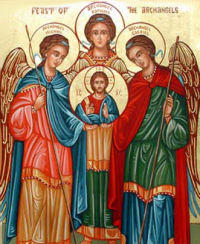
St. Michael the Archangel is my Confirmation saint, so I'm pretty pumped about today :)
Prayer to St. Michael the Archangel:
St. Michael the Archangel, defend us in battle;
be our protection against the wickedness and snares of the devil.
May God rebuke him, we humbly pray;
and do thou, O prince of the heavenly host,
by the power of God,
cast into hell Satan and all evil spirits
who prowl about the world,
seeking the ruin of souls. Amen.
Pray to St. Gabriel the Archangel:
Blessed Saint Gabriel, Archangel
We beseech you to intercede for us at the throne of divine mercy: As you announced the mystery of the Incarnation to Mary, so through your prayers may we receive strength of faith and courage of spirit, and thus find favor with God and redemption through Christ Our Lord. May we sing the praise of God our Savior with the angels and saints in heaven forever and ever. Amen.
Prayer to St. Raphael the Archangel:
Blessed Saint Raphael, Archangel, We beseech you to help us in all our needs and trials of this life, as you, through the power of God, didst restore sight and gave guidance to young Tobit. We humbly seek your aid and intercession, that our souls may be healed,our bodies protected from all ills,and that through divine grace we may become fit to dwell in the eternal Glory of God in heaven. Amen.

Our Lady of Compassion
 Our Lady of Compassion, pray for us!
Mariology Symposium to Focus on Compassion
VATICAN CITY, SEPT. 28, 2005 (Zenit.org).- Compassion and its presence in the life of Mary of Nazareth will be the focus of the 15th International Mariological Symposium, to be held Oct. 4-7 in Rome.
On this occasion, Monsignor René Laurentin, the renowned Mariologist, will confer the René Laurentin-Pro Ancilla Domini award in memory of Servite Father Ignacio María Calabuig, a professor of Mariology who died last year.
This biannual meeting dedicated to Mariology will take place in the Theological Faculty Marianum. This year it will "explore the theological category of compassion as key in reading the significance and role of the Mother of Jesus in the history of salvation," the organizers said in a statement.
Monsignor Angelo Vincenzo Zani, undersecretary of the Congregation for Catholic Education, will preside over the morning session Oct. 4.
Pope John Paul I
Yesterday was the 27th anniversary of the death of Pope John Paul I.

Servant of God, Pope John Paul I, Albino Luciani, pray for us!
Benedict XVI Recalls the "Unforgettable" John Paul I
On Anniversary of His 1978 Death
VATICAN CITY, SEPT. 28, 2005 (Zenit.org).- "Unforgettable for all of us" is how Benedict XVI evoked the memory of his predecessor Pope John Paul I, on the 27th anniversary of his death.
Benedict XVI spoke spontaneously at the end of today's general audience, to greet in Italian "the faithful of the Diocese of Belluno-Feltre who, together with its bishop, Monsignor Giuseppe Andrich," came to Rome "to make a grateful and prayerful remembrance" of the Servant of God, John Paul I, on the anniversary of his death.
John Paul I was born Albino Luciani in that diocese on Oct. 17, 1912. He was ordained a priest in 1935, and received episcopal ordination in 1958. Eleven years later, Pope Paul VI named him archbishop patriarch of Venice, and in 1973 he was elevated to cardinal.
Elected Pope on Aug. 26, 1978, he died unexpectedly, 33 days later.
On Nov. 23, 2003, the diocesan phase of John Paul I's cause for beatification opened in the Cathedral of Belluno.
In late 2004 Cardinal Joseph Ratzinger (now Benedict XVI) acknowledged in the province of Belluno that he prayed "every day for this beatification."
"Pope Luciani is an example for us all," said the then prefect of the Congregation for the Doctrine of the Faith.
The postulator of the cause for John Paul I's beatification, Monsignor Giorgio Lise, told the Web site Korazym: "From the testimonies I receive, humility, confident abandonment in God, and hope are the characteristics of his spirituality."
Monsignor Lise is director of the Pope Luciani Center.
Tuesday, September 27, 2005
first paper
Well, here comes my first paper in seminary. It's for Philosophical Anthropology:
1. Explain Plato's understanding of the human person as presented in the Phaedo. Make sure you take account of:
A. His discussion of the nature of the soul and the significance of death
B. The connection between the immortality of the soul and
a. what he says about the "forms" and
b. his understanding of learning as "recollection"
C. His conception of what constitutes the "good life" for human being.
In describing Plato's views, be sure to note the strengths and weaknesses you see in them. In particular, do the arguments he adduces in support of them work?
2. Compare Plato's views to the views of Paul as described in 1 Corinthians 15. In what ways are they similar? How are they different?
(4-5 pages, typed, double-spaced)
Not tooo bad...we'll see. I may even post the paper here!
Our Lady, Seat of Wisdom, pray for us!
Saturday, September 24, 2005
Epistemological Hell
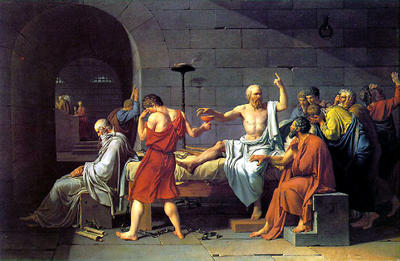
From Plato's Theaetetus (191e-192d):
SOCRATES: Now, when a person has this knowledge, and is considering something which he sees or hears, may not false opinion arise in the following manner?
THEAETETUS: In what manner?
SOC. When he thinks what he knows, sometimes to be what he knows, and sometimes to be what he does not know. We were wrong before in denying the possibility of this.
THEAET. And how would you amend the former statement?
SOC. I should begin by making a list of the impossible cases which must be excluded. (1) No one can think one thing to be another when he does not perceive either of them, but has the memorial or seal of both of them in his mind; nor can any mistaking of one thing for another occur, when he only knows one, and does not know, and has no impression of the other; nor can he think that one thing which he does not know is another thing which he does not know, or that what he does not know is what he knows; nor (2) that one thing which he perceives is another thing which he perceives, or that something which he perceives is something which he does not perceive; or that something which he does not perceive is something else which he does not perceive; or that something which he does not percieve is somthing which he perceives; nor again (3) can he think that something which he knows and perceives, and of which he has the impression coinciding with sense, is something else which he knows and perceives, and of which he has the impression coinciding with sense; -- this last case, if possible, is still more inconceivable than the others; nor (4) can he think that something which he knows and perceives, and of which he has the memorial in good order, is something else which he knows; nor if his mind is thus furnished, can he think that a thing which he knows and perceives is another thing which he perceives; or that a thing which he does not know and does not perceive, is the same as another thing which he does not know and does not perceive, is the same as another thing which he does not know and does not percieve; -- nor again, can he suppose that a thing which he does not know and does not perceive is the same as another thing which he does not know; or that a thing which he does not know and does not perceive is another thing which he does not perceive: -- All these utterly and absolutely exclude the possibility of false opinion. The only cases, if any, which remain, are the following.
THEAET. What are they? If you tell me, I may perhaps understand you better; but at present I am unable to follow you.
SOC. A person may think that some thing which he knows, or which he perceives and does not know, are some other things which he knows and perceives; or that some things which he knows and perceives, are other things which he knows and perceives.
THEAET. I understand you less than ever now.
SOCRATES: Now, when a person has this knowledge, and is considering something which he sees or hears, may not false opinion arise in the following manner?
THEAETETUS: In what manner?
SOC. When he thinks what he knows, sometimes to be what he knows, and sometimes to be what he does not know. We were wrong before in denying the possibility of this.
THEAET. And how would you amend the former statement?
SOC. I should begin by making a list of the impossible cases which must be excluded. (1) No one can think one thing to be another when he does not perceive either of them, but has the memorial or seal of both of them in his mind; nor can any mistaking of one thing for another occur, when he only knows one, and does not know, and has no impression of the other; nor can he think that one thing which he does not know is another thing which he does not know, or that what he does not know is what he knows; nor (2) that one thing which he perceives is another thing which he perceives, or that something which he perceives is something which he does not perceive; or that something which he does not perceive is something else which he does not perceive; or that something which he does not percieve is somthing which he perceives; nor again (3) can he think that something which he knows and perceives, and of which he has the impression coinciding with sense, is something else which he knows and perceives, and of which he has the impression coinciding with sense; -- this last case, if possible, is still more inconceivable than the others; nor (4) can he think that something which he knows and perceives, and of which he has the memorial in good order, is something else which he knows; nor if his mind is thus furnished, can he think that a thing which he knows and perceives is another thing which he perceives; or that a thing which he does not know and does not perceive, is the same as another thing which he does not know and does not perceive, is the same as another thing which he does not know and does not percieve; -- nor again, can he suppose that a thing which he does not know and does not perceive is the same as another thing which he does not know; or that a thing which he does not know and does not perceive is another thing which he does not perceive: -- All these utterly and absolutely exclude the possibility of false opinion. The only cases, if any, which remain, are the following.
THEAET. What are they? If you tell me, I may perhaps understand you better; but at present I am unable to follow you.
SOC. A person may think that some thing which he knows, or which he perceives and does not know, are some other things which he knows and perceives; or that some things which he knows and perceives, are other things which he knows and perceives.
THEAET. I understand you less than ever now.
Thursday, September 22, 2005
Slowly growing...
We got our student ID's today...

But grace was given to each of us according to the measure of Christ’s gift. And he gave some as Apostles, others as prophets, others as evangelists, others as pastors and teachers, to equip the holy ones for the work of ministry, for building up the Body of Christ, until we all attain to the unity of faith and knowledge of the Son of God, to mature manhood, to the extent of the full stature of Christ, so that we may no longer be infants... Rather, living the truth in love, we should grow in every way into him who is the head, Christ...
-- Ephesians 4: 7,11-15
Wednesday, September 21, 2005
Feast of St. Matthew!

What a great day! At this morning's 7:30am Mass here at St. Mary's, Matthew Wetsel (another one of the new guys) and I were the gift bearers. It was good to serve the Mass in this way on my namesake's Feast Day! All the guys have been wishing me a "Happy Feast Day" today too, that's been kinda cool.
The readings today treat this good apostle and evangelist so be sure you check them out if you haven't gone to Mass today.
I always like to joke around and say "yeah, my first name is Matthew, the tax collector, and my middle name is Thomas, the doubter so I got the one-two punch!" But, I think they are appropriate, I too get frequently caught up in money, materialism, doubt, and unblief. I also like to think of it as an honor to be named after these two apostles. While they both get a bad wrap, we must also keep in mind that they both had profound conversions:
St. Matthew dropped everything, his corrupt tax collecting and all, to follow Christ merely at the sound of his voice "Follow me."
And
St. Thomas, upon seeing and probing the wounds of our Blessed Lord after his Resurrection cast out all doubt he had before and made one of the most profound proclamations of Christ's deity in the entire New Testament, "My Lord and My God."
My personal prayer: "St. Matthew, pray for me that I might hear Christ's voice and follow him as couragously as you did. And St. Thomas, pray for me that I might trust in our Lord's grace and mercy and come to a more profound belief in Him."
God of mercy, you chose a tax collector, Saint Matthew, to share the dignity of the apostles. By his example and prayers help us to follow Christ and remain faithful in your service. We ask this through our Lord Jesus Christ, your Son, who lives and reigns with you and the Holy Spirit, one God, for ever and ever.
Requiescant in Pace
The followng is from Phatmass.com:
 The phatmass phamily remembers and prays for Jared and Matty, the two Archdiocese of Kansas City seminarians and who recently died in a car accident. They were both members of the phatmass phorum. They answered their call from God, and their example demands the same love and action from us. May the perpetual light of God shine upon them so that their souls may rest in peace.
"We first want to extend our deepest sympathies to the parents and families of Matty Molnar and Jared Cheek. Both Archbishop Keleher and I were truly impressed with the wonderful service they rendered Christ in their few short years of work here in the archdiocese, both as youth ministers and, more recently, as seminarians.
Their deaths are a great loss for the archdiocese, and they will be deeply felt by the entire archdiocesan family. Their example, however, is not lost to us: They were both wonderful and exuberant missionaries of Christ’s love, and representative of the high quality of young men we have studying for the priesthood of the archdiocese.
We ask all the faithful to pray for the happy repose of Matty’s and Jared’s souls and for the comfort and peace of their families." - Archbishop Joseph F. Naumann
Last Words of John Paul the Great

John Paul II's Last Words
Vatican Publishes the Final "Stations" of His Way of the Cross
VATICAN CITY, SEPT. 20, 2005 (ZENIT.org).- Pope John Paul II's last words before his death April 2 were, "Let me go to the house of the Father," says a chronicle published by the Holy See.
The latest edition of the Acta Apostolicae Sedis, the official Vatican bulletin, begins with the narration of about four pages in Italian, with an introduction in Latin. The text details the last days of John Paul II.
The chronicle of April 2 begins at 7:30 p.m. with the Mass celebrated in the Holy Father's presence, "who began to experience the beginning of the loss of consciousness."
"At the end of the morning he received the cardinal Secretary of State for the last time and then began a sharp increase in temperature," the document said.
"Around 3:30 p.m., with a feeble and hoarse voice, in Polish, the Holy Father pleaded, 'Let me go to the house of the Father,'" the text said. "A little before 7 p.m. he entered a coma. The monitor documented the progressive exhaustion of his vital functions.
"According to a Polish tradition, a small candle lit up the darkness of the chamber where the Pope was slowing fading away.
"At 8 p.m. began the Mass for the feast of Divine Mercy at the foot of the dying Pontiff's bed. The rite was presided by Archbishop Stanislaw Dziwisz, John Paul II's private secretary, together with Cardinal Marian Jaworski, archbishop of Lviv of the Latin rite, Archbishop Stanislaw Rylko, president of the Pontifical Council for the Laity, and Monsignor Mieczyslaw Mokrzycki, the Pope's other personal secretary.
"Liturgical songs accompanied the celebration and they blended with those of the youth and the multitude of faithful gathered in prayer in St. Peter's Square. At 9:37 p.m. John Paul II fell asleep in the Lord."
Cardinals on hand
Cardinal Angelo Sodano, Vatican secretary of state; Cardinal Joseph Ratzinger, dean of the College of Cardinals (now Benedict XVI); Cardinal Eduardo Martínez Somalo, chamberlain of the Holy Roman Church; and several other members of the papal circle arrived immediately to pay their respects to the deceased Pope.
The chronicle coincides with the information given to the media at the time by Joaquín Navarro Valls, director of the Vatican press office.
The spokesman revealed that on April 1, as the multitude prayed for the Pope in St. Peter's Square, John Paul II had said, referring to the youth present, "I have sought you. Now you have come to see me. I thank you."
That day, the eve of his death, according to the Acta Apostolicae Sedis, the Pope was "conscious and serene."
In the morning he concelebrated Mass at 7:15 a.m. and then listened to the reading of the Stations of the Cross, making a sign of the cross at every station.
"Next he asked to listen to the reading of the Third Hour of Prayer during the Day, of the Divine Office, and some passages from Sacred Scripture," the document said. "The situation was of notable seriousness, characterized by the alarming situation of the parameters of his vital signs."
Septic shock
"The patient united himself to the continual prayers of those that assisted him," the document adds.
The text offers details concerning the Pope's illness that until now had been unknown. His condition worsened on March 31.
"Just after 11:00, the Holy Father, who had gone to the chapel to celebrate holy Mass, was possessed by violent shivering which was followed by a sharp elevation of his temperature until it reached 39.6 degrees C," the text explains. That is equivalent to 103.3 degrees F.
"He later fell into a serious septic shock and a collapse of his cardiovascular system caused by an infection of his urinary tract," it adds, confirming data revealed by Navarro Valls at the time.
"The Pope's explicit wish to remain in his room was respected, where complete and efficient assistance was assured," it clarifies.
The text continues: "In the afternoon, Mass was celebrated at the foot of the Pope's bed. He concelebrated with them, with his eyes partially closed, but in the moment of the consecration, he feebly lifted his arm on two occasions, that is to say, over the bread and over the wine.
"He also seemed to make the gesture of touching his chest as he recited the Agnus Dei. The cardinal of Lviv of the Latin rite (Marian Jaworski n.d.r.) administered the Anointing of the Sick. At 7:17 the Pope received Communion. He next asked that a holy hour of prayer and meditation be celebrated."
Blessing the multitude
The chronicle also gathers details concerning the previous periods of hospitalization of the Pope in the Gemelli Polyclinic of Rome and concerning his public appearances, despite his weakness. It describes his appearance at the window of his study on March 30, in which "he gave his blessing to the multitude, which, amazed and sad, received it from St. Peter's Square."
"This was the last public 'station' of his painful Way of the Cross," the text states.
The rest of the volume of the Acta Apostolicae Sedis gathers all the official documents of recognition of his death, his will and testament (original in Polish), the Mass for the deceased Pontiff, the name of the delegations that participated in the funeral Mass and about 150 pages with messages of condolence sent by international representatives.
[To buy the volume, visit www.libreriaeditricevaticana.com or e-mail vendita@publish.va.]
Monday, September 19, 2005
God in the Streets of New York
If you haven't seen the vocation video from the Archdiocese of New York, watch it now. It's the best vocation promotion I've ever seen.
http://www.vocation.com/content-ajd.htm
Here's some shots from the video:





http://www.vocation.com/content-ajd.htm
Here's some shots from the video:


Sunday, September 18, 2005
On Holiness and the Blessed Sacrament
On Holiness and the Blessed Sacrament
"The Priests Who Are in Love With the Eucharist"
CASTEL GANDOLFO, Italy, SEPT. 18, 2005 (Zenit.org).- Here is a translation of the address Benedict XVI gave today before he prayed the midday Angelus with the crowds gathered at the
papal summer residence.
* * *
Dear brothers and sisters:
As the Year of the Eucharist comes to an end, I would like to take up again a particularly important topic, one which was dear to the heart of my predecessor, Pope John Paul II: the relationship between holiness, the path and destination of the Church and of every Christian, and the Eucharist.
In particular, my words today are directed to priests in order to underline that in the Eucharist is precisely the secret to their sanctification. In virtue of holy orders, the priest receives the gift and the commitment to repeat sacramentally the gestures and words with which Jesus, in the Last Supper, instituted the memorial of his Pasch.
In his hands this great miracle of love is renewed, from which he is called to convert himself into witness and herald, every day more faithful ("Mane Nobiscum Domine," No. 30).
For this reason the priest must be, before all else, one who adores and contemplates the Eucharist, from the moment he celebrates the sacrament.
We know well that the validity of the sacrament does not depend on the holiness of the celebrant, but the effectiveness of the sacrament for him and for others would be greater in the measure that he lives with a profound faith, an ardent love and a fervent spirit of prayer.
During the year, the liturgy presents us as examples holy ministers of the altar, which from daily intimacy with Christ in the celebration and adoration of the Eucharist, have found the strength to imitate him.
A few days ago we celebrated the feast of St. John Chrysostom, patriarch of Constantinople at the end of the fourth century. It was said that he had a "golden mouth" due to his extraordinary eloquence, but he was also called a "Eucharistic doctor" for the magnitude and profundity of his doctrine on the Blessed Sacrament.
The Divine Liturgy, which is more celebrated in Eastern Churches [and] carries his name and his motto -- "A man full of zeal is enough to transform an entire people" -- demonstrates the effectiveness of the action of Christ through his sacraments.
In our time, the figure of St. Pio of Pietrelcina stands out, whom we will remember next Friday. Celebrating the holy Mass, he relived with such fervor the mystery of Calvary and the faith and devotion of all. Even the stigmata that God gave to him were expressions of his intimate conformity with Jesus crucified.
Thinking of the priests who are in love with the Eucharist, it is not possible to forget St. John Mary Vianney, humble parish priest of Ars in the time of the French Revolution. With a holy life and pastoral zeal he managed to make the small town of Ars into a model Christian community animated by the Word of God and the sacraments.
We will direct ourselves now to Mary, praying in a special way for all priests of the world so that they take from this Year of the Eucharist the fruit of renewed love for the sacrament that they celebrate.
May they, through the intercession of the Virgin Mother of God, be able to always live and give
testimony to the mystery that has been place in their hands for the salvation of the world.
[The Pope then greeted pilgrims in several languages. In English, he said:]
I extend a warm welcome to all the English-speaking visitors present at today's Angelus. May your time here at Castel Gandolfo and your stay in Rome be filled with joy and deepen your
love of the universal Church. I wish you a happy and blessed Sunday!
Saturday, September 17, 2005
the abortion clinic
Today my fellow seminarian Max Pawlowski (named after Maximillion Kolbe, great guy...both of 'em) and I went early to pray in front of the local abortion clinic. We met a lady there who organizes the pro-life efforts in the area and is there every Saturday. I think her name was Jean. She was a complete ball of energy for the pro-life movement, so confidant, and joyful to be there praying and working for the conversion of the mothers who enter there. She told us story after story of women who have been converted, at least for that moment, and turned away from the clinic because of something she or the other protesters said. One lady even came back and informed her that she had decided to keep her baby and adopt another! Jean even said that she's been arrested a couple times and every time she gets out of jail she returns to the clinic and brings the inmates with her after they hear about how the clinic kills children. She was totally inspirational to Max and I.
After talking with Jean some I prayed morning prayer next to the driveway while Max paced back and forth praying his rosary. Then when I was done we knelt down together and prayed a St. Louis de Montfort Rosary. It's like a regular rosary only there are little prayers that introduce and conclude each mystery. There's also a little phrase you add to the middle of each Hail Mary.
For example, today was the Joyful mysteries. So for the first decade we'd start with:
We offer Thee, O Lord Jesus, this firt decade in honor of Thy Incarnation and we ask of Thee, through this mystery and through the intercession of Thy most Holy Mother, a profound humility.
Then in the middle of each Hail Mary we'd say:
And blessed is the fruit of Thy Womb: Jesus incarnate
We'd conclude the decade with:
Grace of the mystery of the Incarnation, come down into our souls and make them truly humble.
There's a different prayer and phrase for each mystery. It was cool. (The whole thing can be found in St. Louis de Montfort's Secret of the Rosary, here or here)
One young lady even knelt down beside Max and joined us in the rosary...that was cool too :) She's in a young adult group that meets monthly to pray the rosary; we gave her our email addresses.
One thing that Jean said struck me. She said many times God allows us to go through trials so that he can put in our face who we need to pray for! She said when she got arrested, "Oh, I guess these officers need prayers!" hehe. I thought that was a good way to look at it. She said one time she told the three escorts working there that she would pray for them. It was two men and a woman. The two men scoffed but the woman said, "My name is Kimberly, you can pray for me" which angered the guys. So now the Holy Spirit has given us a name to pray for. Let us pray for Kimberly.
St. Gianna Beretta Molla, pray for her...and us.
After talking with Jean some I prayed morning prayer next to the driveway while Max paced back and forth praying his rosary. Then when I was done we knelt down together and prayed a St. Louis de Montfort Rosary. It's like a regular rosary only there are little prayers that introduce and conclude each mystery. There's also a little phrase you add to the middle of each Hail Mary.
For example, today was the Joyful mysteries. So for the first decade we'd start with:
We offer Thee, O Lord Jesus, this firt decade in honor of Thy Incarnation and we ask of Thee, through this mystery and through the intercession of Thy most Holy Mother, a profound humility.
Then in the middle of each Hail Mary we'd say:
And blessed is the fruit of Thy Womb: Jesus incarnate
We'd conclude the decade with:
Grace of the mystery of the Incarnation, come down into our souls and make them truly humble.
There's a different prayer and phrase for each mystery. It was cool. (The whole thing can be found in St. Louis de Montfort's Secret of the Rosary, here or here)
One young lady even knelt down beside Max and joined us in the rosary...that was cool too :) She's in a young adult group that meets monthly to pray the rosary; we gave her our email addresses.
One thing that Jean said struck me. She said many times God allows us to go through trials so that he can put in our face who we need to pray for! She said when she got arrested, "Oh, I guess these officers need prayers!" hehe. I thought that was a good way to look at it. She said one time she told the three escorts working there that she would pray for them. It was two men and a woman. The two men scoffed but the woman said, "My name is Kimberly, you can pray for me" which angered the guys. So now the Holy Spirit has given us a name to pray for. Let us pray for Kimberly.
St. Gianna Beretta Molla, pray for her...and us.
Thursday, September 15, 2005
Our Lady of Sorrows
(formerly "The Seven Sorrows of the Blessed Virgin Mary")

Stabat Mater
(At the Cross Her Station Keeping)
Luke 2:34-35
At the cross her station keeping,
Stood the mournful Mother weeping,
Close to Jesus to the last.
Through her heart, His sorrow sharing,
All His bitter anguish bearing,
Now at length the sword had pass'd.
Oh, how sad and sore distress'd
Was that Mother highly blest
Of the sole-begotten One!
Christ above in torment hangs;
She beneath beholds the pangs
Of her dying glorious Son.
Is there one who would not weep,
Whelm'd in miseries so deep
Christ's dear Mother to behold?
Can the human heart refrain
From partaking in her pain,
In that Mother's pain untold?
Bruis'd, derided, curs'd, defil'd,
She beheld her tender child
All with bloody scourges rent.
For the sins of His own nation,
Saw Him hang in desolation,
Till His spirit forth He sent.
O thou Mother! fount of love!
Touch my spirit from above;
Make my heart with thine accord.
Make me feel as thou hast felt;
Make my soul to glow and melt
With the love of Christ our Lord.
Holy Mother! pierce me through;
In my heart each wound renew
Of my Saviour crucified.
Let me share with thee His pain,
Who for all my sins was slain,
Who for me in torments died.
Let me mingle tears with thee,
Mourning Him who mourn'd for me,
All the days that I may live.
By the cross with thee to stay,
There with thee to weep and pray,
Is all I ask of thee to give.
Virgin of all virgins best,
Listen to my fond request
Let me share thy grief divine.
Let me, to my latest breath,
In my body bear the death
Of that dying Son of thine.
Wounded with His every wound,
Steep my soul till it hath swoon'd
In His very blood away.
Be to me, O Virgin, nigh,
Lest in flames I burn and die,
In His awful Judgment day.
Christ, when Thou shalt call me hence,
Be Thy Mother my defence,
Be Thy cross my victory.
While my body here decays,
May my soul Thy goodness praise,
Safe in Paradise with Thee.
Collect:
Father, as your Son was raised on the cross, his mother Mary stood by him, sharing his sufferings. May your Church be united with Christ in his suffering and death and so come to share in his rising to new life, where he lives and reigns with you and the Holy Spirit, one God, for ever and ever.
Amen.
CRS meeting at St.Mary's

We got a notice yesterday that the Catholic Relief Services Board of Trustees meeing will be held in our Center for Continuing Formation today and tomorrow. The following bishops will be here...which is kinda cool:
Bishop Robert Lynch
St. Petersburg, Florida
Bishop Nicholas DiMarzio
Brooklyn, NY
Cardinal McCarrick
Washington, D.C.
Bishop John McCormack
Manchester, New Hampshire
Bishop George Murry, S.J.
St. Thomas, U.S. Virgin Islands
Bishop George Thomas
Helena, Montana
Bishop John Yanta (the same Bishop Yanta that allowed Fr. Pavone to start the new pro-life religious community in Texas.)
Amarillo, Texas
Bishop Patrick Cooney
Gaylord, Michigan
Wednesday, September 14, 2005
Triumph of the Cross
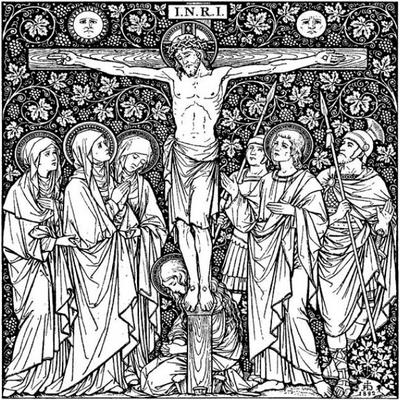
Prayer before a Crucifx:
Look down upon me, good and gentle Jesus, while before Thy face I humbly kneel, and with burning soul I pray and beseech Thee to fix deep in my heart lively sentiments of faith, hope and charity, true contrition for my sins, and a firm purpose of amendment; while I contemplate with great love and tender pity Thy five wounds, pondering over them within me, having in mind the words which David Thy prophet said of Thee, my Jesus: "They have pierced my hands and my feet; they have numbered all my bones."
Collect:
God our Father, in obedience to you your only Son accepted death on the cross for the salvation of mankind. We acknowledge the mystery of the cross on earth. May we receive the gift of redemption in heaven. We ask this through our Lord Jesus Christ, your Son, who lives and reigns with you and the Holy Spirit, one God, for ever and ever.
Fr. Paul's homily: 9-11
Fr. Paul Beach from the Archdiocese of Louisville, was my spiritual director before I came here. I think I may post his homilies regularly; I always get alot out of them. Here is his homily for Sun Sept 11:
Homily for Twenty-Fourth Sunday in Ordinary Time
September 11, 2005
As people who live in our 21st century society, we are very accustomed to a certain way of life. There are certain principles that we live by. One of the most foundational of these principles is that we should get what we pay for.
Earlier this week, I stopped at a McDonald’s on my way to a meeting in Louisville to get a bite to eat for breakfast. Two apple pies and a large coffee: the staple of my diet… Since the coffee is always served scalding hot, I ate my two apple pies first, giving the coffee time to cool down a bit. Three or four miles down the road I popped off the top and much to my chagrin, the cup was barely more than half full. Admittedly, I was immediately a little upset. The first thought in my mind was: "hey, I paid for a large cup of coffee, not a small one." I even felt a bit cheated. Now this was just an incredibly small matter: it’s just a cup of coffee.
I’m happy to say that I didn’t turn around and go back to complain. But how easily this small event caused such a reaction in me. It’s evidence of this attitude we all have to some degree. I want to get what’s coming to me. If I pay my fifty dollars for a gallon of gas, I want every last drop of that gallon… and not a drip less.
Our gospel this weekend, however, portrays a different picture. Our Lord reminds us that sometimes we shouldn’t really want what’s coming to us.
It’s safe to say: no one here is without sin. Not one person in this church doesn’t have something that they regret having said or done. It’s simply a fact: there have only been two people in the history of the world who were sinless, and I’m not one of them. Our actions, we are reminded, have consequences. We live in a world where what we say and do have an effect, good or bad, on ourselves and the people around us.
The story of our gospel this weekend reminds us of two essential elements of our Christian faith. First of all is that God is willing, even anxious, to forgive us our sins. Jesus is continually calling people to recognize their need for forgiveness, and to turn to His heavenly Father. Jesus’ teachings are all characterized by this, He even forgave people their sins Himself. This was a scandal to His religious contemporaries, and is ultimately the reason He was crucified.
The second essential element of faith is that we must be willing to forgive. Repeatedly Jesus speaks of this throughout His life and ministry. "Love one another as I have loved you," is His great commandment to His disciples. When His disciples asked Him how to pray He taught them to say the words: "forgive us our trespasses as we forgive those who trespass against us." Our gospel passage this weekend is a reiteration of these words. God forgives us our sins, and our response must be to share that forgiveness with others.
This, I’m convinced, is the most difficult element of our faith. Not giving up meat on Friday’s, not waking up early each morning to pray my breviary and celebrate Mass. But forgiving people. It’s even more difficult than asking God to forgive me my sins. One of the hardest things to do is forgive someone. It’s hard enough to forgive someone who asks me for forgiveness, it’s exponentially harder to forgive someone who doesn’t ask my forgiveness. But however difficult this may be, Jesus makes clear that we must do it, we must desire it.
If we must do this: if we must forgive someone, then I think it is helpful for us if we see this not so much as a personal initiative on our own part, but rather if we see it as primarily a response. A response to the first action of God forgiving us.
The gospel passage we have just heard depicts the story of a man who made a crucial mistake in faith. He recognized his own need for forgiveness, but failed to recognize the need to share that forgiveness with his brother. He wanted what was coming to him. How different is our faith from some of the most basic attitudes our society operates upon. Let’s pray that God might strengthen us to share His forgiveness.
Which Saint Are You?

You are Joan of Arc! You don't really want to hurt
anyone, but if they attack your friends or your
country and no-one else will stand up to fight
them, you head into the battle. Beware though,
conviction tends to get you killed.
Which Saint Are You?
brought to you by Quizilla
Monday, September 12, 2005
Today, an insight, and a find
The link above provides an interesting little article on the etymology of the name, "Mary." Here's an excerpt:
In accordance with Jewish custom our Lady's parents named her eight days after her birth, and were inspired to call her Mary. The Hebrew name of Mary (in Latin Domina) means lady or sovereign; this Mary is in virtue of her Son's soveriegn authority as Lord of the World. We call Mary our Lady as we call Jesus our Lord, and when we pronounce her name we affirm her power, implore her aid and place ourselves under her protection.
Also, here's an insight on the rosary that I found helpful from St. Louis de Montfort's little treatise, The Secret of the Rosary (or online here). This could really apply to prayer in general:
This faith must be lively and informed by charity; in other words, to recite properly the Rosary, it is necessary to be in God's grace, or at least in quest of it. This faith must be strong and constant, that is, one must not be looking for sensible devotion and spiritual consolation in the recitation of the Rosary; nor should one give it up because his mind is flooded with countless involuntary distractions or one experiences a strange distaste in the soul and an almost continual and oppressive fatique in the body. Neither feeling, nor consolation, nor sighs, nor transports, nor the continual attention of the imagination are needed; faith and good intentions are quite enough. "Faith alone suffices" (From the Pange Lingua)
-- The Eleventh Rose: The Creed
Sunday, September 11, 2005
Fides Et Ratio and the Seat of Wisdom
At the end of JPII's Fides Et Ratio, on the relationship between Faith and Reason, he turns at last to our Mother, the patroness of St. Mary's Seminary, Our Lady Seat of Wisdom (Sedes Sapientiae):
Sedes Sapientiae, ora pro nobis.I turn in the end to the woman whom the prayer of the Church invokes as Seat of Wisdom, and whose life itself is a true parable illuminating the reflection contained in these pages. For between the vocation of the Blessed Virgin and the vocation of true philosophy there is a deep harmony. Just as the Virgin was called to offer herself entirely as human being and as woman that God's Word might take flesh and come among us, so too philosophy is called to offer its rational and critical resources that theology, as the understanding of faith, may be fruitful and creative. And just as in giving her assent to Gabriel's word, Mary lost nothing of her true humanity and freedom, so too when philosophy heeds the summons of the Gospel's truth its autonomy is in no way impaired. Indeed, it is then that philosophy sees all its enquiries rise to their highest expression. This was a truth which the holy monks of Christian antiquity understood well when they called Mary "the table at which faith sits in thought." In her they saw a lucid image of true philosophy and they were convinced of the need to philosophari in Maria.
May Mary, Seat of Wisdom, be a sure haven for all who devote their lives to the search for wisdom. May their journey into wisdom, sure and final goal of all true knowing, be freed of every hindrance by the intercession of the one who, in giving birth to the Truth and treasuring it in her heart, has shared it forever with all the world.-- paragraph 108
Friday, September 09, 2005
yesterday and today
Happy Birthday to you!
Happy Birthday to you!
Happy Birthday dear Blessed Mother!
Happy Birthday to you!
Today we had pictures made for our ID cards and we all had to wear clerics. So today was officially the first day I'd ever put on a clerical shirt before. I felt kinda weird but I'm not really sure why.
Classes are great so far. At some point I'll post about what I'm doing in each one.
Also today I chose my spiritual director. We got an email with the priests on and off campus who had openings. Only a few were on campus so I felt pressure to choose one of them because the gas prices are so high that I'd rather not drive all over 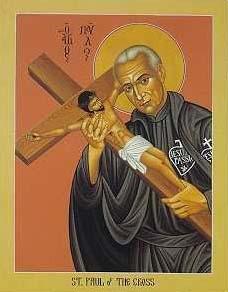 Maryland, yunno what I mean? But I've been wracking my brain since I've been here on who I should choose. I take this decision very seriously. First I was hung up on the whole liberal/conservative thing and if I should pick someone likeminded or not or if that even matters. Then I decided it doesn't and what really matters is A:) If he is personally holy and B:) If he could discern well the movement of the Holy Spirit, or lack thereof, in my life. I tend to get all bent outta shape with decisions like this! So I decided to pray one decade of the rosary for Mary's intercession. Since today is Friday, the day of the Sorrowful Mysteries, I was meditating on our Blessed Lord's agony in the garden. I didn't realize until the 8th Hail Mary that His agony in the garden was part of his Passion. Then I rememberd that one of the priests that I was thinking about choosing is in fact a Passionist. So I decided to go with him. I sent him an email and am waiting for his response. Thank you Blessed Mother for your guidance.
 Maryland, yunno what I mean? But I've been wracking my brain since I've been here on who I should choose. I take this decision very seriously. First I was hung up on the whole liberal/conservative thing and if I should pick someone likeminded or not or if that even matters. Then I decided it doesn't and what really matters is A:) If he is personally holy and B:) If he could discern well the movement of the Holy Spirit, or lack thereof, in my life. I tend to get all bent outta shape with decisions like this! So I decided to pray one decade of the rosary for Mary's intercession. Since today is Friday, the day of the Sorrowful Mysteries, I was meditating on our Blessed Lord's agony in the garden. I didn't realize until the 8th Hail Mary that His agony in the garden was part of his Passion. Then I rememberd that one of the priests that I was thinking about choosing is in fact a Passionist. So I decided to go with him. I sent him an email and am waiting for his response. Thank you Blessed Mother for your guidance.

At 3:00pm we've got a Bocce Ball tournament. Me and my d.b. (diocesan brother), Michael Wimsatt, are going to be partners. Go Archdiocese of Louisville!!
God Bless
Tuesday, September 06, 2005
More books! and a brief explanation
Last week I found out that two classes I took in college, American Identity and Culture & Values, are going to count for History of Western Civ I and II. So rather than take Western Civ I this sememster, I'm taking Contemporary Issues in Philosophy... which I'm very excited about. The first class was today.
Here's the required texts:
The Closing of the American Mind, by Allan Bloom
Culture Wars: The Struggle to Define America, by James Davison Hunter
Equality by Default: An Essay on Modernity as Confinement, by Philippe Beneton
An Intellectual History of Liberalism, by Pierre Manent
Sweeet.
...oh and don't worry Anne, I kept my Western Civ book :)
Now I'm looking forward to meeting with my mentor for the first time and finding a spiritual director amongst the faculty.
Finally, I wanted to briefly explain why I titled my previous post, "Mysterious Mystery at St. Mary's"
I was adoring Our Lord in the Blessed Sacrament during the Holy Hour on Wednesday and was contemplating my role at St. Mary's, how and why I was adoring Our Blessed Lord here in this place. I grew frustrated, as I'm accustomed to doing, because most of the hour seemed dry and unfeeling. But I reassured myself (listen closely dear readers) that's it's not about me feeling something in particular, it's about what Archbishop Timothy Dolan calls, "making a sacrifice of time." It's about spending time with our Lord simply because he deserves our time, adoration, and worship. Then I came to one realization toward the end of the hour. It's certainly by no means an exhaustive answer to the question I was asking our Lord, as I trust he will continue to unfold that answer to me as, God-willing, the years go by. But what I did come away with (to tide me over for now :) was the great Mercy he is showing me by calling me to seminary.
Here I am, in an evironment of routine prayer and formation where I can focus intently on my pursuit of holiness without the distractions of the "outside" world. Here I am in a place where I must pray morning and evening prayer every day and am highly encouraged to pray the other hours of the day as well! Here I am in a place where I must go to Mass every day! Here I am where spiritual reading and writing must take up a majority of my time! What Mercy He has shown me!
Now, granted, St. Josemaria Escriva would argue that one doesn't need to go to seminary or some far off retreat to be holy. One can be holy, even a saint, in his normal workaday state in life:
But, God called me out of my place to be here. I did need to go away, to retreat. This is the mystery I'm discerning.
Sedes sapientiae, ora pro nobis
Here's the required texts:
The Closing of the American Mind, by Allan Bloom
Culture Wars: The Struggle to Define America, by James Davison Hunter
Equality by Default: An Essay on Modernity as Confinement, by Philippe Beneton
An Intellectual History of Liberalism, by Pierre Manent
Sweeet.
...oh and don't worry Anne, I kept my Western Civ book :)
Now I'm looking forward to meeting with my mentor for the first time and finding a spiritual director amongst the faculty.
Finally, I wanted to briefly explain why I titled my previous post, "Mysterious Mystery at St. Mary's"
I was adoring Our Lord in the Blessed Sacrament during the Holy Hour on Wednesday and was contemplating my role at St. Mary's, how and why I was adoring Our Blessed Lord here in this place. I grew frustrated, as I'm accustomed to doing, because most of the hour seemed dry and unfeeling. But I reassured myself (listen closely dear readers) that's it's not about me feeling something in particular, it's about what Archbishop Timothy Dolan calls, "making a sacrifice of time." It's about spending time with our Lord simply because he deserves our time, adoration, and worship. Then I came to one realization toward the end of the hour. It's certainly by no means an exhaustive answer to the question I was asking our Lord, as I trust he will continue to unfold that answer to me as, God-willing, the years go by. But what I did come away with (to tide me over for now :) was the great Mercy he is showing me by calling me to seminary.
Here I am, in an evironment of routine prayer and formation where I can focus intently on my pursuit of holiness without the distractions of the "outside" world. Here I am in a place where I must pray morning and evening prayer every day and am highly encouraged to pray the other hours of the day as well! Here I am in a place where I must go to Mass every day! Here I am where spiritual reading and writing must take up a majority of my time! What Mercy He has shown me!
Now, granted, St. Josemaria Escriva would argue that one doesn't need to go to seminary or some far off retreat to be holy. One can be holy, even a saint, in his normal workaday state in life:
"How anxious people are to get out of place! Think what would happen if each bone and each muscle of the human body wanted to occupy some position other than its own. There is no other reason for the world's discontent. Continue where you are, my son; right where you are... how much you'll be able to work for the true kingdom of our Lord!" --The Way #832
"your perfection consists in living perfectly in the place, occupation and position in which God, through those in authority, has assigned you." -- The Way #926
But, God called me out of my place to be here. I did need to go away, to retreat. This is the mystery I'm discerning.
Sedes sapientiae, ora pro nobis
Subscribe to:
Posts (Atom)