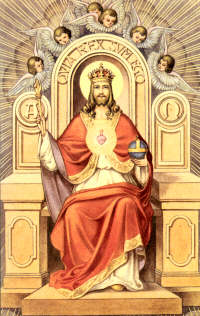
Saturday, February 11, 2006

The Ministry of Lector

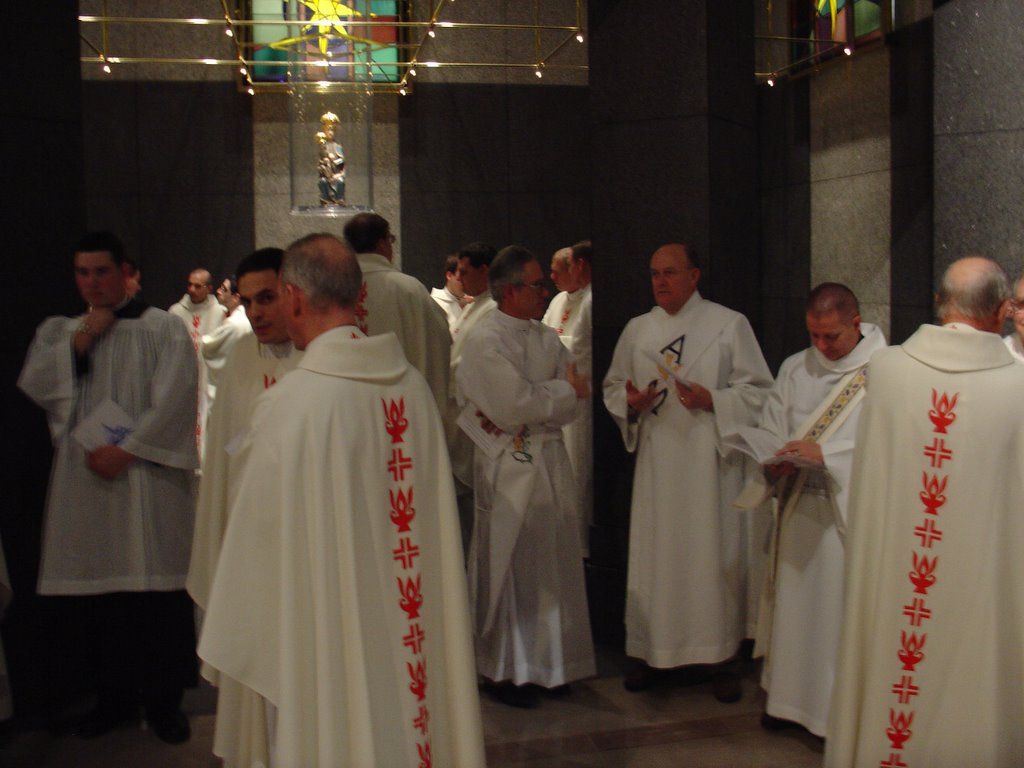
Wednesday Feb 8, 2006 I had the honor and grace to receive the Ministry of Lector from Most Reverend Michael R. Cote, D.D., Bishop of Norwich, CT here at St. Mary's Seminary & University, Baltimore, MD.

Vested Concelebrants:
Most Revered Paul G. Bootkoski, D.D., Bishop of Metuchen, NJ
Revered Robert F. Leavitt, S.S., President/Rector, St. Mary's Seminary & University

That day was a beautiful day. I woke up refreshed which is quite a rarity and happened to be assigned to read at Morning Prayer which I thought was awesome, given that I would be instituted as a Lector later that same day. I think I did a pretty good job.

That morning at practice for the mass/ceremony we were told in what order we'd approach the bishop. We'd go up in two's and I was happy to see that I'd be kneeling beside one of my best friends here at St. Mary's, Dan, who's been in a couple posts on this blog (here and here). The practice went well and I was excited for the Mass to come. This would be my first step, God-willing, to Ordination in 2010.

During the ceremony I goofed a little bit, I'm always so absent-minded! When we got to the head of the line, we were supposed to bow, approach the bishop, kneel, place our hands on the Bible as he read the words of institution, say Amen, stand up, bow, turn inward and walk to the end of the line. Well, I forgot to bow and started to turn, then I remembered so I kinda threw the "choreography" off a little bit. Oh well :)

Afterwards I got a picture with Bishop Cote and Dan that I hope to get soon and post here.

Here's the rite:
CALLING OF CANDIDATES
After the gospel, the bishop, wearing his miter, sits, and the appointed deacon or priest calls the candidates:
Those to be instituted in the ministry of reader please come forward.
The candidates are called by name, and each one answers: Present, and goes to the bishop, before whom he makes a sign of reverence.
HOMILY
Then all sit, and the bishop gives the homily, which he concludes by speaking to the candidates in these or similar words:

Dear sons in Christ, through his Son, who became man for us, God the Father has revealed the mystery of salvation and brought it to fulfillment. Jesus Christ made all things known to us and then entrusted his Church with the mission of preaching the Gospel to the whole world.

As readers and bearers of God's word, you will assist in this mission, and so take on a special office within the Christian community; you will be given a responsibility in the service of the faith, which is rooted in the word of God. You will proclaim that word in the liturgical assembly, instruct children and adults in the faith, and prepare them to receive the sacraments worthily. You will bring the message of salvation to those who have not yet received it. Thus with your help men and women will come to know God our Father and his Son Jesus Christ, whom he sent, and so be able to reach eternal life.

In proclaiming God's word to others, accept it yourselves in obedience to the Holy Spirit. Meditate on it constantly, so that each day you will have a deeper love of the Scriptures, and in all you say and do show forth to the world our Savior, Jesus Christ.
INVITATION TO PRAYER
Then all stand, and the bishop, whithout his miter, invites the people to pray:
Brothers and sisters, let us ask God our Father to bless these servants who have been chosen for the ministry of reader. Let us pray that they may be faithful to the work entrusted to them, proclaim Christ to the world, and so give glory to our Father in heaven.
All pray in silence for a brief period.
PRAYER
Then the bishop, with hands joined, continues:
Lord God,
source of all goodness and light,
you sent your only Son, the Word of life,
to reveal to mankind the mystery of your love.
Bless + our brothers
who have been chosen for the ministry of reader.
Grand that as they meditate constantly on your word
they may grow in its wisdom
and faithfully proclaim it to your people.
We ask this through Christ our Lord.
R. Amen.
INSTITUTION
Each candidate goes to the bishop, who gives him the Bible, saying:
Take this book of holy Scripture
and be faithful in handing on the word of God,
so that it may grow strong in the hearts of his people.
The reader answers:
Amen.
Meanwhile, Psalm 19 or another appropriate song may be sung, especially if there are many candidates.

O Venerable Bede, patron saint of Lectors and Doctor of the Church, pray for us!

Pics from the March for Life


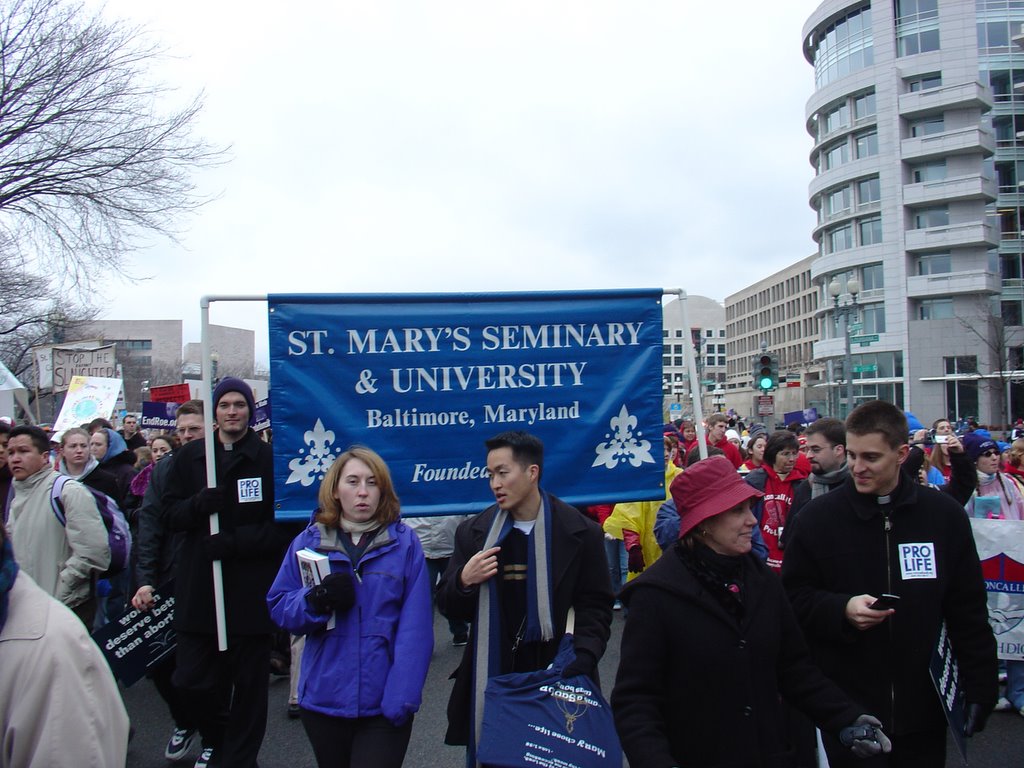
(l) The youth march outside the MCI Center (r) Our St. Mary's banner at the main march


(l) My d.b. Michael carries the banner (r) Jonathan with a sign that says "women deserve better than abortion" and Dan prays the rosary


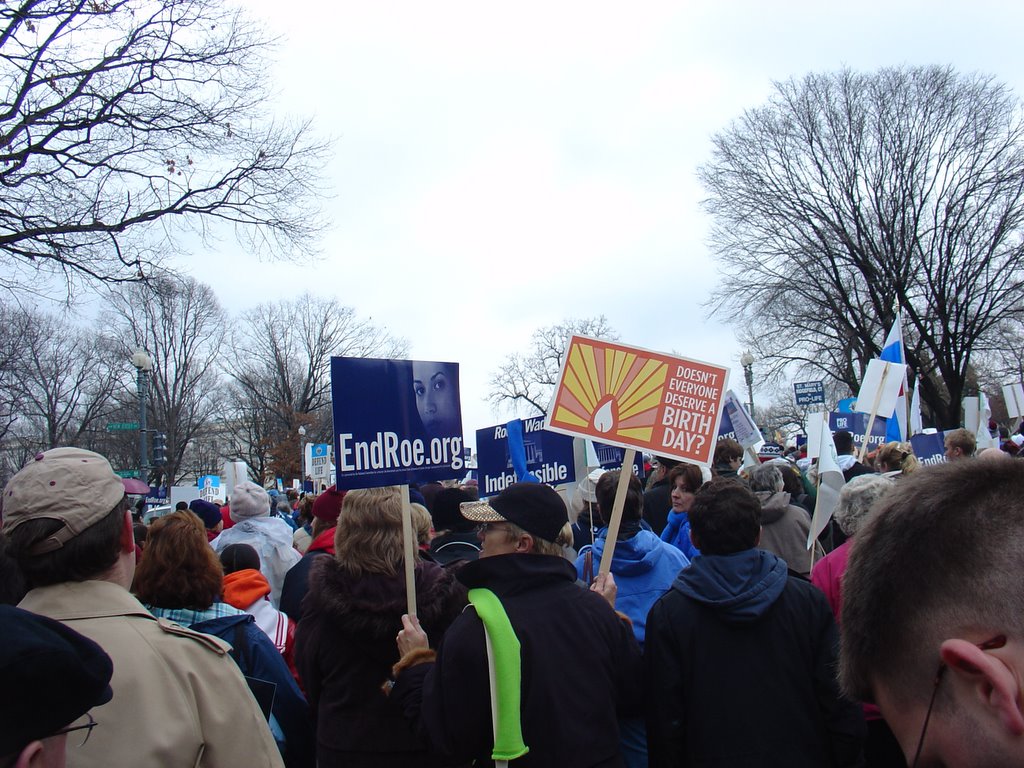
(l) Marching alongside brothers from the Dominican House of Studies in D.C. (r) Two signs that say "EndRoe.org" and "Doesn't everyone deserve a birthday?" The one between and behind them says "Roe v Wade: Indefensible"

Wednesday, February 01, 2006

More Pro-Life Pics

Last week was crazy and this week hasn't been very hot so far either. So I'm just now getting around to posting more pics of the Pro-Life weekend in D.C., as I like to call it. I mentioned in my previous post that I wished I could portray better the size of the Basilica to those who haven't been there. Here's a pic I took in Fall '05:


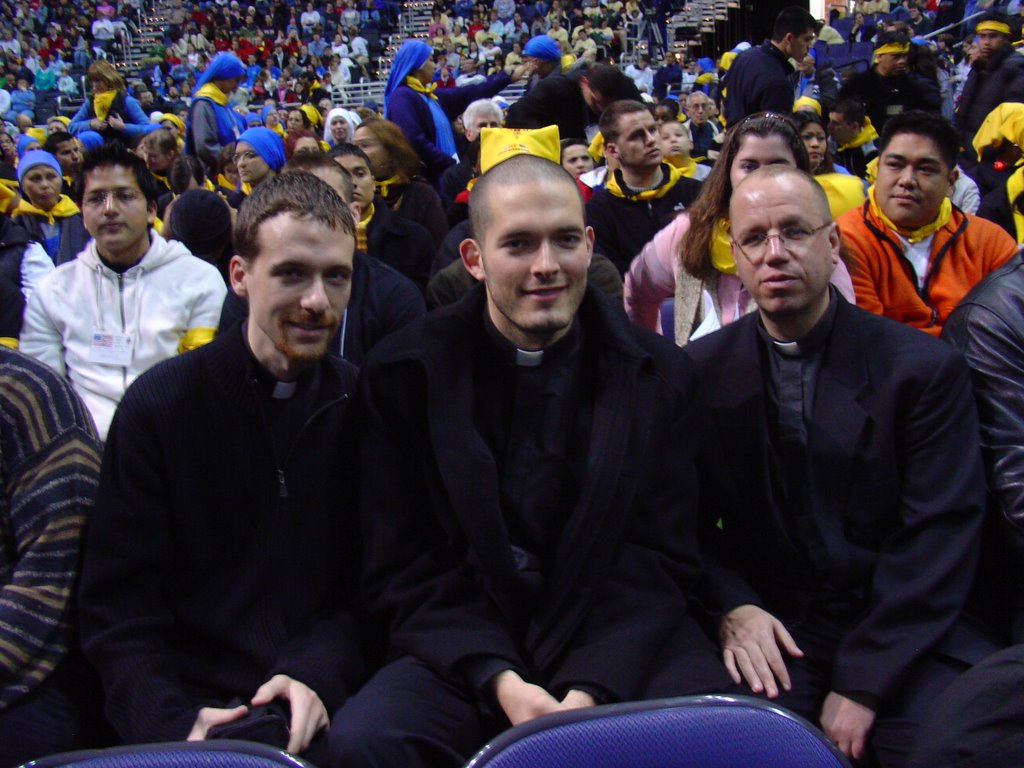
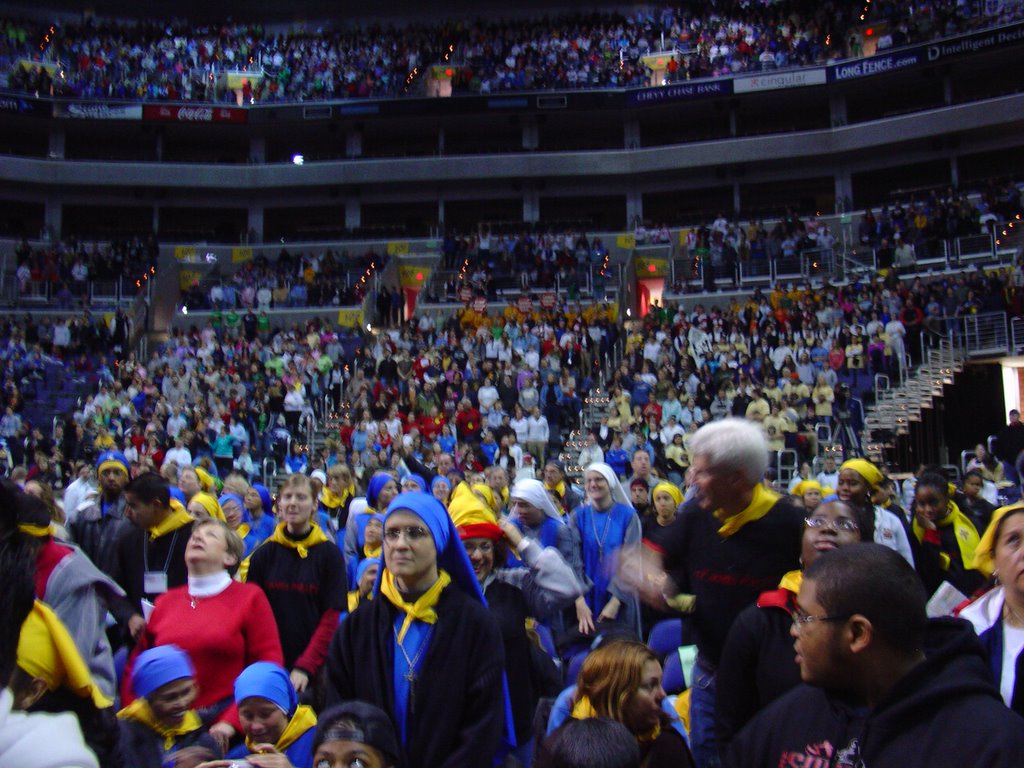
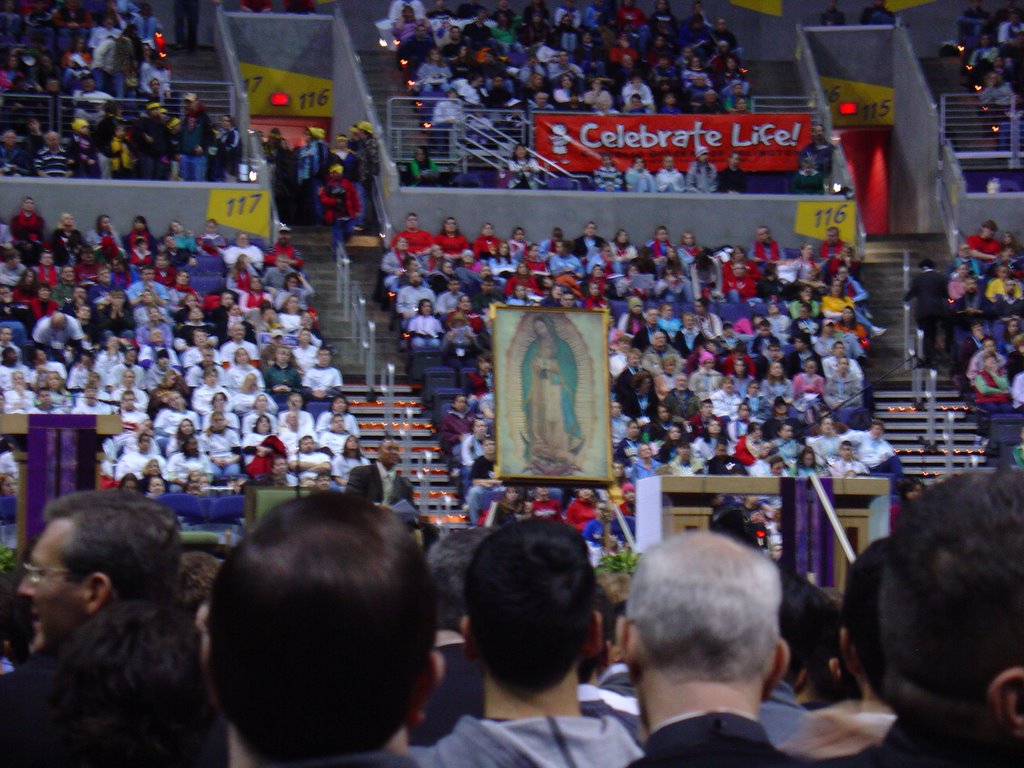
Now, on to the Youth Mass for Life at the MCI Center. This thing was packed too. The floor was packed with seminarians, priests, and religious sisters and brothers while all the seats (20,000 of 'em) in the house were filled with youth and young adults from across the country. The priest in charge of Pastoral Formation and a few others from St. Mary's were part of the unfortunate group of 2000 people who couldn't even get in! It was an awesome Mass. As it was a youth Mass you had a lot of the popular Catholic musicians like Fr. Stan Fortuna et al and the music was typical praise and worship but without being obnoxious. The Mass was still very reverent. They had a wonderful youth gospel choir from one of the local Catholic high schools.

This was my first time going and I was glad to be able to go as a seminarian. One thing I had heard about and was anxious to see is the bit after Mass where Cardinal McCarrick does a little vocation promotion. First he asked all the seminarians to stand up. When we all did we received a very encouraging standing-o. Then he asked any young men who were thinking about or discerning the priesthood to stand up. I was so happy to see guys stand up from all over the place. The seminarians stood up and gave them a long applause with many confirming head-nods, hand-shakes, and waves. Then the Cardinal did the same for the women religious and young ladies. It was great to see so many youth on fire for the pro-life movement, discerning their vocation, and most especially our Blessed Lord in the Mass.

Uh oh...watch out now... I present to you...The Louisville Coalition!

That's me, Michael Wimsatt, and Fr. Gladstone "Bud" Stevens, a Sulpician from the Archdiocese of Louisville. He's been on the faculty for about 4 years or so and is the Dean of Students. I had him last semester for Intro to Catholic Theology and Epistemology. All I can say is the man is top notch in many many ways... and I'm not just saying that because he's the Dean!

It's just Mike and I here at St. Mary's (and we have a couple guys elsewhere), but I have no worries, my prediction still stands ;)

More pics of the faithful:


Coming up: Pics and comments on the March for Life.

St. Gianna Beretta Molla, pray for us.

Wednesday, January 25, 2006

Pope Benedict XVI's New Encyclical

We preempt this series of pics from last weekend to bring you our Holy Father, Pope Benedict XVI's new encyclical, Deus Caritas Est ("God is Love").
ENCYCLICAL LETTER
DEUS CARITAS EST
OF THE SUPREME PONTIFF
BENEDICT XVI
TO THE BISHOPS
PRIESTS AND DEACONS
MEN AND WOMEN RELIGIOUS
AND ALL THE LAY FAITHFUL
ON CHRISTIAN LOVE

INTRODUCTION

1. “God is love, and he who abides in love abides in God, and God abides in him” (1 Jn 4:16). These words from the First Letter of John express with remarkable clarity the heart of the Christian faith: the Christian image of God and the resulting image of mankind and its destiny. In the same verse, Saint John also offers a kind of summary of the Christian life: “We have come to know and to believe in the love God has for us”.
We have come to believe in God's love: in these words the Christian can express the fundamental decision of his life. Being Christian is not the result of an ethical choice or a lofty idea, but the encounter with an event, a person, which gives life a new horizon and a decisive direction. Saint John's Gospel describes that event in these words: “God so loved the world that he gave his only Son, that whoever believes in him should ... have eternal life” (3:16). In acknowledging the centrality of love, Christian faith has retained the core of Israel's faith, while at the same time giving it new depth and breadth. The pious Jew prayed daily the words of the Book of Deuteronomy which expressed the heart of his existence: “Hear, O Israel: the Lord our God is one Lord, and you shall love the Lord your God with all your heart, and with all your soul and with all your might” (6:4-5). Jesus united into a single precept this commandment of love for God and the commandment of love for neighbour found in the Book of Leviticus: “You shall love your neighbour as yourself” (19:18; cf. Mk 12:29-31). Since God has first loved us (cf. 1 Jn 4:10), love is now no longer a mere “command”; it is the response to the gift of love with which God draws near to us.

In a world where the name of God is sometimes associated with vengeance or even a duty of hatred and violence, this message is both timely and significant. For this reason, I wish in my first Encyclical to speak of the love which God lavishes upon us and which we in turn must share with others. That, in essence, is what the two main parts of this Letter are about, and they are profoundly interconnected. The first part is more speculative, since I wanted here—at the beginning of my Pontificate—to clarify some essential facts concerning the love which God mysteriously and gratuitously offers to man, together with the intrinsic link between that Love and the reality of human love. The second part is more concrete, since it treats the ecclesial exercise of the commandment of love of neighbour. The argument has vast implications, but a lengthy treatment would go beyond the scope of the present Encyclical. I wish to emphasize some basic elements, so as to call forth in the world renewed energy and commitment in the human response to God's love.

Tuesday, January 24, 2006

Pro-Life Mass and March

Yesterday marked the 33rd Anniversary of Roe v Wade and the March for Life in Washington, D.C. I had been three times before but this was my first time as a seminarian. It was an amazing experience to participate in this capacity. Seeing the overwhelming numbers and support of seminarians from all over the country was very inspirational. I even got to join the procession of the Vigil Mass for Life in the Basilica of the National Shrine of the Immaculate Conception. The procession alone took 30 minutes! There were hundreds of seminarians, priests, and bishops. One thing that struck me the most was walking the long procession, winding through the crowd and seeing the faces of the thousands of faithful packed into the Basilica. All of their smiles and waves as we processed through were very encouraging and I could really feel the love of the Universal Church for her seminarians. And now...here's some pics:

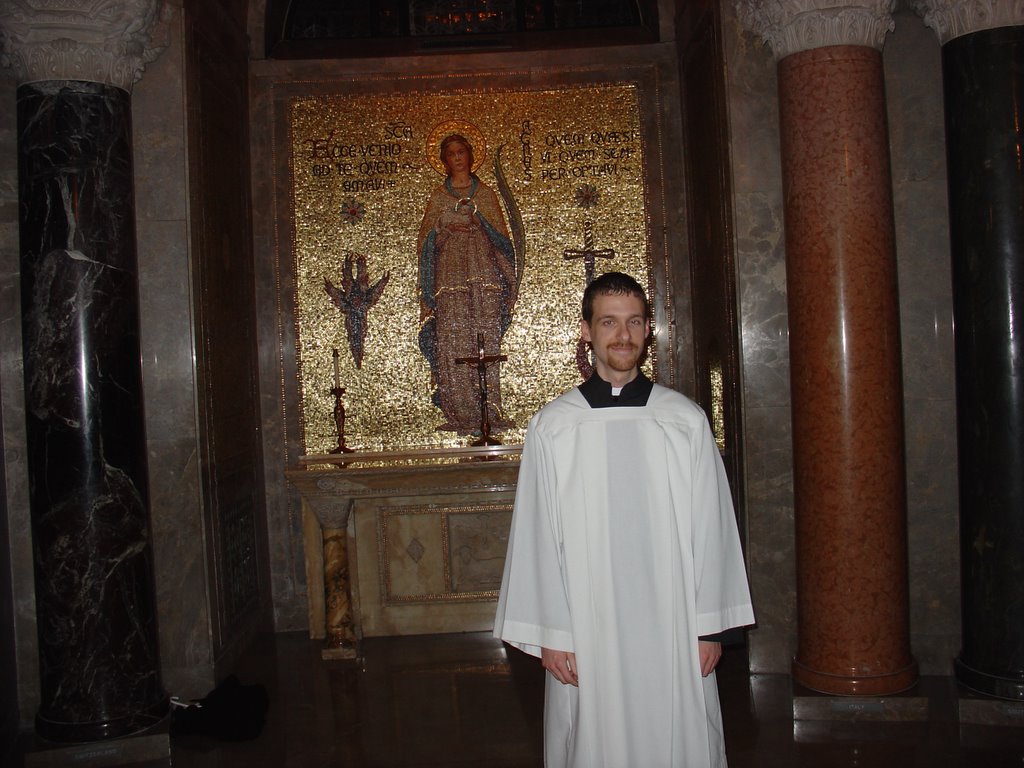
Here is one of my best friends at St. Mary's, Dan Hoffman of the Diocese of Erie, PA, in front of the side altar of St. Agnes in the crypt church of the Basilica............... and me:


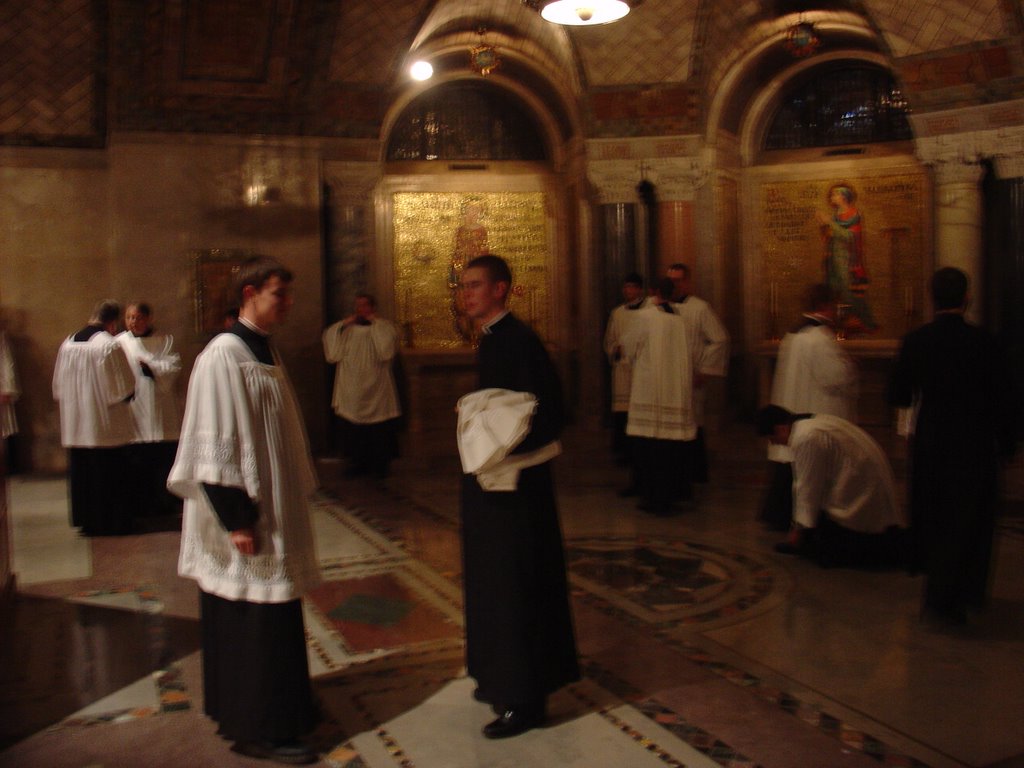
Here are just a few of the hundreds of seminarians who donned their cassocks and surplices to get ready for the procession and Mass..... wait for it.....wait for it.....P.O.D.!!
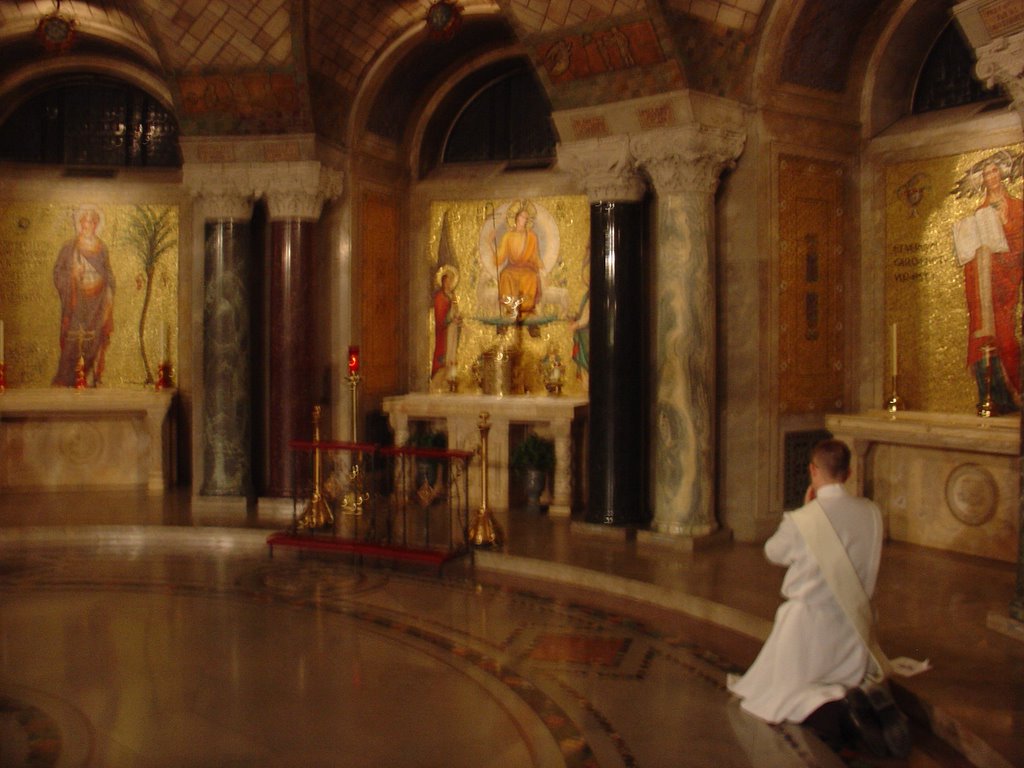
And a deacon prepares for Mass as well, in prayer before the tabernacle of the crypt church.


Here's a shot of the many, many priests vesting for Mass and the best shot I could get of Fr. Frank Pavone (I must admit I was a little star-struck!) - he's on the right.


Unfortunately, I didn't get any pictures of the main church. I can't explain well enough how huge the basilica is (largest Catholic Church in the Americas, top 10 largest of any church in the world) and how many thousands of people were packed in for Mass.

In future posts coming soon: Pics from the Youth Mass for Life at the MCI Center, and pics from the March for Life!

St. Gianna Beretta Molla, pray for us!

Tuesday, January 17, 2006

Just in case...

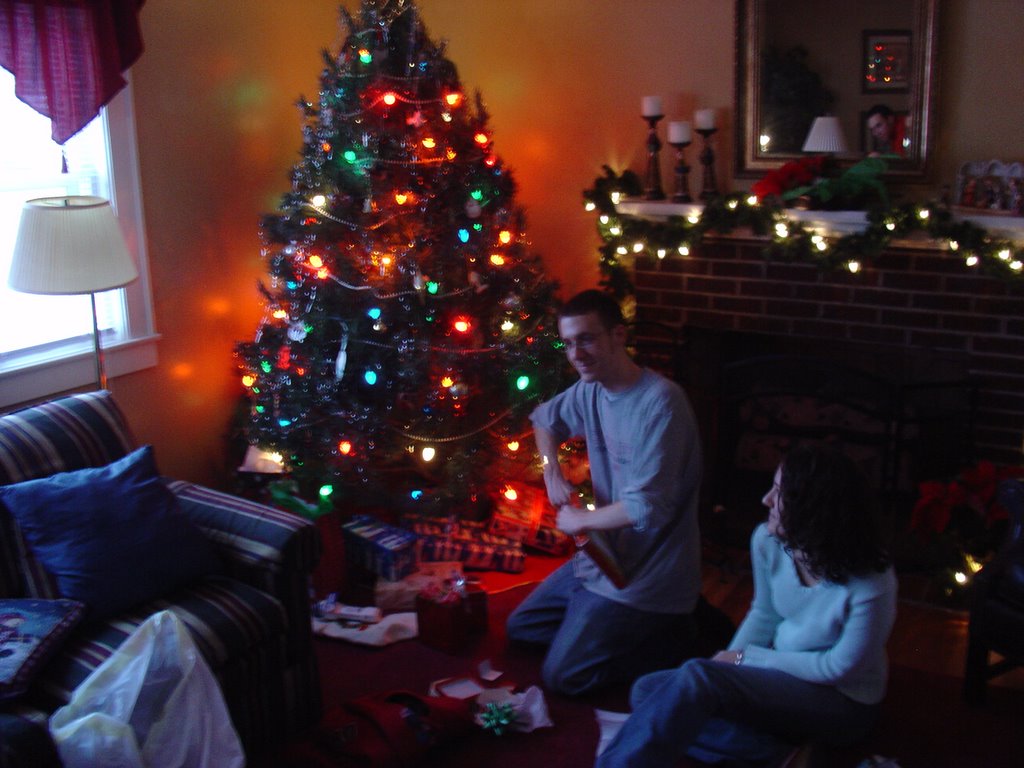
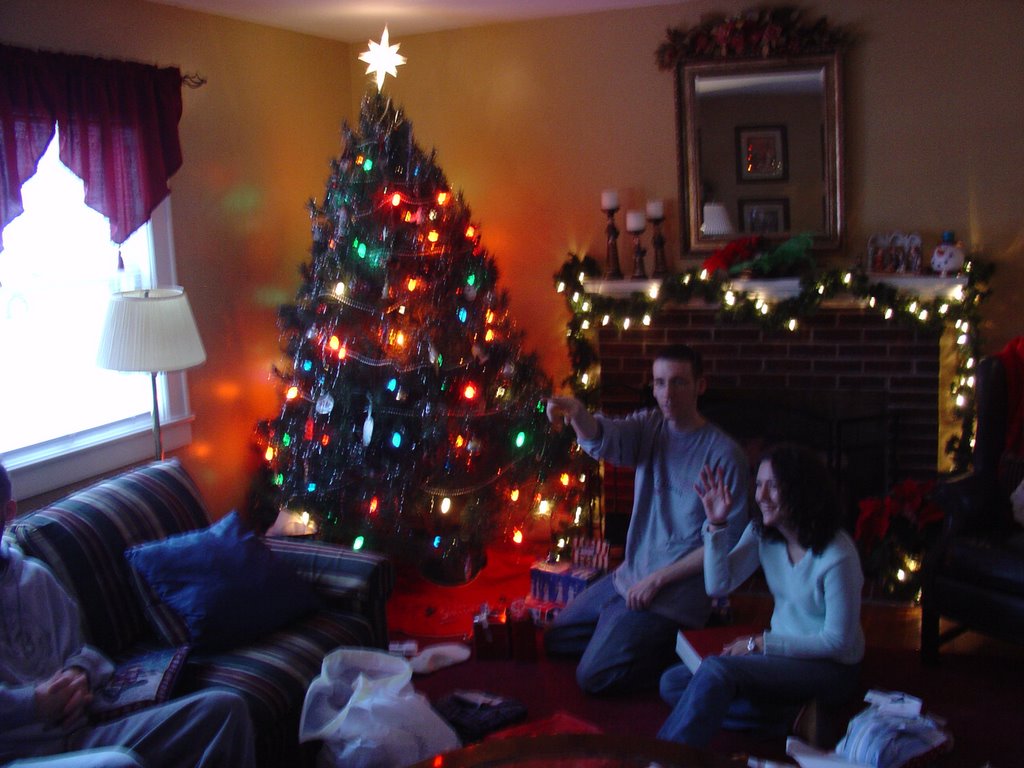
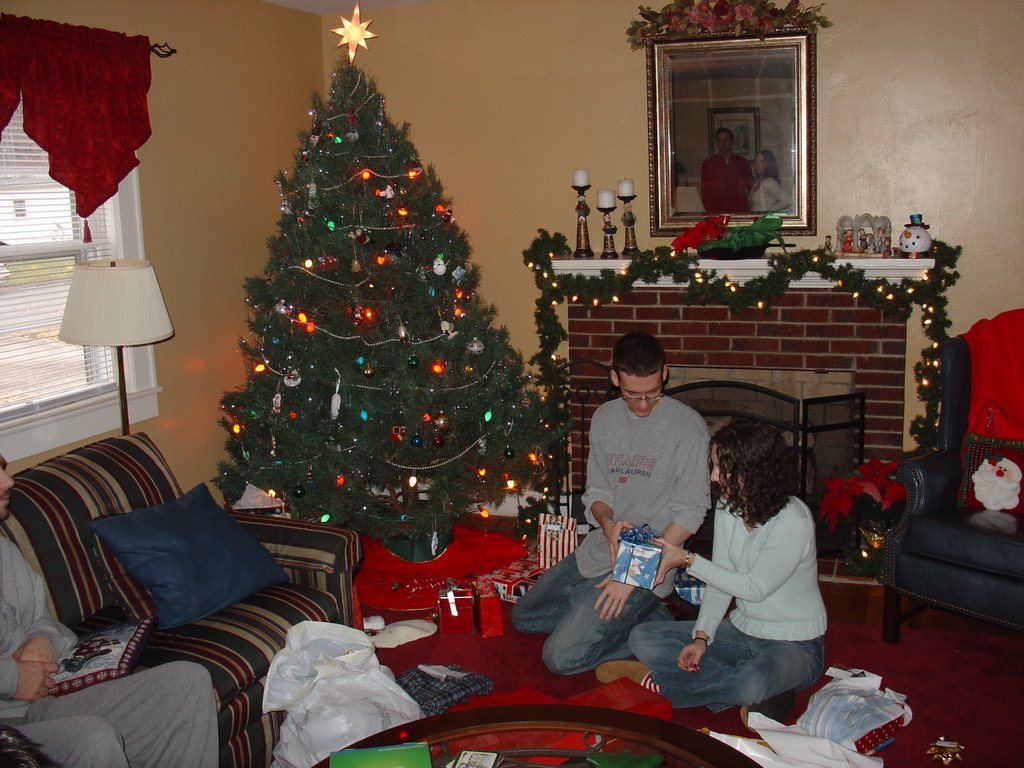
Just so we're clear and to prevent any scandal/formation issues with my seminary brethren, the pics in "My Christmas Break: Part 2" are NOT of me, but of my twin brother Nick... I promise! :)

Monday, January 16, 2006

My Christmas Break: Part 3

The third and final week of my Christmas Break was awesome too. I stayed and worked at Fr. Paul's parish (my old spiritual director). He has St. John the Apostle in Brandenburg and St. Martin of Tours in Flaherty, KY. The whole week was very busy with M.C.'ing daily Mass (with two on Sat and two on Sun), mass at the convent at St. John's, mass at the nursing home, hospital visits, work at the tribunal, and most memorable: An Anointing, death, and funural.

One day Fr. got a call from a lady he didn't recognize, asking him to come over because her neighbor was dying. I had brought my clerics home just in case I needed them... I didn't expect too... but Fr. asked me to put them on because he thought a time like this would be appropriate. So I hurried to change and couldn't find the tab for my collar! I finally had to borrow one from Fr. Paul and then I couldn't find my black dress shoes! I rumaged all through my stuff and in my car, finally found them, and we hurried on to the lady's house. We went down several country roads until we turned on one that led to her house only to find two cars side-by-side in the middle of the road talking to each other! We had to wait a couple minutes for them to finish and then finally go to their house. I was a little nervous because I'd never seen anyone die before. I asked Fr. Paul if there was anything special I should know. As he reached in his glovebox to get his holy oil and prayer book for Anointing of the Sick he said, "Just stand politely off so the side and don't say anything." "I can do that," I replied.

Apparantly the lady was on hospice care. She looked very old, laying in a recliner hooked up to a breathing machine thing, with all her family surrounding her, crying. A couple of the men there shook our hands quietly without saying anything. Fr. said later he didn't recognize any of them from his parishes. He thinks they were fallen-away Catholics because no one he talked to afterward had heard of the family. We knew they were Catholic because they all made the sign of the cross at the beginning of the Rite. Then Fr. Paul began:

Lord Jesus, you healed the sick:
Lord, have mercy.
R. Lord, have mercy

Lord Jesus, you forgave sinners:
Christ, have mercy.
R. Christ, have mercy

Lord Jesus, you give us yourself to heal us and bring us strength:
Lord, have mercy.
R. Lord, have mercy

May almighty God have mercy on us, forgive us our sins, and bring us to everlasting life.
R. Amen

He then did the Laying on of Hands, then anointed her forehead saying:
Through this holy anointing may the Lord in his love and mercy help you with the grace of the Holy Spirit.
R. Amen
And anointed her hands saying:
May the Lord who frees you from sin save you and raise you up.
R. Amen

Let us pray.
Father in heaven, through this holy anointing grant (Anna) comfort in her suffering. When she is afraid, give her courage, when afflicted, give her patience, when dejected, afford her hope, and when alone, assure her of the support of your holy people.
We ask this through our Christ our Lord.
R. Amen

Then we said the Our Father and Fr. Paul gave her a final blessing.

The above is what I can remember, looking at the Rite, that Fr. Paul said when we were there. I know he abbreviated the rite but it's all a little bit of a blur. I remember how profound it was though to be the only one saying the responses because everyone else was crying. I almost got choked up as we said the Our Father but I held it back because I knew I had to be strong for the family. Fr. Paul said later that it was nice having me there to say the responses because no one is ever able to. He also said he gave her the Apostolic Pardon but I don't remember that part.

Two minutes after he anointed her she died. I think I missed it too. When we first got there I noticed she was having the short rattley breathing that you hear about people having before they die. I made a point to listen to her breathing but then I got caught up in the prayers and the whole moment. I just said Hail Mary's over and over.

... "Holy Mary, Mother of God, pray for us sinners, now and at the hour of our death..."

I was standing sort of above and behind her with Fr. Paul and her family standing and kneeling in front and beside her. I didn't hear her final breath. The only reason I knew she died is because after the rite her daughter walked toward her to give her a kiss and then recoiled toward Father. It was then that I knew. I was surprised at how unassuming it was. She died peacefully and quietly with her family surrounding her. Then I glorified God and his Providence. Despite all the delays -- my having to change, find a tab, find my shoes, getting stuck behind two cars -- the timing of Father's anointing was perfect. It's like she was waiting for us to get there. There were some prayers after she died as well.

We stayed with the family for a while and then headed back to the rectory. On the way he got a call from one of his parishioners saying his mother had died earlier in the week. She died in a nursing home and for some reason Father didn't know about it. We went straight to his house to console him. His wife was a wonderful lady, very hospitable. He was on the phone when we got there, talking about arrangements with his brothers who were out of town. When he got off the phone other relatives showed up at the door and we all sat down together. He (I think his name was Joe) choked up a little bit here and there as he talked about what happened. I think he was in his 50's or 60's. He started to share a prayer that his mother had written before she died, but he started crying and couldn't finish it. We stayed with his family a while longer, discussing funeral plans, and then left.

That day we never heard from Anna's family about a funeral or anything. But we were in contact with Joe and the funeral Mass was scheduled for Friday. I got to serve my first funeral Mass. When it was time to insense the coffin I hadn't lit the charcoal well enough so barely any smoke came out... darnit... But, at the meal following the burial Joe's family was very thankful so I felt good about being a part of that too.

God, Father of Mercies, look with favor on Anna Pendleton and Joe's mother. Bring them into your kingdom where you reign forever and ever. Amen.
St. Mary, pray for us.

My Christmas Break: Part 2

The second week of my Christmas break, I spent with my family. It was great to hang out with them again plus I missed mom's cooking... and laundry! :) I saw a ton of my relatives too, which was nice. And also, Nick's new giiiiirlfriend came in town! hehe I was looking forward to meeting her, she's cool. And now, to embarrass Nick, here's some pics!


Monday, January 09, 2006

My Christmas Break: Part 1

Well, I'm back from Christmas break and anxious to update my blog, it's been a while.

I got back Saturday night after a ten hour drive and hit the ground runnin! Classes started back up today!

I have so much to say that I worry about how long this post may be!

During my break I spent one week in El Salvador, one week with the family, and one week working in a parish. It was a break filled with many excellent opportunities and experiences, probably the best Christmas break I've ever had. I have a ton of pictures so I'll share a few here and then maybe setup an online slideshow later.

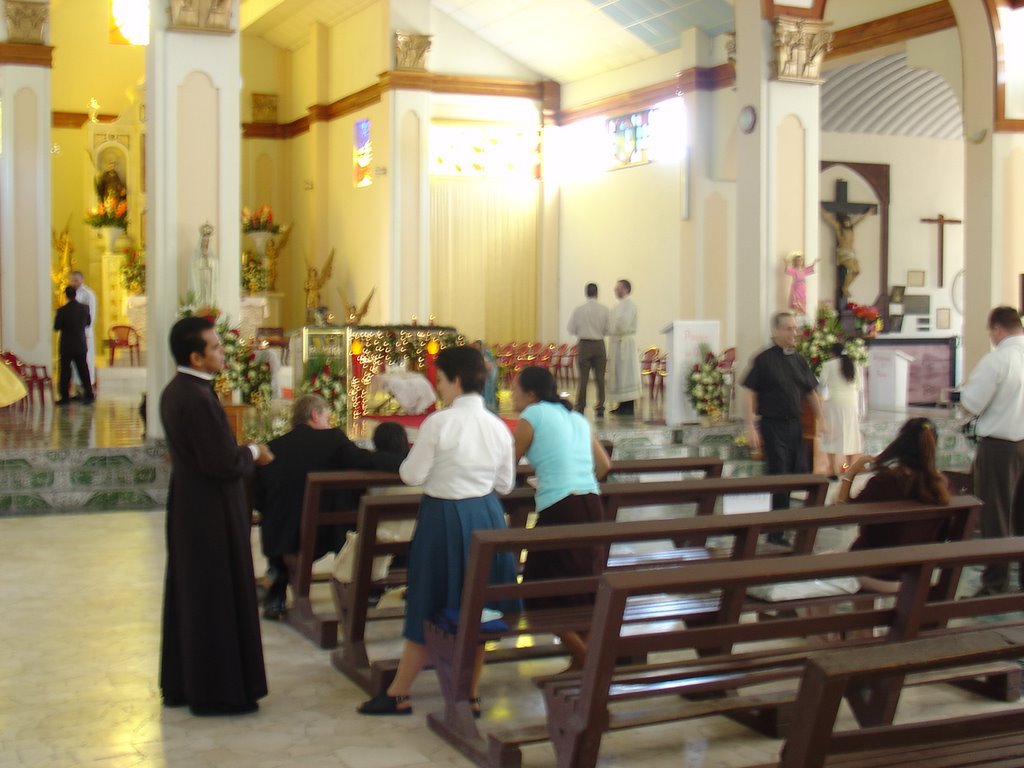
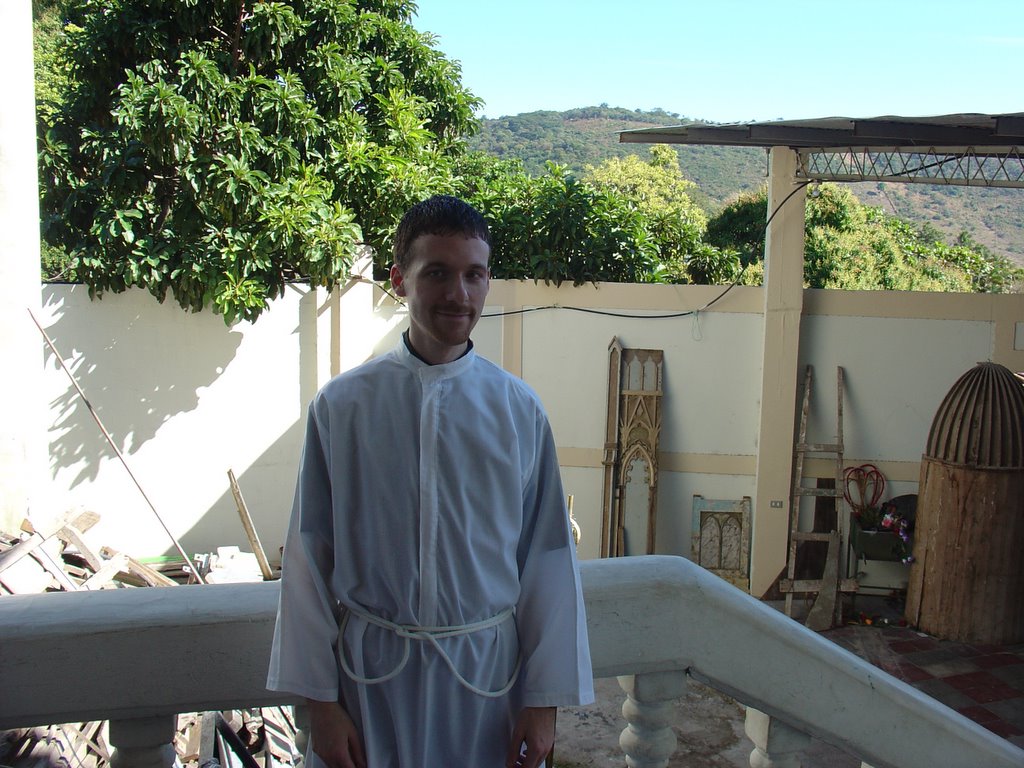
The trip to El Salvador was awesome. One of our seminarians, Pablo Hernandez, is from San Vicente and wanted his Diaconate Ordination to be in his home town. So my vocation director, a priest-friend of his, his associate, my brother seminarian Michael, and I flew down for it! I got to serve his ordination as the crosier bearer, which was an immense blessing.


Oh...and what's that? A priest in a cassock folks, that's P.O.D.
Here's me:

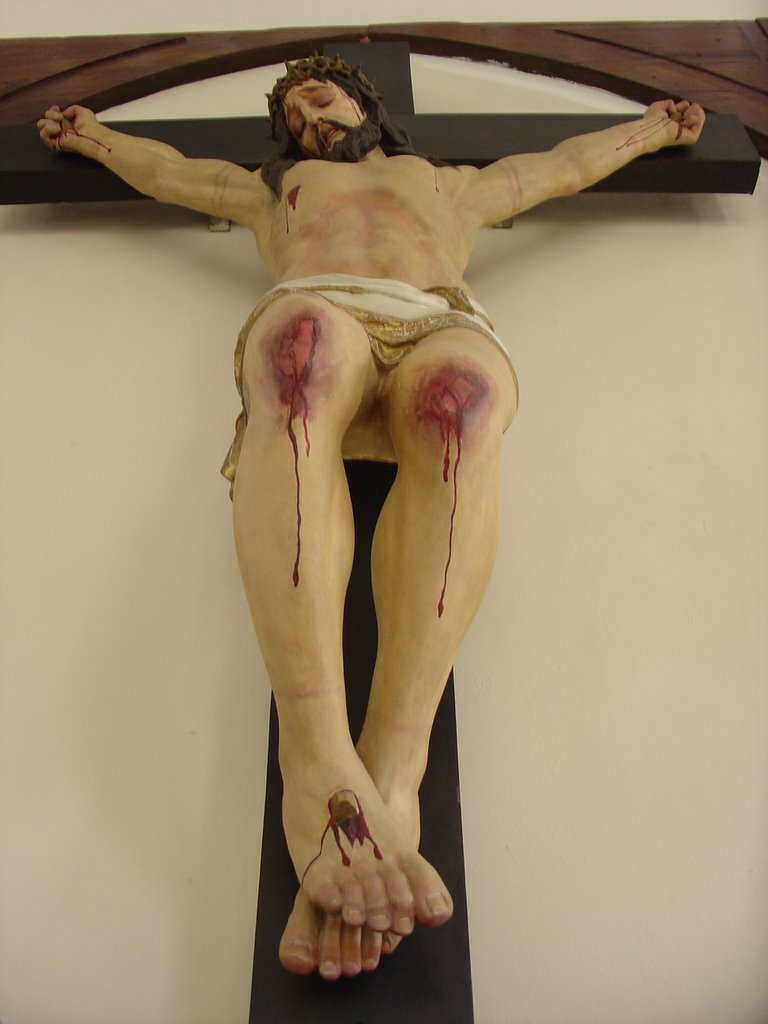
Now THAT'S a crucifix! I was speechless when I saw it...
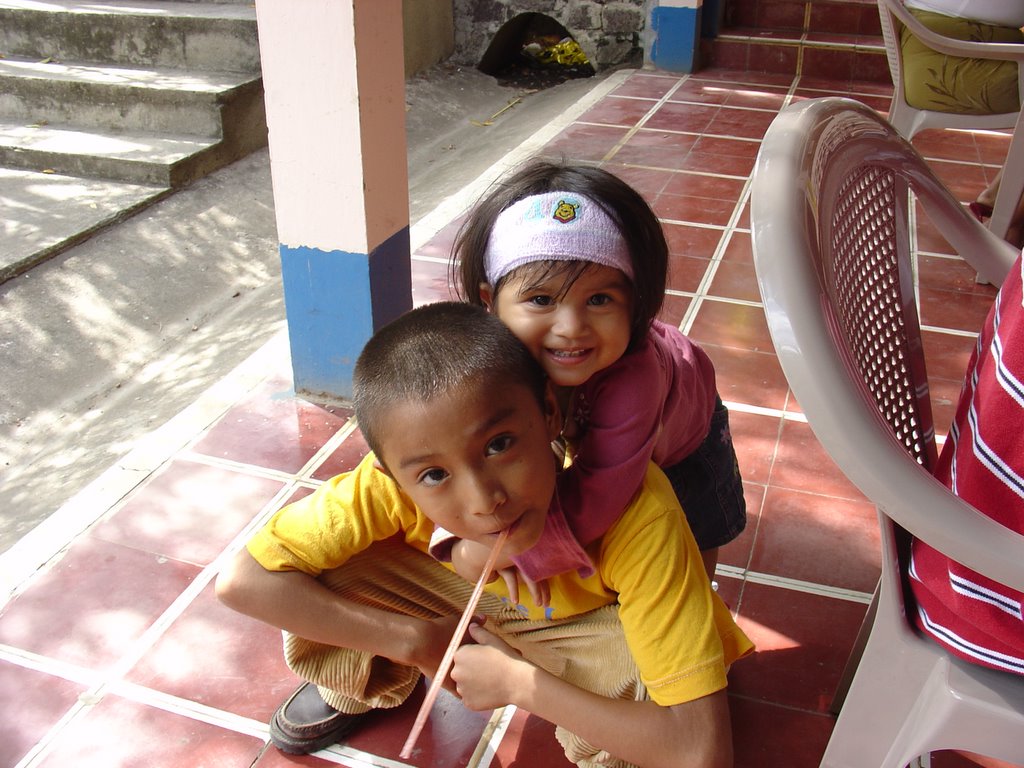
My pics of Pablo's nieces and nephews are my favorite of the hundreds I took. Here's two I particularly like:

Here the new Deacon Pablo and Fr. Bill blessing Pablo's family's new house:

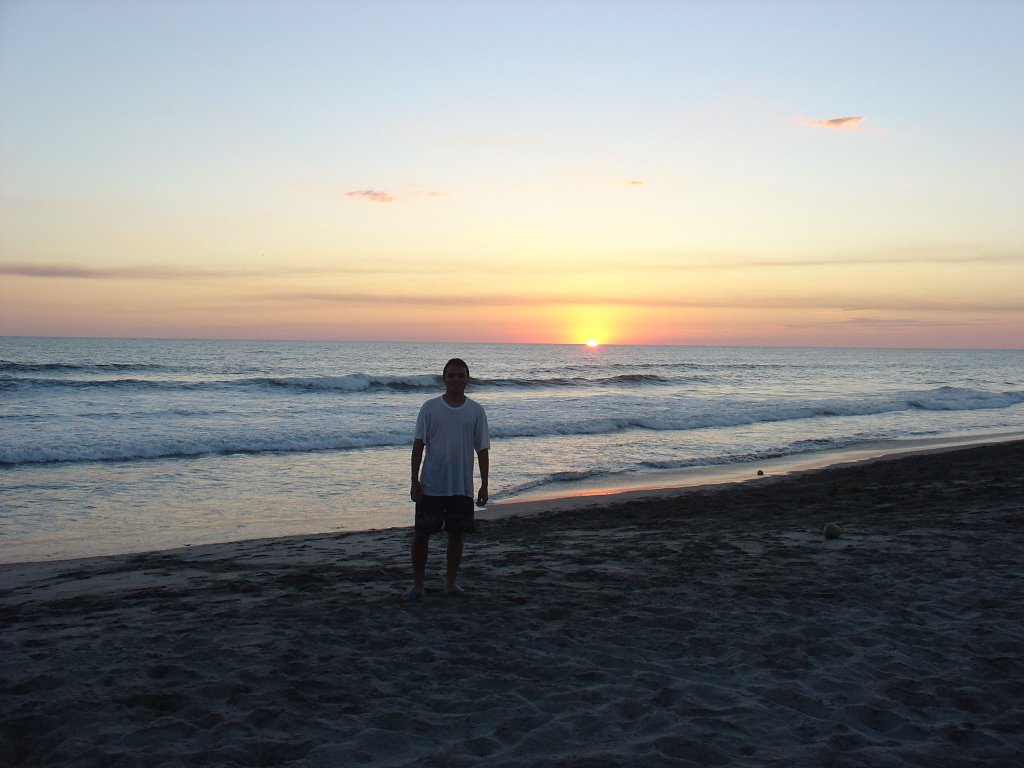
Ahhh... the beach, I got to swim in the warm Pacific ocean for the first time:

Living the Corona commercial:

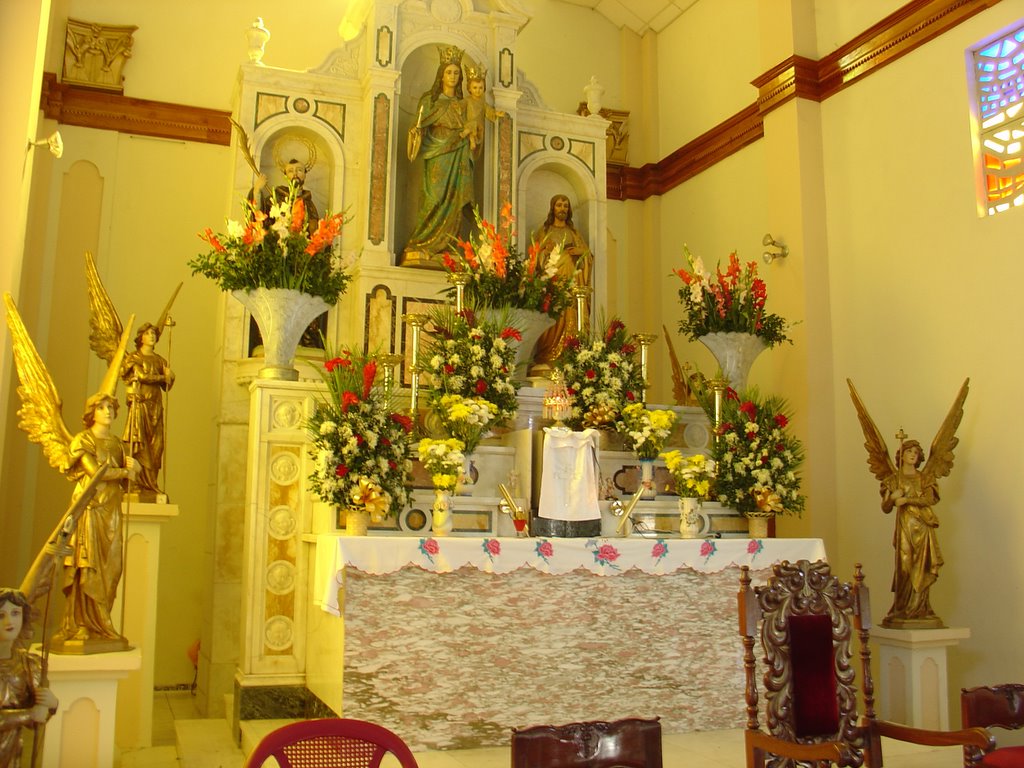
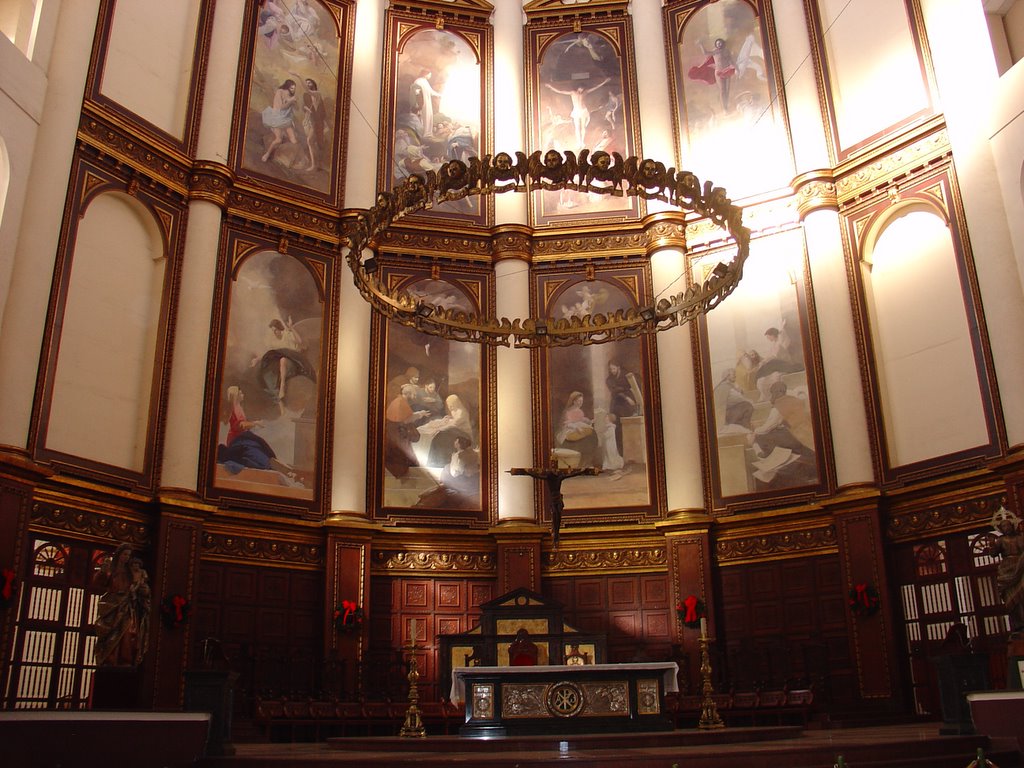
Here is the Cathedral in San Salvador, where Archbishop Oscar Romero's tomb is located:

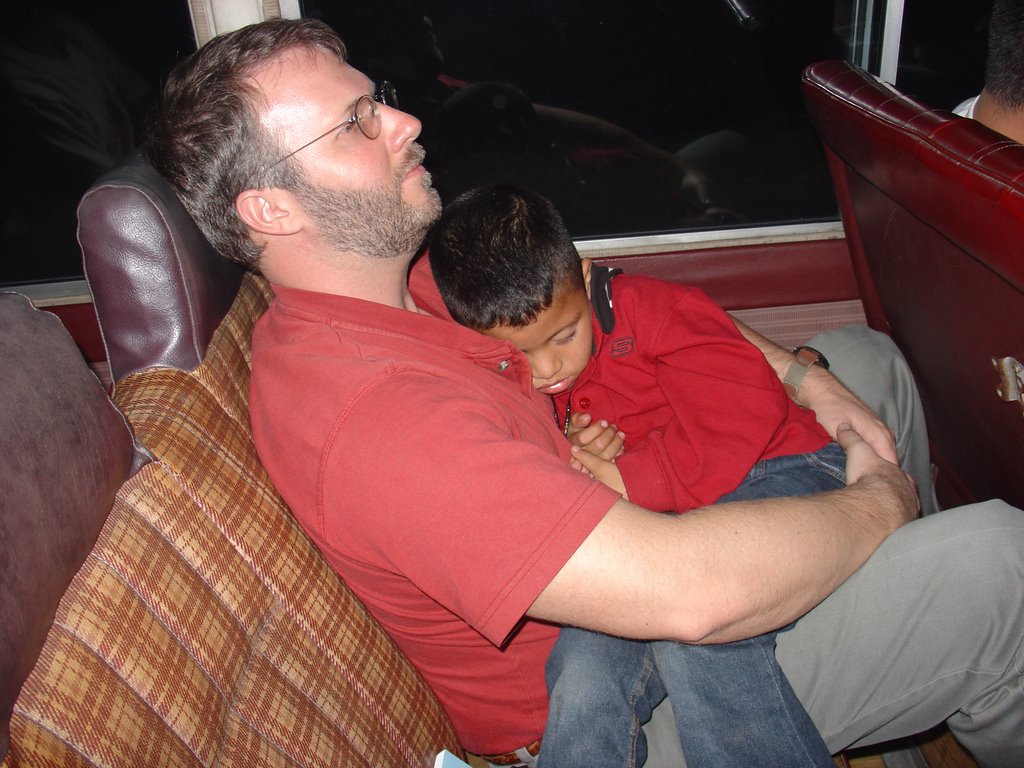
Finally, dinner at a restaurant at the top of one of the many Salvadoran mountains. Notice the lights of San Salvador below... and one of Pablo's nephews conks out on Fr. Bill's lap during the bus ride back to San Vicente after a long, eventful day...


Next entry I'll talk about Christmas with the family (and Nick and Amy!) and working in a parish (plus witnessing my first death).

In Jesu, per Mariam,
Matt1618

Wednesday, December 07, 2005

New Seminarian blog

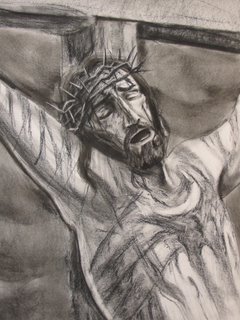
This blog is from a good friend of mine who is taking some time off from seminary to discern his vocation in relation to his artwork. He really is a brilliant artist and much of his work was used throughout the seminary. He's now keeping a blog of his philosophy of art with samples. He's done some beautiful charcoal scenes from the movie, The Passion and of our late Holy Father. Please check out his blog. He's a dear friend and I'm glad to stay in touch with him in this way. I hope you'll find his work as inspirational as I have. He is equally inspirational in person.

Art Is Servant


God Bless you Dave!

Monday, December 05, 2005

Plenary Indulgence Attainable on Dec 8

The Solemnity of the Immaculate Conception of the Blessed Virgin Mary

Plenary Indulgence Attainable on Dec. 8
Papal Decision for 40th Anniversary of Close of Vatican II

VATICAN CITY, NOV. 30, 2005 (Zenit.org).- Benedict XVI is offering the faithful a plenary indulgence on the solemnity of the Immaculate Conception, Dec. 8, the 40th anniversary of the close of the Second Vatican Council.

The indulgence was announced in a decree published in Latin on Tuesday, signed by Cardinal James Stafford and Conventual Franciscan Father John Girotti, penitentiary major and regent, respectively, of the Apostolic Penitentiary.

The document establishes that when the Pope renders public homage to Mary Immaculate in Rome's Piazza di Spagna, he "has the heartfelt desire that the entire Church should join him, so that all the faithful, united in the name of the common Mother, become ever stronger in the faith, adhere with greater devotion to Christ, and love their brothers with more fervent charity."

"From here -- as Vatican Council II very wisely taught -- arise works of mercy toward the needy, observance of justice, and the defense of and search for peace," adds the decree.

For this reason, the decree continues, the Holy Father "has kindly granted the gift of plenary indulgence which may be obtained under the usual conditions (sacramental confession, Eucharistic Communion and prayer in keeping with the intentions of the Supreme Pontiff), with the soul completely removed from attachment to any form of sin, on the forthcoming solemnity of the Immaculate Conception, by the faithful if they participate in a sacred function in honor of the Virgin, or at least offer open testimony of Marian devotion before an image of Mary Immaculate exposed for public veneration, adding the recitation of the Our Father and of the Creed, and some invocation to the Virgin."

At home

The document concludes by recalling that faithful who "through illness or other just cause" are unable to participate in a public ceremony or to venerate an image of the Virgin, "may obtain a plenary indulgence in their own homes, or wherever they may be, if, with the soul completely removed from any form of sin, and with the intention of observing the aforesaid conditions as soon as possible, they unite themselves in spirit and in desire to the Supreme Pontiff's intentions in prayer to Mary Immaculate, and recite the Our Father and the Creed."

On Dec. 8, 1965, Pope Paul VI, in closing Vatican II, dedicated great praise to the Blessed Virgin who, as Mother of Christ, is Mother of God and spiritual Mother of all mankind.

Latin at St. Mary's

I've been very impressed with how much we use Latin here at St. Mary's in Baltimore. We use Latin Mass parts every now and then, sing the Salve Regina after Rector's Conferences and after Evening Prayer during the Marian months, and we're now singing a Latin hymn during Advent Season as well. But...alas..no Latin class.

So...I'm trying to get one setup :)

I've got about 10 guys who are interested and we're meeting with the Academic Dean tomorrow to discuss it. I think he's favorable to it he just wants to make sure we're serious about it.

Here's a recent, pertinent article:

Benedict XVI Encourages Teaching of Latin
Greets Members of Latinitas Foundation

VATICAN CITY, NOV. 28, 2005 (
Zenit.org).- Benedict XVI encouraged the teaching of Latin, especially to young people, with the help of new methodologies.

The Pope made this proposal today when greeting the participants in a meeting organized by the Latinitas Foundation, a Vatican institution that promotes the official language of the Latin-rite Catholic Church.

The Holy Father, who addressed the participants in classical Latin, congratulated the winners of the Certamen Vaticanum, an international competition of Latin prose and poetry.

Benedict XVI said that this foundation must see to it that Latin continues to be part of the daily life of the Church, so that understanding of many of its treasures will not be lost.

The Latinitas Foundation, founded by Pope Paul VI in 1976, has the dual aim of promoting, on the one hand, the study of Latin and classical and Christian literature, and on the other, the use and spread of Latin through the publication of books in that language.

The foundation publishes a quarterly magazine, Latinitas, and every year celebrates the Certamen Vaticanum. The foundation has also published a dictionary, the Lexicon Recentis Latinitatis, containing more than 15,000 neologisms translated into Latin.

For those who ever wondered about the Latin equivalent for "computer," "terrorist" or "cowboy," there are now answers.

"Instrumentum computatorium" is the way the Latinitas Foundation refers to computers.

Those who sow violence and terror are called "tromocrates (-ae)"; while characters in Westerns are called "armentarius."

Some of the words of the Lexicon Recentis Latinitatis can be consulted on the foundation's Web page.

See
here.

Sunday, December 04, 2005

Eucharist and Marian Devotion

Eucharist and Marian Devotion
Perspective of Theologian Father Michael Hull

NEW YORK, NOV. 20, 2005 (
ZENIT.org).- Here is the text of a talk given by Father Michael F. Hull, who participated in the recent videoconference of theologians on the topic of the Eucharist. The Vatican Congregation for Clergy organized the event. Father Hull is a professor of sacred Scripture at St. Joseph's Seminary in Yonkers, New York.

* * *

The Holy Eucharist and Marian Devotion
Michael F. Hull

Devotion to the Holy Eucharist and devotion to Our Lady are so closely bound as to be inseparable. As Mother and Son are united in an "indissoluble tie" ("Lumen Gentium," No. 53), so too devotion to Mother and Son are tightly linked. This is expressed most beautifully by the medieval religious poem "Ave Verum," immortalized as a motet by Wolfgang Amadeus Mozart in 1791.

In his encyclical letter "Ecclesia de Eucharistia," the late Pope John Paul II devotes the sixth and final chapter to Mary, which he entitles "At the School of Mary: 'Woman of the Eucharist.'" Therein, the Pope points out significant parallels in the lives of Jesus and Mary.

For example, Jesus' words at the Last Supper -- "Do this in remembrance of me" (Luke 22:19) -- echo Mary's words at the wedding at Cana -- "Do whatever he tells you" (John 2:5). Likewise, Mary's fiat to the Archangel Gabriel (Luke 1:38) prefigures the Amen of each communicant at the reception of Holy Communion.

Speaking of Mary's own reception of holy Communion after the Lord's paschal mystery, John Paul remarks: "For Mary, receiving the Eucharist must have somehow meant welcoming once more into her womb that heart which had beat in unison with hers and reliving what she had experienced at the foot of the Cross" ("Ecclesia de Eucharistia," No. 56). "Mutatis mutandis," we are also brought to the foot of the Cross in holy Communion, where we are united not only with the Lord, but also with the "stabat Mater dolorosa."

Finally, we find Our Lord entrusting his Mother to St. John, who as the "beloved disciple" had such a prominent place at the bosom of Jesus at the Last Supper, and St. John to his Mother (John 19:26-27). Holy tradition recounts how Mary and St. John eventually settled at Ephesus, the place where Mary kept so much in her heart until her assumption (cf. Luke 2:33-35 and 2:51).

During the public ministry of the Lord, Mary is rarely in the foreground. Except for the wedding at Cana -- when Jesus prefigured his miracle of the Eucharist by turning water into wine at Mary's request (John 2:1-11) -- and at the foot of the Cross -- when Jesus concluded his passion (John 19:25) -- Mary is always in the background. Her presence is always pointing toward her Son. And that is the very heart of Marian devotion: a strong, omnipresent, and relatively silent expression of devotion to the will of God oriented to his and her Son.

Throughout the history of the Church, the saints have understood this truth. Two examples will suffice.

In the fourth century, St. Ambrose expressed the hope that all of his people would inculcate the spirit of Mary as a means to glorify God: "May the heart of Mary be in each Christian to proclaim the greatness of the Lord; may her spirit be in everyone to exult in God."

Similarly, 1,400 years later St. John Bosco had a vision of two pillars anchoring the bark of Peter in the midst of a stormy sea: the pillar of the Eucharist and the pillar of the Blessed Virgin Mary. The larger pillar, that of the Eucharist, had the words "Salvation of Believers," and the smaller, that of Mary, "Help of Christians."

Mary is, indeed, the help of Christians, leading them to Jesus and the Eucharist. Devotion to Our Lady is always together with devotion to Our Lord, especially in the Eucharist, as the Church sings: "Ave verum corpus natum de Maria Virgine …"

Saturday, December 03, 2005

eighth paper

This is another paper for Philosophical Anthropology, mentioned here: Descartes' and Nietzsche's Understanding of the Human Person: A Critique and Contribution to Christianity.

Lemme tell ya, I was honestly shocked that I got an A on this one, I was prepared to get a low B at most. This is definitely the hardest paper I've worked on all semester, even moreso than my paper on the Goodridge Decision. My professor made many insightful comments on my paper, as he ususally does, but I won't put those here.

Really, all of my professors, on all of my papers have seen every hole in my logic. These have been very valuable. If you've read any of my papers on here and thought, "Well, hmmm, that doesn't sound right," odds are there was a comment made about it. If you're interested in these email me at matthardesty at hotmail dot com.

You'll also see, I'm a maniac when it comes to footnotes!

Here it is:


René Descartes, in “Part Four” of his Discourse on Method[1], states, “[B]ecause our senses sometimes deceive us, I wanted to suppose that nothing was exactly as they led us to imagine.”[2] This statement became one of the driving forces behind his effort to rectify what he believed was a system of doubts indoctrinated in him during his schooling as a child. Descartes, essentially dismissing the classics, the early Church Fathers, and Medieval scholasticism in the process, would devise a new method for discovering knowledge and truth. He would “raze everything to the ground and begin again,”[3] he said, by “building upon a foundation which is completely my own.”[4] This method would deny the senses so that then, freed from the doubts they bring, only “the things we conceive very clearly and very distinctly [would be] true.”[5] This would also further his argument for the “real distinction between mind and body.”[6] But, Friedrich Nietzsche, coming 250 years after Descartes, seems to dismiss Descartes by saying that his is just the typical “irritation and rancor against sensuality”[7] that has plagued every philosopher that has ever lived. But, this essay will show that Nietzsche’s opinion doesn’t exactly apply to Descartes. Descartes’ real purpose will be presented and then highlighted by Nietzsche’s opposing argument concerning the body in his “ascetic ideal.” Finally a conclusion will be made determining if any elements from either argument could be useful to Christian theology, a theology that is threatened by both philosophers.[8]

To be sure, the arguments Descartes posits for the doubting of the senses and thus the distinction between mind and body are baseless. In “Meditation Six” of Descartes’ Meditations on First Philosophy, Descartes explains that the senses are suspect because of, for example, the “betrayal” of depth perception,[9] because some amputees have reported pain in their “phantom limb,” and because senses seem equally present in dreams as in wakefulness. But these are not deceptions, per se, as if the senses are inherently flawed, deceitful, or will to be malicious. They simply function according to the way God designed them and the world that they detect. Descartes himself states his trust in the order God has made and is even confidant that He is not a deceiver: “[F]rom the beginning, God made it such as it had to be”[10] and “it is impossible for God ever to deceive me.”[11] So how could his senses be absolutely deceitful?

In his search for “clear and distinct” truth, Descartes banishes from his knowledge everything he’s ever learned through his senses or by way of demonstration. This would mean the total erasure of any and all knowledge (and being) but Descartes escapes this absurdity by stating that one thing does remain: his res cogitans, his “thinking thing.” “[T]hought exists, it alone cannot be separated from me. I am; I exist – this is certain… I am therefore precisely nothing but a thinking thing.” From here he can conclude, “I am not that concatenation of members we call the human body.”[12]

He elaborates on the distinction between his mind and body in “Meditation Six.” Because Descartes has a clear and distinct idea of himself as a thinking thing only and a clear and distinct idea of his body as res extensa, an extended thing only, he can conclude that he is really distinct from his body and can exist without it. Because clear and distinct ideas come from God then it must be obvious that God intended to differentiate and separate the two.[13] Plus Descartes asserts that he recognizes distinct faculties in himself; imagining and sensing require and must belong to thinking only; and movement, shape, etc. require and must belong to a body only. Thus there is a “real distinction between mind and body,” with the mind being the sole and total source of essence and being.[14]

Again, this distinction is based on the assumption and assertion that radical doubting of the senses is acceptable. But we must not believe that Descartes was oblivious to this dubious foundation. Rather, he built it quite purposefully because it was necessary for his new vision and method for knowledge, one that he hoped would control the world and place man on top if it using mathematical physics. This is where he differs quite drastically from Nietzsche’s caricature of the philosopher.

In his work, On the Genealogy of Morals, Nietzsche makes the case that religion and morality, especially in Christianity, are the enemy of life in man and keep him from fully expressing his will and experiencing the present at its fullest. He traces this back to the Jews who, rather than take on the morality of their conquerors, as was the traditional behavior, they resented their plight and devised their own morality.[15] In this resistance, their priestly caste succeeded in making their conquerors feel guilty for exerting the strength that they had by nature.[16] This caste then compounded the guilt by holding up their peoples’ weakness and lowly state as a virtue to be aspired to and followed. This “slave morality,” this “ascetic ideal,” has thus poisoned mankind from generation to generation.

The ascetics, as a people, retreat from life and deny themselves through “poverty, humility, chastity,”[17] and through other means in reaction to the suffering or constraint imposed on them by the various “masters” or obstacles in life.[18] Philosophers, a particularly sophisticated subset of the ascetics, retreat from life and moderate their senses not out of reaction to oppression but for higher truths, a higher realm, the gods and immortality.[19] This is the motivation behind the typical “philosophers’ irritation and rancor against sensuality.”[20] But, Descartes is no typical philosopher. He denigrates the senses not to escape this life but to control it, and he does it not to pursue the gods and the higher life but to become a god himself over this life.

For Descartes, even at “one of the most renowned schools of Europe,” knowledge and truth weren’t valuable in and of themselves, but only in so far as they yielded “everything that is useful in life.” He had a “tremendous desire to master them”[21] and “to distinguish the true from the false, in order to see [his] way clearly in [his] actions, and to go forward with confidence in this life.”[22] And what obstructed him from living “confidently”? In “Part Six” of his Discourse on Method, Descartes states his hopes for his method. He must be subtle here, to avoid eliciting a reaction to his work like that of Galileo’s, but his intentions are clear:

[I]t is possible to find a practical philosophy, by means of which, knowing the force and the actions of fire, water, air, the stars, the heavens, and all the other bodies that surround us, just as distinctly as we know the various skills of our craftsmen, we might be able in the same way, to use them for all the purposes for which they are appropriate, and thus render ourselves, as it were, masters and possessors of nature.

Mankind, with his method, would also be able to enjoy “trouble-free the fruits of the earth and all the goods found there,” the “maintenance of health,” and freedom from an “infinity of maladies,” and even “the frailty of old age.” In this regard Descartes has little use for mankind (other than to further his experiments[23]), natural law, the Church, and God who would, if he were to have his way from his day forward, no longer be the masters of these domains. This shapes his entire life’s project, and offers little to Christian theology.

Now that we have used Nietzsche’s “ascetic ideal” to highlight Descartes, can we find anything in Nietzsche’s arguments that would be useful for Christian theology? On the surface it seems to be not so, as Nietzsche rails extensively on Christianity as not only a system of belief that tends towards or sometimes falls into the faults he finds with it, but one that essentially embodies those faults. For Nietzsche, Christianity is a religion of cowardice, passive-aggressiveness, and ressentiment (“resentment”)[24]. It builds comforting illusions to escape the hardships of this life and has developed an elaborate religiosity as a weapon against its oppressors. Christians have the same “will to power” as any other peoples only theirs is under the guise of truth, compassion, and justice.

Although the picture Nietzsche paints of Christianity is indeed a caricature, he is more useful than Descartes because his arguments are based on observations of behavior, rather than mere assertions and assumptions. So, we must be careful not to fall into his caricature, to become what Nietzsche thinks we are. Is our faith just a search for security? Is it merely a form of escapism? Is our asceticism merely hatred for the body, mere “death instinct,” mere “denial of life intensity”? Or does it aid us not only in attaining the “next life” but in enhancing our current life as well? We must also ask ourselves if our prayer and worship are founded on our belief that they are true or fear of the alternative if they are not true.[25] All of these challenges, if taken seriously, can be valuable in helping us maintain Christian orthodoxy and orthopraxy. Merold Westphal, in his book Suspicion and Faith, mentions not only Nietzsche but also Karl Marx and Sigmund Freud in his particular challenge to Christianity. He says that we must

take the religious critiques of this unholy trio seriously rather than simply trying to refute or discredit them, to read them as a kind of Lenten spiritual exercise in self-examination… If there is more to the life of faith than self-deception in the service of self-interest, the best demonstration of this is not proof but practice.[26]

So we see that by understanding Nietzsche’s scathing challenges we can not only serve to check ourselves but address the currents of his thought in society as well.


[1] Any quotes from Descartes’ Discourse on Method or Meditations on First Philosophy will be from the work that combines the two, translated by Donald A. Cress, 4th ed., ©1998, Hackett Publishing Co. Hereafter referred to as either “Discourse” or “Meditations” depending on which part of the work is referenced.
[2] Discourse, “Part Four,” p. 18
[3] Meditations, “Meditation One,” p. 59
[4] Discourse, “Part Two,” p. 9
[5] Ibid. “Part Four,” p. 19
[6] This is the title of Meditations, “Meditation Six”: “Concerning the Existence of Material Things, and the Real Distinction between Mind and Body”.
[7] On the Genealogy of Morals 3.7, p. 106. Any quotes from Nietzsche’s On The Genealogy of Morals will be from the work that combines it with Ecce Homo, translated by Walter Kaufmann, Vintage Books ed, Nov 1989, ©1967 Random House, Inc. Hereafter referred to as “Genealogy”.
[8] I arrived at the direction of this three-part thesis during conversation on the topic with Dr. Paul Seaton, St. Mary’s Seminary & University, and acknowledge his assistance here.
[9] Meditations, “Meditation Six,” p. 95: “Towers that had seemed round from afar occasionally appeared square at close quarters. Very large statues mounted on their pedestals did not seem large to someone looking at them from ground level.”
[10] Discourse, “Part Five,” p. 24
[11] Meditations, “Meditation Four,” p. 81
[12] Ibid. “Meditation Two,” p. 65
[13] Cf. ibid., “Meditation Six,” p. 96-97
[14] Cf. Discourse, “Part Four,” p. 19
[15] Cf. Genealogy 1.7, p. 33-34, “the Jews, that priestly people, who in opposing their enemies and conquerors were ultimately satisfied with nothing less than a radical revaluation of their enemies’ values, that is to say, an act of the most spiritual revenge.”
[16] Cf. Ibid. 1.13, p. 45, “To demand of strength that it should not express itself as strength, that it should not be a desire to overcome, a desire to throw down, a desire to become master, a thirst for enemies and resistances and triumphs, is just as absurd as to demand of weakness that it should express itself as strength.”
[17] Cf. Ibid. 3.8, p. 108
[18] Cf. Ibid. 3.13, p. 120, “the ascetic ideal springs from the protective instinct of a degenerating life which tries by all means to sustain itself and to fight for its existence.
[19] Cf. Ibid. 3.11, p. 117, “in that case, the case of the ascetic life, life counts as a bridge to that other mode of existence.”
[20] Ibid. 3.7, p. 106. Nietzsche also notes, “There also exists a peculiar philosophers’ prejudice and affection in favor of the whole ascetic ideal.”
[21] Discourse, “Part One,” p. 3
[22] Ibid. p. 6
[23] Cf. Discourse, “Part Six,” p. 35-36: “For, having the intention of spending my entire life in the search for so indispensable a science… I judged… to communicate faithfully to the public the entirety of what little I had found and to urge good minds to try to advance beyond this by contributing, each according to his inclination and ability, to the experiments that must be performed and also by communicating to the public everything they might learn in order that, with subsequent inquirers beginning where their predecessors had left off, and thus, joining together the lives and labors of many, we might all advance together much further than a single individual could do on his own.
[24] Cf. Genealogy 1.10, p. 36, “The slave revolt in morality begins when ressentiment itself becomes creative and gives birth to values: the ressentiment of natures that are denied the true reaction, that of deeds, and compensate themselves with an imaginary revenge… [I]n order to exist, slave morality always first needs a hostile external world; it needs, physiologically speaking, external stimuli in order to act at all – it’s action is fundamentally reaction.”
[25] The questions are from notes given by Fr. Bud Stevens on Nietzsche in Phil 501 Epistemological Issues in Theology, St. Mary’s Seminary & University
[26] This quote is from an excerpt of Suspicion and Faith in God and the Philosophers: The Reconciliation of Faith and Reason edited by Thomas V Morris, ©1994 Oxford University Press, p. 223

another paper

I guess this would be my seventh paper, as I've kept count on this blog, but it's out of order in real time... I just forgot to put it up here.

This was for my History of Philosophy class, I got an A.


Leon Kass, in his book, The Hungry Soul[1], sets out to answer, among other questions, “What kind of ‘world relationships’ are entailed by the necessity of finding food? What, finally, is the relationship between what one is and what one eats?” “At stake in this inquiry,” Kass says, “is the adequacy or sufficiency of a materialistic explanation of metabolism and animal eating, and therewith of life as such.”[2] Kass breaks down the first chapter of this philosophical treatment of eating and being into ten parts. This essay will focus on the fifth part, “The Cause of Nourishing,” in which he discusses cause and responsibility vis-à-vis “metabolism and animal eating” and modern science’s explanation for these.[3] To be sure, the entire chapter (and the entire book for that matter) is rich with valuable insights and lessons both to the scientific community and to the common thinker. We will focus on the fifth part of chapter one, and the important lessons it holds, because it marks the start of a new tone in the chapter, and the book as a whole.

Kass begins by explaining that his reflections up to this point have “hardly broken new ground,” thereby implying that we should be familiar with what he has treated so far. If not, the reader is forced to wonder why and how his reflections have evaded us. Any good writer knows how to make his reader think, even about “the same ‘ol stuff.” Kass keeps us thinking throughout the entire work. After starting this part the way he does, he makes his reader suspect that a groundbreaking is eminent. But not only is he about to break new ground, he is about to enter into “controversial” territory. What he has treated so far should be of no surprise. Description and facts are more like surface coverage, explanation and cause take us to the real heart of the matter, literally and figuratively.[4]

Kass says that the act of nourishing not only drives performance, an action of the animal and man, but it is its own action as well, “one of the whole’s performances. As the many recent references to ‘self’ imply, an organism feeds and nourishes itself.” These references[5] to “self” include: “For the organism, unlike a machine, to nourish means to maintain as well as to fuel, and the organism is self-maintaining and self-repairing”[6] and “Nourishing is thus the activity of self-renewal as well as self-fueling, self-maintenance, self-healing, and self-maturation.”[7] These examples reinforce the idea of nourishing as an “accomplishment” and not just something that happens to or in an organism.

Here Kass also teaches us to think in terms of wholes with parts as even in this statement he gives the five parts of the nourishing-accomplishment: the “impulse to feed,” ingestion, digestion, absorption, and regenerative biosynthesis. Here also, he does not use the words “impulse” and “accomplishment” very lightly; he even puts the latter in italics. First, the word “impulse” comes from the Latin, impulsus, from the past participle of impellere, “to impel,” or “to push, strike against, drive forward, urge on.” And his use of the word “accomplishment” brings very human connotations with it: a sense of will, intention, volition, and as we’ll see very shortly, responsibility. Nourishing and metabolism are not just the processes that keep an organism alive, they are initiated by the very organism they sustain.

“What is in the organism that is responsible for these activities?” Again, Kass is invoking very common, human language to walk us through his points. How many times have we heard a mother ask her misbehaving child, “What’s gotten into you!”? What is in the child that is responsible for his actions? As was mentioned above, “This is, of course, the heart of the matter.” (emphasis mine) “At issue is the very nature and being of living things.” But, unfortunately, Kass states that this is a question “once much debated by philosophers, but now virtually neglected even by biologists.” Even by biologists! Of course philosophers would be consumed by such matters[8] but they are such a fickle crowd. But biologists!? Their whole science deals with “living things”! One can almost hear the underlying tone in Kass’s voice, making the comments above. With these three subtle words, “even by biologists,” he shows the folly of modern philosophy and science.

“Nothing less than a complete ontology[9] can answer the question [of the “very nature and being of living things”], and I am, quite frankly, unequal to the task” (emphasis mine). Here Kass introduces through his own witness the necessity for humility when entering into philosophical discussion. Socrates exhibited the same; for him wisdom was not in knowing all there is to know, but knowing his own ignorance and also being willing to inquire. Kass makes us wonder about his colleagues, “Is this humility in them?” A sort of intellectual pride must be at the heart of their experiments. At any rate, although Kass is “unequal to the task” he feels the question is important enough that we must do what we can to answer it and in a footnote he reassures us that the via media is always difficult, especially with matters as important as these.

The problem with society and its scientists today is that we want an explanation for every “organic change” we come across, we are not content with mystery. We must know what is “beneath” the change. We want to grab the change so we can hold it still and look at it from all sides, poke it, prod it, see what is under the hood, take it apart, dissect it, and put it back together again. If we cannot do that, it becomes a constant source of tension and grief. “When we ask about responsibility for metabolism, we are asking about such an under-lying cause, the stable something beneath or behind the flux.” In another footnote Kass implies that he uses the word “responsibility” rather than “cause” because we are not ready at this stage in the discussion to handle the 2500 years of baggage that this phrase brings. The good reader patiently proceeds.

Kass then says that “this question of responsibility or cause was first elaborated in classical antiquity” thus calling to mind the classics: Socrates, Plato, and Aristotle. Then he goes right ahead and uses them in answering why, for example, the chair the reader is sitting in is “the way it is.” In Aristotle’s Four Causes, we see the Efficient Cause of the chair, its “from-what,” is the “carpenter-upholsterer who made it” and “his art and tools.” The Material Cause, its “out-of-what,” is “the wood or springs or cushioning.” The Formal Cause, its “what,” is “the shape or structure it displays.” And finally the Final Cause of the chair, its “for-what,” is “the use it serves, sitting.” These are all “modes of responsibility” and carefully bring us into the notion of cause.

Next, Kass moves into a more heavy-handed critique of modern science and its shrinking of the “notion of causation” to mean “only the moving cause or the efficient cause,” the first “Cause” we described above. For example, the Newtonian explanation for movement takes the easy way out: “[I]t proved easier to describe and quantify these changes than to identify the sought-for underlying substantive cause.” The modern scientist denies his very own innate capacity for wonder. He denies the “underlying substantive cause,” the “Why,” for an empty “How.” But this empirical tendency not only pervades the scientific community but the larger society as well. Kass states that the “common opinion” too has embraced these “laws of motion,” laws that at the end of the day, “do not explain motion or address its cause.” We force phenomena into our “preconceived parameters of space and time” rather than allow ourselves to be amazed.

Despite these difficulties, scientists are “by orientation” drawn to materialism and “[b]iologists are no exception.” Notice how Kass uses the phrase “by orientation” rather than “by nature.” He leaves an opening for science to change. If one is faced in the wrong direction, one can always change his “orientation” to face the right direction. Changing one’s “nature” is a whole different and eminently more difficult problem. Remember, “Descartes [a scientist] broke with his philosophical ancestors to present his doctrine of the ‘animal machine’ and a purely mechanical explanation of vital phenomena,” including “feeding, nourishing, and metabolism.” Descartes’ method, the modern method, wasn’t always the method. Kass is frustrated that modern biology has made such “enormous progress” by “eschewing all such speculation” of “form, or soul or purpose” in understanding “metabolism or, indeed any activity of life.” One can sense that he would like to put “progress” in quotation marks.

Kass then goes on, in the second to last paragraph of this part, to give examples of progress made in modern biology. He explains how scientists have figured out all of the pathways, structures, mechanisms, elements, processes, and “chemical bas[es]” of “ingestion, digestion, absorption, and regenerative biosynthesis” and even appetite! Any reader with some knowledge of philosophy will know that “appetite” carries with it quite a bit of baggage as well, but that did stop the modern scientist from clasping it under his microscope.

“[T]he whole is treated in terms of its ‘parts’” and this is how “most scientists vindicate their mechanistic and materialistic presuppositions, not only as heuristic[10] but as ontological hypotheses.” But isn’t an understanding of wholes and parts good? Isn’t that what Kass did in the beginning with the “nourishing-accomplishment”? Yes, but objects must be understood in a concept called the hermeneutic circle, when a whole is interpreted in light of its parts and the parts are interpreted in light of the whole, rather than primarily in one direction. Both directions in the hermeneutic circle, in the interpretation of an object, must be taken together. When this concept is not used, we come to a point where a flippant phrase like “you are what you eat” becomes serious science. Kass is the last one to make such a blunder.

In his closing paragraph of this part, Kass says, “Against the stream I want here to argue for the necessary supremacy of living form.” By saying he is about to embark “against the stream” he reminds his reader of the “controversy” he mentioned in the first paragraph. He has only scratched the surface. Kass also warns the reader not to interpret him wrongly; the “How” of metabolism is “both illuminating and useful.” But, now he will approach the “What” and “Why” by breaking out of his “form-material” discussion and moving toward one of “the relation of living form to its own material” which “differs markedly.” But in order to do this, we must first understand “form and material.” And so he sets us, and modern science, on a different orientation, to face the right direction.


[1] The Hungry Soul: Eating and the Perfecting of Our Nature by Leon R. Kass, M.D., University of Chicago Press ©1999. Any page numbers given in this essay are to be understood to come from this text.
[2] p. 20
[3] The fifth part, “The Cause of Nourishing,” is in the above book on pages 31-34. This essay is designed so that the reader can follow along with the Kass text. It steps through the fifth part, paragraph by paragraph in its analysis, so page number citations for each quote are omitted unless they reference a different part.
[4] Pun intended
[5] From the fourth part, “What Use Is Food?” p. 27-31
[6] p. 28
[7] p. 31
[8] Puns intended
[9] From the Gk. ontos “being” + logia “writing about, study of”
[10] From Gk. heuretikos “inventive,” related to heuriskein “to find,” meaning “serving to discover or find out”

Monday, November 28, 2005

my article

My recent article in The Record online:

"O God, come to my assistance; O Lord, make haste to help me." (Psalm 70[69])

These are the opening words to the Liturgy of the Hours, the universal prayer of the church prayed by seminarians, clergy and the laity every day. These were also my words as I knelt nervously in the chapel to receive a blessing by one of the deacon-seminarians on the first day of my arrival at St. Mary’s Seminary and University in Baltimore on Aug. 25, 2005.

What a grand seminary! What a grand chapel!

Pope John Paul II, of blessed memory, knelt in that same pew 10 years earlier during his visit to Baltimore. It all seemed so daunting as I prayed for God’s help.

And he has given me his help. I’m enjoying myself and settling into the routine of daily morning prayer, evening prayer, Mass and the flow of community life with seminarian brothers from all over the country.

Thankfully, I’ve gotten into the swing of course work too, after having been out of college for three years. I have our very own Father Gladstone "Bud" Stevens, a priest of the Archdiocese of Louisville who teaches at St. Mary’s on Monday and Thursday mornings: Epistemology (the art and science of knowing) and introduction to Catholic theology.

In the former, I’ve been studying Vatican II documents such as Fides et Ratio (Faith and Reason) and the search for and knowledge of truth. In the latter, I’m learning how to enter into a "conspiracy" with the Church. You see, the Latin word for conspiracy (conspirare) means "to act in unison with."

My remaining courses are history of philosophy, philosophical anthropology and political philosophy, all of which have done a nice job of burying me up to my ears in reading assignments. But as our professors keep telling us: "Gentlemen, you’ve got to learn how to think before you can learn theology. This is no longer about you, but the faithful whom you’ll serve, who are waiting on you to give them meaning and the truth."

So, it all seems like a nightmare when I think of seminary as if it’s "college all over again."

But it’s not. It’s more than that; it’s formation, it’s becoming a priest after Christ’s own heart, assuming that almighty God, my archbishop and my vocation director will it to be. When I think of it that way, all the reading and the papers are more than worth it.

How humbling it is to be here. What an honor it is to study for the priesthood. When I pause and think of all the sacrifices you have made and all the prayers you’ve offered for me and my fellow seminarians so we can study and pray here at St. Mary’s, it amazes me.

All I can do to repay you is to say that I will work my hardest to continue to discern if the priesthood is not only something that I want but what God wants for me as well. I will never forget all the encouragement and support so many of you in the Archdiocese of Louisville gave me before I packed up the U-haul and left for "Mary’s land."

Weekly holy hours with the community and a small daily rosary group have been my anchors in addition to your prayers.

I will work to take the words of St. Paul to the Ephesians to heart: "But grace was given to each of us according to the measure of Christ’s gift ... to equip the holy ones for the work of ministry, for building up the Body of Christ, until we all attain to the unity of faith and knowledge of the Son of God, to mature manhood, to the extent of the full stature of Christ, so that we may no longer be infants. ... Rather, living the truth in love, we should grow in every way into him who is the head, Christ." (4:7,12-15)

Mary’s Magnificat, her canticle of praise and thanksgiving to God, is also part of the Liturgy of the Hours in evening prayer. It will be through God’s abundant grace and Mary’s intercession if I achieve "the full stature of Christ" and discern his will for me.

So, I echo Mary’s words: "My soul proclaims the greatness of the Lord, my spirit rejoices in God my savior for he has looked with favor on his lowly servant. ... the Almighty has done great things for me, and holy is his name." (Luke 1:46-49)

Please continue to pray for vocations, for Michael Wimsatt (my fellow Louisville seminarian here) and for me. Feel free to write us at: St. Mary’s Seminary and University, 5400 Roland Ave., Baltimore, Md. 21210.

Reflection for Solemnity of Christ the King

Here's my reflection for the gospel on Sunday, November 20th, the Solemnity of Our Lord Jesus Christ the King, for my Lectio Divina study group. The gospel was Matthew 25:31-46.

The three parables before this reading, of the faithful servant who was responsible while his Master was away, of the wise and foolish maidens preparing for the coming of the bridegroom, and of the talents in which the servants used the gifts their master had given them – these three are concluded with this account of the Last Judgment in which all such matters will be resolved. This is called the Last Judgment because it will happen at the end of time and will be a public proclamation of the sentence already given at our Particular Judgment, the one we receive at the moment of our death.

But how does this reading coincide with the Solemnity of Christ the King? Here Christ is identified with the hungry, the thirsty, the naked, the sick, and the imprisoned. To the righteous he says, “Truly I say to you, as you did it to one of the least of my brethren, you did it to me.” And to the wicked he says, “Truly, I say to you, as you did it not to one of the least of these, you did it not to me.” This identification with the least of his brethren hardly sets Him up as a king, right? But, in the beginning of this reading, in the first verse, we see that he will “sit on his glorious throne” and throughout the reading we see that it is “the King” who addresses the righteous and the wicked, welcoming them into his “Kingdom” or banishing them from it. As a matter of fact, this very act of judgment of all the nations gathered before him is one proper only to a King. We also see the image of the Messiah as being on a throne, judging his people, elsewhere in scripture, in the Prophets and the Book of Revelation.

So today, we are called to reflect on Christ as King, King of Heaven and Earth. But, Christ’s Kingdom is not one of brick and mortar with lavish estates and palaces and conquered lands and peoples strewn across the earth. No, Christ’s Kingdom is established in our hearts. Is Christ the King of your Heart? It is His by right. Do you obey his commands and precepts as a loyal subject of his Authority or do they fall on deaf ears? Are you quick to resist his commands as if he, the King of your Heart – who knows every square inch of your Heart and knows how to direct and order His Kingdom – does not know how to direct you, his lowly subject? In any of the monarchies on earth, if any king were to order his subject to do something, he would do it without delay would he not? And if the President were to call or write one of us, we would obey his command right away. But when it comes to Christ, who is the King of much more precious a kingdom than any country or nation, our world has largely decided that it does not need to heed His royal commands.

And so it is for this reason that we must also, today, reflect on the sheep and the goats in this passage and our place among them. If we, His loyal subjects, obey the Lord, Our King, when he commands us to give food to the hungry, drink to the thirsty, welcome to the stranger, clothing to the naked, care to the sick and company to the imprisoned – if we do these very concrete actions – then we will show the world who the king of our hearts really is and thus who the king of this world really is. We must proclaim Him as our King, and him alone, and perform these works because he is our king. Then the world, including us, will see the oppression of their current master – pride, covetousness, envy, wrath, lust, gluttony, and laziness – and upon seeing this oppression, weather in their hearts or in their rulers, will allow themselves to be conquered by Christ’s grace and love and to welcome his Reign.

As Christ is totally different from any other Master, so too must our obedience be totally different. In obedience to our vices, we may do these good works, feeding the hungry, giving clothes to the naked, etc. but out of pride seeking recognition or approval or out of envy of others wealth, to show the giving we are capable of as well, as a sort of competition. In obedience to our presidents and kings, we may do these good works out of a vague sense of compassion, giving for the sake of giving, or giving to meet a certain status quo. This type of compassion is empty and without meaning or purpose. Christ, our true King, calls us to avoid both types of disordered obedience. He calls us not to mere philanthropy but true and meaningful Christian charity. And this can only happen when we identify our King, as St. Matthews does in this gospel, with the least among us. So not only are we obeying our King’s command, but in doing so we are acting for him, too him! When we can see the face of our King in the lowly and approach each one as if he was our King himself, only then are we exhibiting Christian charity. On the contrary, if we distribute food to a nation, for example, just so we can raise the poverty rate or if we welcome strangers merely to fulfill a quota or a certain level of diversity, if we do either of these and others then we are denying the Royal dignity inherent in each of the least of our brethren and we act in vain. This is why St. Paul asserts that “if I give away all I have… but have not love, I gain nothing.”

Finally, St. Teresa of Avila writes: “Here the Lord asks only two things of us: love for his Majesty and love for our neighbor. It is for these two virtues that we must strive, and if we attain them perfectly we are doing his will. The surest sign that we are keeping these two commandments is, I think, that we should really be loving our neighbor; for we cannot be sure if we are loving God, although we may have good reasons for believing that we are, but we can know quite well if we are loving our neighbor. And be certain that, the farther advanced you find you are in this, the greater the love you will have for God; for so dearly does his Majesty love us that he will reward our love for our neighbor by increasing the love which we bear to himself, and that in a thousand ways: this I cannot doubt.”

Closing Prayer:

O Jesus Christ, we acknowledge You as universal King. All that has been made, has been created for You. Exercise all Your rights over us. We renew our baptismal vows, renouncing Satan, his empty promises and his works; and we promise to live as good Christians. In particular do we pledge ourselves to labor, to the best of our ability, for the triumph of the rights of God and Your Church.

Divine Heart of Jesus, to You do We offer our poor services, laboring that all hearts may acknowledge Your Sacred Kingship, and that thus the reign of Your peace be established throughout the whole universe. Amen.

Friday, November 18, 2005

sixth paper

Here is my Philosophical Anthropology paper, mentioned here, I got an A!

St. Thomas Aquinas, in the first half of the second part of his magnum opus, the Summa Theologiae[1], treats one of the fundamental questions of human existence, the good and evil of human actions. Through the course of addressing this question he concludes that not all human actions are good, that some are indeed evil. In doing so, he reveals interesting insights into his understanding of the human person (and even provides a basis from which to compare his thought to Plato’s). Here we will focus our attention on Article 1, of Question 18 in this particular section[2] in order to examine these understandings and how he arrives at them.

Article 1 asks the following question: “Whether every human action is good, or are there evil actions?”[3] Before we begin, a clarification must be made that will affect how we understand the rest of this article and ancillary articles that St. Thomas references. When he says “Evil” here in the title he doesn’t only mean moral evil. “Evil” also suggests “non-goodness,” a distinct idea from moral evil. Peter Kreeft, professor of philosophy at Boston College, gives the example of a tree to illustrate this point. He says that “a tree is not evil for not being God, but a tree, unlike God, can be diseased, and disease is evil for a tree.”[4] Noting this distinction from the beginning will give us a broader understanding of St. Thomas’ language which we will see later.

St. Thomas begins the article by presenting three Objections against the possibility that any human actions can be evil, which he will then analyze and refute. In Objection 1 he states: “Dionysius says that evil occurs only in virtue of what is good.” But since the power of good cannot produce evil, evil actions must not exist. Objection 2 says that an evil action is one that is deficient in some way. But all actions can be perfected and perfected actions are only good. Therefore, “every action is good and none is evil.” Finally Objection 3 again quotes Dionysius who states that evil only happens accidentally. But all actions must have proper effects, not accidental ones, “therefore no action is evil; on the contrary, every action is good.”

St. Thomas then gives a general rebuttal by quoting our Lord in John 3:20, “Everyone who does evil hates the light.” The witness of Scripture being one of his primary authorities, he states that some human actions must be evil. He then gives his own Response that will expound on the rebuttal and concludes the article with specific Replies to each Objection. In this Response and in the Replies we see the heart of St. Thomas’ understanding of the human person.

First he says that if we can understand how some things can be evil themselves, understanding evil as it was described earlier, then we can progress to an understanding of how human actions can be evil as well. The “good-ness” or “evil-ness” of an action flows from the “good-ness” or “evil-ness” of the thing that produces the action. He begins this train of thought by stating that since a thing exists at all, it is good. This he proved in two earlier Articles in the Summa and is worth examining here[5]. In the first part of the Summa under Question 5, Articles 1 and 3 ask “Whether goodness differs really from being?” and “Whether every being is good?” respectively. He answers negatively to Article 1 and affirmatively to Article 3. “Goodness and being are really the same, and differ only in idea” because goodness is desirable, and it is desirable in so far as it is perfect, perfect in so far as it is actual and actual if it simply exists. Therefore, as St. Augustine says, “inasmuch as we exist we are good.”[6] In answering positively to Article 3, it is enough to see that being denotes existence and so we are in the same line of logic used in Article 1 and can conclude that every being is good.

Returning to St. Thomas’ Response, we now have the first point revealed about his understanding of the human person, that because he exists, he is good, or to put it a better way, he is essentially good. We will see the appropriateness of this word, essence, later in our examination of the Response.

St. Thomas then states that “In God alone the complete fullness of His being is in something one and simple, while in everything else the fullness of being proper to it involves diverse things.” He makes this point to draw out the distinction between God and man. Man is good because he has being as a human, as was shown before. But, unlike God, man’s fullness of being isn’t in “something one and simple,” but requires the composite of soul and body with all of their respective capabilities intact. So in this respect if man falls short in one of these capabilities he is imperfect and so is not exhibiting the complete fullness of his being of which he is capable. Therefore, he is evil in this way, or rather; he has evil or “non-goodness” in him. St. Thomas illustrates this in his example of the blind man: “a blind man possesses goodness inasmuch as he lives, but evil (or “non-goodness”)[7] inasmuch as he lacks sight.”

Finally, St. Thomas concludes:

We must therefore say that every action has goodness, in so far as it has being: whereas it is lacking in goodness, in so far as it is lacking in something that is due to its fullness of being; and thus it is said to be evil: for instance if it lacks the quantity determined by reason, or its due place, or something of the kind…[8]

Peter Kreeft comments here that “St. Thomas means by ‘being’ not [only] ‘existence’ (for evil acts exist) but also essence [as was mentioned before], including proper form and order to the end.”[9] Here again “evil” means some sort of deficiency or “non-goodness” but this now leads us to the more popular understanding of “evil” as a moral issue because these deficiencies make evil possible.[10] It is because of this connection that St. Thomas can conclude that some human acts are evil.

An example of “non-goodness” making “moral-evil” possible is illustrated in Article 8 of Question 5 in the first half of the second part of the Summa.[11] Here the question is “Whether every man desires happiness?” In his Response, St. Thomas states that “to desire happiness is nothing else than to desire that one’s will be satisfied. And this everyone desires”[12] But, some do not know the proper object of happiness which is the vision of the Divine Essence.[13] This deficiency in knowledge, this “non-goodness,” leads man to engage in destructive behaviors, morally evil actions, that he thinks will bring him happiness but will only offend him, others, and God. Therefore a second point revealed about St. Thomas’ understanding of the human person is that though man is essentially good, he is capable of committing absolutely morally-evil acts.

We can also draw out of the previous examination a basis for comparison to Plato. Where St. Thomas’ definition of man portrays him as fully being only when he is a composite of body and soul, Plato regards only the soul as the real being and the body as merely its “prison.” For St. Thomas the body and soul, together with all its faculties work together for the attainment of happiness, i.e. vision of the Divine Essence. Plato’s vision of the Divine Essence, the “Form of the Good,” is hindered and constricted by the body, and all his energies are spent trying to subdue and minimize the body’s influence and contribution (Phaedo 64e-65b).

This brings us to St. Thomas’ Replies in our focus Article. In his Reply to Objection 1, in which Dionysius says that evil “occurs only in virtue of what is good,” St. Thomas qualifies this by saying that “evil occurs in virtue of a deficient good.” Indeed he would agree that an absolute good could not produce evil. But this particular good (which still has goodness by virtue of being a good) is “deficient” thereby allowing the possibility for evil to be produced. In his Reply to Objection 2, in which it is asserted that evil actions do not exist because actions are perfectible and therefore good, St. Thomas counters that a certain aspect of an action can indeed be perfected while another aspect, the deficient one, can yield the evil. For example, a blind man has the “power of walking” like any other man but his deficiency in sight hinders his walking. Here we have evil as a “non-goodness” which, for further example, could lead to the moral-evil of despair or impatience. Finally in his Reply to Objection 3, which states that evil only happens accidentally rather than properly – so no action is evil – St. Thomas states that an evil action can have a proper effect according to the “goodness and being it has.” For example, adultery generates another human being by virtue of the “union of male and female” not the “lack in the order of reason” (a deficiency of reason) that made the adultery possible.

Now that we have examined the entirety of this Article in St. Thomas Aquinas’ Summa Theologiae, we can state clearly and separately two points that we have uncovered regarding his understanding of the human person: 1. That man is good because he exists and due to his essence and 2. It is possible that some of his acts are evil despite his essential goodness. One may be spurred by this examination to ask, “Why would man make evil actions?” In our brief treatment here we have said that this is due to man’s deficiencies of the soul and body that make evil possible. Armed now with this understanding of the human person and the cause and capability of evil in him, we can come to reconcile the real evil human action in this world with the dignity with which man was created.


[1] In this essay, I use the translation of Summa Theologiae in Treatise on Happiness, translated by John A. Oesterle, ©1983, University of Notre Dame Press edition, hereafter referred to as “TH.” I also refer to a different translation of Summa Theologiae used in Summa of the Summa, edited and annotated by Peter Kreeft, ©1990, Ignatius Press – that was done in 1920 by The Fathers of the English Dominican Province – hereafter referred to as “SS.” All quotes from Summa Theologiae are of the former translation unless indicated otherwise.
[2] 1-2.18.1 to be precise
[3] SS translation used here
[4] SS, p. 414, n. 120 says, “‘Evil’ is meant here not only in the narrow and specific sense of moral evil, but as the opposite of any good. St. Thomas does not believe that evil is a being, but that it is in beings. He does not belief that multiplicity and finitude are evil in themselves, as the Gnostics and Manichees taught, but that finitude and multiplicity make evil possible. A tree is not evil for not being God, but a tree, unlike God, can be diseased, and disease is evil for a tree.”
[5] TH, p. 161, n. 7 directed me toward these articles. They are, to be precise, 1.5.1 and 1.5.3
[6] The quotes in this paragraph up to this point, except for “good-ness” and “evil-ness” which are my own invention, are from the SS translation
[7] Cf. n. 4 above
[8] SS translation used here
[9] SS, p. 415, n. 121
[10] This is distinct from saying the deficiencies themselves are evil. Cf. n. 4 above.
[11] 1-2.5.8 to be precise
[12] SS translation used here
[13] Cf. 1-2.3.8

Thursday, November 17, 2005

Pre-Theology Ministry Log 05

(see here)

Pre-Theologian Ministry Log

Date: Thursday, Nov 17, 2005

Event: St. Ambrose Family Outreach Center: This week very few adults were there, I think it may be because it was the first really cold evening and maybe people didn’t feel like getting out. So Vic and I only stayed there for an hour while he helped one young man. No one else needed help and the teens were playing basketball so I chatted with the teen coordinators at the front desk

Name the feelings you experienced during the event: I was talking with one of the guys that runs the teen program, Gregory, and he was so excited to hear that I had worked in software development before seminary. He talked about the calendar project that the teens were working on and I could tell how proud he was of the project and of the kids. He showed me the calendar they made last year and went on and on about how much work it took to make and how some of the kids were really sharp with computers. He wanted to much for me to help them with their next calendar because it would be good for the kids and they could learn so much from me. They wanted me to come Tuesday night (Nov 22) but I said that Vic would be going home and St. Mary’s likes for us to come in pairs. Besides, I have work study in the library that night from 7-10pm.

What was difficult and or troubling? Why? Nothing, although I did feel very tired.

Where was God in this event? In Gregory’s zeal for working with the teens.

What have you learned about yourself in the wake of this event? Nothing evident at the moment