Sunday, April 10, 2011

Homily 5th Sun Lent, Year A: Lazarus, Risen and Freed

    In the summer of 2008, I had one of the most difficult experiences of my entire formation to be a priest. In order to gain more pastoral experience, I participated in a program at the University of Louisville hospital in my home state of KY called C.P.E. – Clinical Pastoral Education. This is an ecumenical program in which I worked as a hospital chaplain while learning how to be a more effective minister. Each of us in the group, of different faiths, and genders, and ages, were assigned to visit the patients in a particular department of the hospital. We would then gather as a group to discuss and study our experiences.

My department was particularly difficult: Palliative Care – which is the care that one receives in order to manage pain or to aid in making end of life decisions. Most of the patients I visited were dying or near death, but I felt like it was a great honor to be with these patients in their greatest need. I was glad to be able to sit down with the families and help them to make the right decisions. But, perhaps what I appreciate the most are the times I spent with patients who, while they were dying of a terrible cancer or intense pain, were comforting and praying for us, consoling us, and reassuring us. Shouldn't we be taking care of them? What was it about these particular patients that enabled them to be so other-centered, so charitable, so loving, so peaceful? How did they have more emotional and spiritual strength than we did? What made them different than the patients who gave up, or were bitter, or angry, or flippant about their death? I saw a wide range of reactions to death that summer. I myself had a wide range of reactions! The Gospel from today's Mass, of Jesus raising Lazarus from the dead, has helped me to understand better what I experienced during that summer almost three years ago.

    In today's Gospel reading and in many other places in Scripture, we can see that wherever Christ is present at significant events, he sanctifies the situation. One of the reasons we celebrate Matrimony as one of the Church's seven sacraments is because Christ was present at the Wedding Feast of Cana, thus making it holy, making it a vehicle of grace, and a way in which his love is shown to the Church and to the world. One of the reasons we celebrate Baptism as a sacrament is because Jesus entered the waters of the Jordan River to be baptized by John even though he was without sin, thus making the waters of Baptism holy and able to wash away sins and give divine life. And so today, on this 5th Sunday of Lent, Jesus enters into our experiences of suffering and death, making them holy too, making suffering and death a mystery, taking away the crude and narrow finality that we too often give them and replacing it with his presence. Even death, even times of great suffering, when Christ enters into them, can become times of his healing and divine life. What was a time of grief and confusion for Mary, Martha, and their friends and family, became an occasion of faith, hope, and love.

    Because Jesus Christ was fully human, we can feel comfortable inviting him into any place, any circumstance, any struggle, any memory whatsoever. He was once like us, completely human, in every way except our sinfulness. That humanity he still has but in a glorified state, no longer affected by the limitations he once felt alongside us. He did feel them. He felt the full range of human emotion. The Gospel mentions that he wept in sympathy for Mary and Martha and what Lazarus had to endure. He understands our lives and what we are going through. At the same though He is fully God and so wherever he goes, wherever we welcome him, he brings the fullness of divinity and all that God has to offer.

To places of pain and suffering he brings new purpose, meaning, and value; he brings the Resurrection. He is the Resurrection. To places of happiness and success he brings a glimpse and a foretaste of eternal happiness with him in everlasting life. He is everlasting life. We can very well believe that he loves us as much as he loved Lazarus. He wants to be for us, right here and now, Resurrection and Life. He wants to show us too that death is not the end, it is simply the step to eternal life. And he wants to give us a share in eternal life which grace brings to the soul even while we still live on earth. Mary and Martha have shown us how to enter into this type of relationship with Jesus Christ. "They said to him, 'Lord, come and see.'" As Catholic Christians, I think we would do well to have these words always on the tip of our tongue in prayer: "Lord, come and see."

    To the students here: Whenever you get a good grade on a test, pray to him, "Lord, come and see" and he will share that joy with you and help you to know he is proud of you whenever you use the gifts he has given you well. After the 12:30pm Mass one of the new deacons on our team, Deacon Chris Hess, will celebrate his first Baptisms. There too we will pray with him and the family: "Lord, come and see" and we believe that he will be present there, strengthening Chris's new ministry and giving the parents the graces they need to cultivate the new spiritual life of their child. What else can we invite the Lord to come and see today? I know that I will be praying today for the Lord to come and see me through the last few weeks of seminary so that I can transition well into the priesthood. What is it for you? Perhaps it is a childhood trauma that has affected you for years. Perhaps it is a relative or a friend who has driven you to your wit's end. Perhaps it is a physical or psychological illness or the struggles of someone in your family.

Lent is a good time for self-reflection and re-focus. We still have a week and a half of Lent remaining. If your Lenten practices of renewed self-discipline, prayer, and generosity have been going well, then maybe this little prayer of invitation could be a way of going even deeper so that you can experience the glory of Easter all the more. If your Lenten practices haven't gone so well, then this could be a way of offering all that we have left to God. It was the widow outside of the Temple who offered one gold coin that gave the most, because it was all that she had.

    Mary and Martha have taught us what power can come from the simple prayer of invitation, "Lord, come and see." But they have also taught us that when we run to the Lord without delay, with patience and humility, and without presumption, even though he may seem to delay he actually desires to exceed our expectations. For example, when St. Paul was blinded on the road to Damascus for persecuting Christians, he heard the voice of the Lord call him to conversion. He was also told to proceed to Damascus where he would be told what to do next. There Paul waited for three days, blinded, without food or water. But he had a prophecy that a disciple of the Lord, Ananias, would come, lay his hands on him, and restore his sight. This is all that Paul expected. Ananias, with some reluctance, did this but then he did even more! He also filled him with the Holy Spirit, baptized him, and fed and strengthened him!

    This is the type of God that we have. He is not content to simply restore us to level zero. He wants to do that and so much more! He wants to restore us and then increase us! This may be hard to believe when the Lord doesn't respond to our invitation when we want him to. If Jesus had come to Lazarus in two days rather than four then Lazarus could have been cured and would not have died. But, Jesus knew that raising Lazarus from death to life would have a more profound effect on his disciples' faith than simply raising him from sickness to health.

"So then Jesus said to them clearly, 'Lazarus has died. And I am glad for you that I was not there, that you may believe.'" Despite this though, when Martha came to Jesus she said, "Lord, if you had been here, my brother would not have died" not in order to complain to him or to ridicule him but because she actually believed that to be true. Her faith was so deep that she didn't even ask him to raise her brother Lazarus from the dead. She abandoned herself to him, trusting that if he willed it he could do it. Jesus, moved by her faith and the sympathy he felt, raised Lazarus from the dead. He could have left it at that! But he also asked his disciples to unbind Lazarus after he had risen. Then he had a meal with Lazarus and his family.

    St. Augustine sees this episode as an image of the sacrament of Reconciliation. Whenever we sin, our spiritual lives can begin to die and we find ourselves in our own tomb of despair, isolation, or radical self-reliance. The call to reconciliation that this Lenten season brings is like Jesus crying out to each one of us, "Lazarus, come out." Through the words of absolution our sins are forgiven, we are given new life and emerge from the tomb. Jesus tells his priests, for us, "Unbind him, and let him go." We are released from the sins that bind us and are restored to full fellowship and communion with God and with the Church, our spiritual family.

    All of this is offered to each one of us, individually, personally, during the remainder of this Lent and beyond. The prayer to the Lord to "come and see" and his call that we be unbound and "let go" – these are how a dying cancer patient can have more peace and strength then those sent to minister to her. When the Lord is present and we are set free, our happiness can be transformed from happiness that fades away to happiness the brings a taste of eternal life. And suffering and death are transformed from a meaningless pain or a senseless end, to experiences that give faith to others by the sheer power of what God can do in the heart of one who believes. He gives us the hope that with death life is changed, not ended.

Sunday, February 13, 2011

Homily 6th Sun O.T. Year A: World Marriage Day

    My Canon Law professor at the seminary, Msgr. Fulton, had a way of teaching Church law that made us actually enjoy learning it; he made it a joy to know the law and to help others to know it too. We even nicknamed our textbook "The Big Green Monster" because it is a huge, unwieldy book containing the Code of Canon Law and the commentary on each canon. It's almost 2000 pages long and is paperbound so it never keeps its shape and is impossible to carry around. In his great sense of humor he would joke that our Canon Law text, The Big Green Monster, "is everything Jesus meant to say!" The point he made to us, without explicitly saying it, is that the law of the Church, which is a reflection of the law of the Lord, should be taught and learned and followed with joy and from the heart. The law is not intended to be something that embitters us. The law is not meant to be followed with white-knuckled anxiety or with demands that are impossible to meet. Laws, when they are just, do not bind up… they set free.

    Now, it is certainly true that we all bristle under the law every now and then – whether it's that speeding ticket for going 5 miles over the speed limit or that sudden realization that it's a Friday in Lent right before you bite into a steak. This is nothing though compared to what the Israelites felt in Biblical times under the weight of law put onto them by the scribes and Pharisees. The 10 commandments, as awesome as they are, were ultimately national laws for public observance. "Thou shall not take the Name of the Lord thy God in vain" meant that henceforth it was illegal for them to do so. "That shall not kill" made murder illegal. Breaking one of the 10 commandments brought grave punishments. And on top of these were the hundreds of other laws that governed almost every aspect of their way of life. But, these laws were good because they helped to separate the Israelites from the pagan worship and influences of the peoples that surrounded them. They helped to set the standard for exhibiting a right relationship with God. These laws helped set their nation apart, to define and protect them, as God's chosen people. The point of the old law was that God was preparing them for a New Covenant in Jesus Christ that would inscribe the law of God on their hearts. God was preparing them for a kingdom not of rigid boundaries but of the whole world, a kingdom to which all people will be invited.

    But, the scribes and Pharisees missed the point of the law. Rather than accept Jesus who fulfilled, completed, perfected, and transformed the law into the means of their salvation, they based their salvation in strictly observing "the smallest letter" and "the smallest part of a letter" of the law, every "jot and tittle" as they used to say (Mt 5:18). Thank God we don't have the same burdens placed on us. Thank God Jesus really did fulfill and transform the law from something heavy and external to something light and heartfelt. "My yoke is easy," Jesus said, "my burden light" (Mt 11:30). No more do we have laws that are impossible to follow. Under the Kingship of our Lord, we are given a new moral law that brings right along with it the aid to carrying it out.

    So for example, none of us needs the law "You shall not kill" because we have been given the grace and blessing of a good upbringing, well-ordered hearts and minds, patience, mercy, and forgiveness. We can say we are free of the demands of that law. But Jesus wants us to go deeper. What about the anger in our hearts that kills our relationship with our parents, or our siblings, or our coworkers? What about the lack of patience with ourselves that we cannot let go of? What about the revenge that we secretly desire every time we are offended? These thoughts and desires that spring from the heart cause us to suffer a hundred tiny deaths throughout our lives if we do not let the law of the Lord, the law of love, set us free from them.

It is this kind of deeper meaning that Jesus wants us to see in each of the 10 commandments as we strive to follow them. They are still true for us, as true as they were for the Israelites. But now God is asking us to love him with our whole heart, soul, mind, and strength, not just with our external observances. Jesus said, "If you love me, you will keep my commandments. And I will ask the Father, and he will give you another Counselor, to be with you forever" (Jn 14:15). We are given grace and the Holy Spirit that help us to go so far as to even love the law. Through what else but the spirit of God was the psalmist able to pray, "Open my eyes, that I may consider the wonders of your law. Instruct me, O Lord, in the way of your statutes, that I may exactly observe them. Give me discernment, that I may observe your law and keep it with all my heart" (Ps 119). We have to believe that this is possible for us too

But, "You shall not kill" is an easy one. What about "You shall not commit adultery"? "Whoever looks at a woman with lust," Jesus says in our Gospel today, "has already committed adultery with her in his heart." And "whoever divorces his wife," he continues, "causes her to commit adultery, and whoever marries a divorced woman commits adultery" (Mt 5:27, 32). Still, most of you here today who are married do not need that law either – when most of you exchanged your consent on your wedding day you intended fully to be exclusively faithful to each other, even until death, and to be open to children. You should be very proud of the covenant you have kept in your marriage. In fact, because today is World Marriage Day, the Archbishop is celebrating a special Mass at 3pm specifically to honor and affirm your commitment. Everyone is invited to celebrate marriage today with him and to pray that a bill in the Maryland senate that is challenging the definition of marriage will be defeated.

For most the bonds of marriage have never been at risk. But, perhaps for some, this hasn't been so easy. Perhaps through a build-up of a bunch of big or small bad choices along the way, what was a good and valid marriage has become broken and torn asunder. Perhaps there are some that have chosen divorce or some that have followed that with remarriage outside of the Church and have endangered their ability to receive the sacraments or hold certain positions. Perhaps there are some that have had divorce inflicted on them, through no fault of their own. It is in these situations that the law is truly hard, that the yoke is not easy, and the burden is not light. But, even in situations like these, as unbelievable as it may seem, God is offering the help needed to do the right thing or to receive healing. That could take the form of advice from a wise priest or deacon who can help you sort through the many layers of the problem. Or it could take the form of advice from the Archdiocese's tribunal in helping you understand exactly where you stand with regard to the law. These are the helps that should be pursued first.

Statistically speaking, most of us here today know someone in our family or friends who is divorced or divorced and remarried. The rate of divorce in the general population, about 50%, is now the same rate among Catholics – we have caught up with the rest of society. But it is important that we remember, either for ourselves or for those in particular who we know, that these do not mean that we are excommunicated from the Church. Even if you cannot receive Communion, for example, because the manifest grave sin persists, this does not mean that you are unwanted from the community or that the Church no longer wants you to be part of its life. The obligation to attend Mass on Sundays and Holy Days doesn't necessarily always include the reception of Holy Communion. There are others who may not receive for any number of reasons - it could be from breaking the hour fast, gulping down a Starbucks coffee as you walk through the door, or it could be because of a serious sin like committing adultery.

The point is we can still benefit greatly from the real presence of Christ in the person of the priest, in the Word of God proclaimed, and in the gathered congregation. And fellowship with fellow Catholics in the myriad of spiritual, pastoral, and intellectual programs of the parish can be the help we need toward advancing to a more perfect obedience of the Lord's commands, to a more perfect love of Him. This is something, frankly, that we should all work toward together, reaching out and helping each other along the way. Even the most difficult laws of the Church can be followed with ease if we take the risk of giving our hearts to each other and ultimately to God and allowing Him to place in us His Sacred Heart, a heart that beats with love, mercy, forgiveness, purity, and strength. Today, let us all take courage. "If you choose you can keep the commandments, they will save you; if you trust in God, you too shall live; he has set before you fire and water; to whichever you choose, stretch forth your hand" (Sir 15:15-16).

Monday, January 17, 2011

Homily 2nd Sun O.T. Year A: The Lamb of God

Last Sunday, the Feast of the Baptism of the Lord was the official beginning of the Season that we are now in: Ordinary Time. It had a special focus on Jesus' Baptism and its meaning for our lives. This Sunday continues that theme but there is no special Feast Day; it is just a quote/unquote "normal Sunday." But, what is special about this Sunday and the other Sundays of Ordinary Time, is that rather than focusing on a particular aspect of the life of Jesus or the saints, the focus is now on those day-to-day duties and responsibilities of a faithful Catholic. These include remembering that every Sunday is a Holy Day of Obligation (not just the Immaculate Conception, Christmas, Easter Sunday, etc.). Ordinary Time also reminds us to return to normal routines of prayer that can be disturbed by the busy-ness of the holidays, to renew those small acts of penance that make up the penitential lifestyle of the Catholic, and to examine our conscience regularly to see how prepared we are to receive Holy Communion. These are not extraordinary acts, these are and should be the common, ordinary, practices of every mainstream Catholic. What is beautiful about Ordinary Time, is that it reminds us that through Ordinary things, Extraordinary things can happen.

For us, "Ordinary" does not have to mean "mundane," but we often get the two confused. How many times, for example, have you heard Father say as he holds the consecrated Host over the chalice, "This is the Lamb of God who takes away the sins of the world. Happy are those who are called to his supper"? Every Sunday you've heard it, maybe even every day. Many of you have heard this thousands of times throughout your life. Sometimes we can forget what it really means. But this phrase should never become mundane to us. It is an ordinary expression that has an extraordinary meaning.

This phrase, said at every Mass, actually comes from the Gospel reading that you heard today: "John the Baptist saw Jesus coming toward him and said, 'Behold the Lamb of God, who takes away the sin of the world.'" In the same way, we who are united in the Body of Christ in the Sacrament of Baptism and strengthened in the Eucharist are called to point others to Jesus, just like John the Baptist did, through our words and actions. [1]

The second part of this prayer reflects the words of the Book of Revelation, where God revealed to St. John what the Mass in heaven will look like: "Then the angel said to me, 'Write this: Blessed are those who have been called to the wedding feast of the Lamb'" (Rev 19:9). In this prayer, we are not rejoicing that we may receive the Eucharist. Instead, we rejoice for those who have been found worthy to share in the heavenly Liturgy, the supper of the Lamb, and we pray that one day, we may join them in the everlasting life of the Kingdom of God. [2]

So, a better translation of this prayer of the Mass, one more clearly linked to Scripture is: "Behold the Lamb of God, behold him who takes away the sins of the world. Blessed are those called to the supper of the Lamb." From this we see that the Scriptures in the Mass do not end after the Gospel and the Homily. The entire Mass is filled with Scripture. We Catholics know Scripture better than we might think! When we hear this prayer, we should think of ourselves as John the Baptist. And we should call to mind those who are enjoying the Mass in heaven with the saints. God is calling all of us to be saints, every single one of us, and he has given us the Mass, the sacrifice of the Lamb of God, to help us on that journey.

Now, I know all of that sounded a bit academic. But I like to do a little bit of teaching about the Mass whenever the opportunity comes because I think whenever we can understand more deeply what the Mass means and what it means for our lives, then we can receive more fully this wonderful gift. If we are calling Jesus the "Lamb of God" during our Mass, if John the Baptist called Him the "Lamb of God" as he walked on earth, and if the Book of Revelation calls him, as he reigns in heaven, the "Lamb of God" 28 times in the span of 22 chapters, then what does that tell us about the Mass!? It tells us that we are participating in something that is literally heaven on earth. It shows us that everlasting life in heaven is possible and that this earth is not all that we live for. For something that happens so ordinarily, this is quite extraordinary! [3]

This phrase, "Behold the Lamb of God," is also a challenge to us today. It is a challenge because the Lamb of God, Jesus Christ, takes away the sins of the world. How does he take away your sins or mine? He certainly doesn't force Himself on us. We have to accept this for ourselves. The way that we do this is by receiving Communion but also by going to the sacrament of Reconciliation. In the Mass, the victory of the Lamb of God over sin is realized for our own time and place. In Confession, the Lamb of God takes away and forgives the sins of my own world, my life, through the absolution of the priest.

A great way to think about all of this is with the image of a family. The Catholic Church is "nothing other than the family of God." Through Baptism we enter God's family. Through Confirmation we are "firmed up" to reach Christian maturity within the family. At the altar of the Eucharist, which is like the family meal, we are nourished by the food of Jesus' Body and Blood. And just like at home when a sick child is tended to, through the sacrament of the Anointing of the Sick God heals our body and soul. Through Ordination God raises up fathers for His earthly family, the Church. In Holy Matrimony, new Christian homes are made, which tradition calls "domestic churches." But, whenever we have wounded or cut off our family life, the sacrament of Reconciliation, by our confession and receiving forgiveness, restores us to normal family life. [4]

Going to confession is an ordinary practice for good Catholic families who desire to strengthen their family and to grow in holiness. This should be as common as all of the other "ordinary" practices, so to speak, of Ordinary Time. Saints and popes have consistently encouraged us to go to Confession eat least on a monthly basis. When we hear at Mass, "This is the Lamb of God who takes away the sins of the world" we should let that phrase be our reminder. When I hear that phrase I think about how he has taken away the sins of my own world and when the last time was that I let him into my world. After all, he was a friend to tax collectors and sinners and he ate with them. He forgave the woman caught in adultery with the simple words "Go and do not sin again". In the parable of the tax collector and the Pharisee he taught us to pray "God be merciful to me a sinner!" And in the parable of the prodigal son he shows us that we too are sons of a Father and have gone astray and so our Father humbles himself, comes to us, and gives us what we need to come home to stay. Can we ever lose hope of being forgiven when it is Christ who forgives? Can we ever lose hope of receiving the graces we need to be saints when it is Christ who can give them to us? The assurance fills us with great peace and joy. [5]

In this current season, let's call to mind again that there is nothing ordinary about Ordinary Time. Let us use this time to focus on the extraordinary graces offered to us. Thank God that through the Mass and Reconciliation, by the power of the Lamb of God who takes away the sins of the world, graces as extraordinary as forgiveness and the very divine life of God are made ordinary parts of our lives.

[1] USCCB, Parish Guide to Implementing the Roman Missal Third Edition, Appendix D Bulletin Inserts, “Scripture and the Mass,” back
[2] Ibid.
[3] Scott Hahn, The Lamb’s Supper: The Mass as Heaven on Earth, p. 9
[4] Scott Hahn, Swear to God: The Promise and Power of the Sacraments, p. 42, 43, 45, 47, 48, 51, 52, 54 for the short family connections of each sacrament.
[5] Francis Fernandez, In Conversation with God, Vol. 3, p. 42-43 for the forgiveness episodes.

Sunday, December 12, 2010

Homily 3rd Sun. of Advent, Year A: Rejoice! The Lord is near!

    About three weeks ago, while I was in my hometown of Owensboro, KY spending time with my family during Thanksgiving break, I had the great pleasure of being able to baptize my twin brother's first born child. His name is Dominic Joseph Hardesty. That moment was very meaningful to me because I have always been very close to my twin brother, Nicholas, and I was able to baptize his son, at the parish we grew up in, Blessed Mother Church. His wife Amy's family, who are from Maine, were able to be there too and it was one of the first times that my extended family was able to see me "in action," so to speak, celebrating a sacrament with them 

    In the beginning of the ritual, I reminded Nick and Amy of the joy with which they welcomed their son as a gift from God, the source of life, who wishes to bestow his own life on their little one – then at his Baptism, and throughout his life through the sacraments, especially the Eucharist. I asked them to think back to the moment when they discovered that Amy was pregnant, to recall the excitement and joy that they felt. And I asked them to call to mind how their longing and anticipation grew as their son grew more and more. And finally I asked them to remember the overwhelming joy and relief when Dominic was finally born and placed in their arms. As Nick and Amy were coworkers with God in giving him natural life, it was a great joy of mine to be a coworker with God in giving him supernatural life.

    This experience of a young married couple, of Christian joy and happiness, of longing and anticipation, is the same experience we should have today on this Third Sunday of Advent, a day that the Church calls Gaudete Sunday. This comes from the first word of today's Entrance Antiphon, "Gaudete," which means Rejoice! The Entrance Antiphon is a short verse found in the Missal which can be chanted as the Entrance hymn. The full verse says, Gaudéte in Dómino semper: íterum dico, gaudéte. Dóminus enim prope est.

 
"Rejoice in the Lord always; again I say, rejoice! The Lord is near." Against the backdrop of short, cloudy days and long, cold, rainy nights… against the backdrop of Advent violet symbolizing penance and good works which, though less intense than in Lent, are still a serious component of the Advent season… against the backdrop of a renewed awareness of our need for the Lord and the longing we have for his return… against all of these we have today a beacon of hope, symbolized by the rose-colored vestments we wear today. We can begin to see the rays of light beaming from the Star of Bethlehem, from the manger of the Son of God; it is Jesus Christ, the Light of Lights! He is near at hand! He is not far off now! Only two more weeks and he will be ours again! And what beautiful gifts he has in store for us!


    The prophet Isaiah foretold that even "the desert and the parched land" will exult. Even the dry land eagerly awaits the coming of the Spring of Living Water which is Jesus Christ. And when he finally comes, the land will exult and bloom! "Let the earth bless the Lord. Praise and exult him above all forever. Mountains and hills, bless the Lord. Everything growing from the earth, bless the Lord!" But, as the Psalmist could ask, "Do you sons of men, bless the Lord?" How eagerly do we await his coming? If the earth and all of the Lord's creation can be filled, in a mystical way, with joy at our Lord's coming, we certainly can as well.


    But, I realize that precisely this time of year, when the Church asks us to be joyful in our time of waiting, can be a season of sorrow, of loneliness, of disappointment. For some of you this may be a time in which you mostly deeply feel the separation from a loved one who has died, or the desire for friendship or intimacy that has escaped you. Perhaps you may be feeling the stress of wanting to buy that perfect gift that you couldn't possibly afford. Perhaps this is one more Christmas in which your son or daughter in the military is fighting in a country worlds away. Or a relative could be right next door but still distant and estranged. I feel it myself sometimes, when I let papers pile up on me at the end of the semester and all I want to do is go home to Kentucky to see my family. I think these feelings happen in all of us in some way or another. But how is it that some blessed souls are able to maintain their joy leading to, during, and throughout the Advert and Christmas seasons while others experience such sadness? The difference is in where we choose to locate our happiness.


    Happiness is a lot like love – even though both can be very deeply felt they are essentially not feelings but acts of the will. In other words, when we let the grace of God empower our decisions we can choose to be happy, to receive happiness, to give happiness… just like we can with love. So, for example, with love: We may not feel very warm and fuzzy inside about the idea of having to sit at the bedside of an ailing grandparent or bringing food to the poor in the streets of Baltimore – but we do these anyway, even if they don't feel very good at all, because we have chosen to love, because we have chosen to make a sacrifice of ourselves for another person. It is the same with happiness – with God's grace, we can choose to be happy.


Turn back to my brother and his wife Amy for a second, if you don't mind. They had only been married for about a year, still newlyweds with much uncertainty. My brother is a Director of Religious Education at our home parish and his wife is a housewife. They had many questions and worries like all newlyweds do, but they did not let these interfere with the happiness they had for their first child. Think of Mary and Joseph, having to travel by camel while Mary was deeply pregnant, being rejected when they sought shelter, having to deliver the long-awaited Messiah in a feeding trough, in a cave. But, despite all of these difficulties, "it is not difficult for us to imagine Our Lady, in these days of Advent, radiant with joy at carrying the Son of God beneath her heart." She chose the happiness that comes from single-minded reflection on the nearness of the Lord. He is near to us today, He is close at hand, He truly is!


    If sadness dominates our own lives during this Advent or Christmas season, it is because we have taken our eyes away from Jesus Christ who is the unfailing, ever-present, ever-nearby source of happiness and joy even in the midst of trials and difficulties. A Christian who has his eyes always on the happiness that Jesus Christ offers – a happiness that does not come and go with our circumstances or our feelings, a happiness that is the bedrock of his life – will be able to endure difficulties in a different and better way than others. Those who take their eyes off of Jesus or choose other less dependable ways of achieving happiness are badly shaken and disturbed when difficulties come their way. But the one who keeps her eyes on Jesus Christ, will be able to endure difficulties with patience and calmness, with peace and serenity, because she knows the source of her happiness is still at her side, still close by, still hers to choose to accept and to give to others. We can choose despair or we can choose peace. The Lord is near, he is close at hand, offering us the choice. "There is no sorrow which he cannot alleviate." Today is the day in which we must choose happiness, not only for ourselves but for those who could receive happiness from us, if we could only offer it to them. "People need to be convinced that Christ has really been born in Bethlehem, and few things are more convincing than the habitual happiness of the Christian, even in the midst of pain and contradictions." If God has blessed you with an enduring happiness, never forget how great a gift that is and always be willing to share it.


    One of my favorite poems during Advent and Christmas is a poem by Robert Herrick. It is most often referred to by its first few words, "What sweeter music," and was made famous when it was composed as a hymn by John Rutter. The poem invites us to consider how miraculous it truly is that the Son of God, the Eternal Word, was made flesh and dwelt among us; how all creation was transformed and this transformation can take place in our own lives as well. Allow me to share this poem with you:

What sweeter music can we bring,
Than a Carol, for to sing
The Birth of this our heavenly King?
Awake the Voice! Awake the String!
Dark and dull night, fly hence away,
And give the honor to this Day,
That sees December turn'd to May.

Why does the chilling Winter's morn
Smile, like a field beset with corn?
Or smell, like a meadow newly shorn,
Thus, on the sudden? Come and see

The cause, why things thus fragrant be:
'Tis He is born, whose quick'ning Birth
Gives life and luster, public mirth,
To Heaven and the under-Earth.

We see Him come, and know Him ours,
Who, with His Sun-shine, and His Showers,
Turns all the patient ground to flowers.

The Darling of the World is come,
And fit it is, we find a room
To welcome Him.

The nobler part
Of all the house here, is the Heart,
Which we will give Him; and bequeath
This Holly and this Ivy Wreath,
To do Him honor; who's our King,
And Lord of all this Revelling.

The miracle of Bethlehem, if you, if I, choose to accept it, can be the miracle of our very own hearts. If at the coming of the Lord, "the blind regain their sight, the lame walk, lepers are cleansed, the deaf hear, the dead are raised, and the poor have good news proclaimed to them," then our own lives too can be transformed to see more clearly, to walk more steadily, to be healed of the infirmities of sin, to hear more loudly God's call, to have a heart raised up to him, and to know his peace and happiness. Today, let us put away all sadness, let us rejoice! For the Lord who has and will do these things and much more is near… is very near…

Saturday, December 04, 2010

Surprised by Christmas, 3rd edition

It seems that every year, a Christmas song that I have heard a hundred times or have not noticed, all the sudden surprises me with how beautiful it really is once I pay attention to the words.  First, it was Little Dummer Boy, then Good King Winceslas, and this year it is What Sweeter Music.  The latter has been on a compliation CD of sared hymns that I've listened too over and over tons of times.  But, I looked up the words a few days ago and they are absolutely beautiful.  Listen to this hymn and read the words at the same time.


A Christmas Carol, Sung to the King in the Presence at White-Hall


WHAT sweeter music can we bring,
Than a Carol, for to sing
The Birth of this our heavenly King?
Awake the Voice! Awake the String!
Dark and dull night, fly hence away,
And give the honor to this Day,
That sees December turn'd to May. 2x

Why does the chilling Winter's morn
Smile, like a field beset with corn?
Or smell, like a meadow newly shorn,
Thus, on the sudden? Come and see

The cause, why things thus fragrant be:
'Tis He is born, whose quick'ning Birth
Gives life and luster, public mirth,
To Heaven and the under-Earth.

We see Him come, and know Him ours,
Who, with His Sun-shine, and His Showers,
Turns all the patient ground to flowers. 2x

The Darling of the World is come,
And fit it is, we find a room
To welcome Him. 2x

The nobler part
Of all the house here, is the Heart,
Which we will give Him; and bequeath
This Holly and this Ivy Wreath,
To do Him honor; who's our King,
And Lord of all this Revelling. back

[The Musical Part was composed by Master Henry Lawes].
Robert Herrick

Saturday, November 20, 2010

Homily Christ the King Year C

christ_the_king_2Since I am in my fourth year of Theology, my last year at St. Mary’s Seminary here in Baltimore, every day that passes is one more day closer to… Comprehensive Exams. These are a series of oral and written exams that is meant to test how well we have integrated all four years of theological studies. The Comprehensives are in February and I’m beginning to get a little nervous. They remind me of a similar experience I had in college, before I entered seminary. Then, in my senior year, I had to do what was called a “capstone project,” a project that summed up the four years of study in my major.

A capstone is a crowning achievement. In architecture, it is the top stone of a structure or wall, like the top stone of the each of the grand arches in our Cathedral. As much as we have been looking forward to the day when the construction equipment will finally be removed – in a way, I’m glad to see it, even if it is a bit of an eyesore. I’m glad because I know work is being done to keep the roof from falling down around us! But I’m also glad because it has a deeper meaning too. It means that this Cathedral is working, one arch at a time, to make sure that its capstone – it’s crowning achievement – is in place. That crown for us is the crown of Christ, whose kingship we celebrate today: the Solemnity of Our Lord Jesus Christ the King. This very building itself, like each one of its many windows and sculptures, is teaching us to maintain the Crown of Christ as the crown of our lives and if it begins to fall away, it must be restored.

We celebrate the Solemnity of Christ the King on the last weekend of Ordinary Time, at the end of another Church Year. Next weekend marks the beginning of Advent, the beginning of a new Church Year as we wait with joyful hope for the coming of our Savior at Christmas. We celebrate Christ the King at the end of the Church year because the Church wants to teach us that by putting his Kingship at the end, we can see that His Crown is the Crown of the year, the capstone. All of the action of the Church Year moves forward and up to His Kingship and is summed up by it. He is the King of all we have done and all we have celebrated. Everything from his Incarnation to his Ascension is both a sign of and a testament to his Kingship. This building teaches us this as well. Make a point as you walk outside and down the steps after Mass to turn and look back at the façade. Beneath the first of our arches that forms the façade is a 20 foot tall statue of Christ the King. His crown is almost literally the capstone of that arch. You will be able to see this statue facing the inside too, surrounded by stained glass, once the plastic protecting the choir loft is removed. This statue stands at the top of our Church, looking both inside and outside, as the summit of all of our prayer in here and of all of our ministry and work out there. He is our king in here. Is he our king out there?

Luke’s Gospel today puts us into a terrible scene: Jesus is dying of his crucifixion while the rulers, solders, and criminals around him mock and jeer at him. Over his head hung the charge for which he was found guilty. It was written in Hebrew, Greek, and Latin so that all who passed by could read it. The Latin read, “I.N.R.I.” (“Iesus Nazarenus Rex Iudaeorum”) – Jesus of Nazareth, King of the Jews. He claimed to be king, but the Jews and the Romans already had their king, King Herod. Therefore, Jesus was killed. “He saved others, let him save himself if he is the chosen one, the Christ of God,” they shouted. “If you are King of the Jews, save yourself,” they jeered. One of the criminals mocked him: “Are you not the Christ? Save yourself and us” His persecutors were so blinded by their sin and hatred that they could not see Him for Who He truly is. They were expecting a worldly king with worldly power. They could not see that here hung before them the King of kings and the Lord of lords, the King of a kingdom not of this world, the King of the kingdom of God. This he told Pilate only hours before when Pilate asked Jesus if he was the King of the Jews. “Jesus answered, ‘My kingship is not of this world… For this I was born, and for this I have come into the world, to bear witness to the truth.”

Upon the throne of his cross, Christ the King achieved much more than a mere escape from their torture, he achieved for all mankind of all times freedom from the torture of sin and death. Jesus always gives us more than we ask for and more than we expect. The good thief who hung at his right was moved to conversion by Jesus’ courage and resolve and by the prayers of forgiveness that He offered for those who persecuted him. He recognized Jesus for who He truly is. And so he asked Jesus only to remember him when he comes into his kingdom. But Jesus gave him infinitely more; He gave him everlasting happiness with him in Paradise. This was given to the good thief because he saw rightly, he acknowledged Jesus as his king, he repented of his life of crime, and he prayed that Christ the King would be mindful of him.

Is Christ our King, not only in this mighty Cathedral, but in the rest of our lives as well? His kingship is easily recognized in this Church. Can others recognize his kingship in the temple of our hearts? The Israelites in the Old Testament knew a king when they saw one. Our first reading described how the elders of Israel chose David to be their king because he “led them out and brought them back”, he shepherded them, he fed them, and he successfully commanded them in battle. And so the elders anointed David king of Israel. Can we recognize a king when we see one? Have we forgotten what the angel Gabriel proclaimed to Mary about her newborn Son? “He will be great, and will be called the Son of the Most High; and the Lord God will give to him the throne of his father David, and he will reign over the house of Jacob for ever; and of his kingdom there will be no end.” Have we forgotten what Paul reminds us in our second reading, that at our Baptism and every time we went to Confession, “God delivered us from the power of darkness and transferred us to the kingdom of his beloved Son, in whom we have redemption, the forgiveness of sins”? Upon further reflection, we might be surprised.

Let us treat this week, the end of the Church Year, like we often treat the end of the calendar year. Often the rolling of one year to the next causes us to look back and see how we have done. We may check our budget for the year and see how it panned out. We may check our expenses to see where we might save a little in the new year. This week, let’s look back on our spiritual year. Let’s call to mind how well we have been servants of our good and merciful Lord and King. Have we acknowledged him as our King? Or have we anointed another to be king in his place? Have we placed on the throne of our hearts a tyrant? Have we preferred King Herod over Jesus Christ? Has our homage been to our work, our money, or the latest technology? Have we adored our reputation, our appetites, or our passions? Have we bowed down before our anger, our jealousy, or our laziness? So many things, people, and spirits are masquerading as our king, vying for our devotion. The more we choose Christ as our King, the easier it will be to recognize him, and to choose rightly every time. It is similar to the way inspectors can tell when a dollar bill is counterfeit. The best inspectors know the real bills because they have handled the them by the hundreds. Hundreds of real bills, one by one, have passed through their hands until they almost know by instinct which one is a fake. The more we choose Christ, the easier it will be to recognize when a fake presents itself.

Let us choose Him again today. The good thief in our Gospel – this very building! – tells us that it is not too late. If His Crown has fallen away from your life, restore it to the summit of your heart through the Sacrament of Reconciliation at your first opportunity. Consider when you receive Communion that what looks like bread and tastes like bread is not really bread at all but is instead your loving, forgiving, merciful King, waiting to be chosen by you, wanting to lead you out and bring you back, to shepherd you, to feed you, to successfully command you in your daily battle toward union with him and the good thief in Paradise.

Tuesday, November 16, 2010

Archbishop Kurtz is new Vice-President of USCCB

Today, Archbishop Timothy Dolan of the Archdiocese of New York was elected the new President of the USCCB and Archbishop Joseph Kurtz of the Archdiocese of Louisville, was elected the new Vice-President!  Congratulations your Excellency!
http://whispersintheloggia.blogspot.com/2010/11/in-bishops-shocker-tim-wins.html

Saturday, November 13, 2010

Homily 33rd Sun O.T. Year C: Wisdom and Perseverance

In Jesus’ discourse that we heard this evening, his “Little Apocalypse,” he refers to many who will come forward, claiming to be the Messiah, before his Second Coming at the end of the world. At the same time there will be many wars, natural disasters and persecutions. All this he tells them in the shadow of the great Temple in Jerusalem, as it faces east to the Mount of Olives.

The apostles were staring at the Temple, amazed at its beauty and grandeur. Its platform alone covered about 35 acres. Some of the stones of the Temple were 40 feet long, weighing nearly 100 tons. The eastern wall of the Temple was almost 300 feet high. They must have thought, “There is no possible way this Temple could ever be destroyed.” Jesus uses their awe at the Temple to teach them that unimaginable suffering will come their way, things as unimaginable as the Temple being destroyed. But, as in all of the apocalyptic messages in Scripture, there is always a ray of hope. The prophet Malachi foretold in our first reading, “But for you who fear my name, there will arise the sun of justice with its healing rays.” The light of Christ, the Wisdom of God, will be given to us when we need it. Our part is simply to remain faithful and to persevere.

stoningFr. Doherty mentioned in his homily on Friday that most of us will not be called to shed our blood, to be “red martyrs” for our faith. But, perhaps all of us will be called to be “white martyrs”, to endure many other types of persecutions because we remain faithful to Jesus Christ and the Church. I think a good model for us to follow in this is St. Athanasius, who suffered a great deal in his “white martyrdom.”

Throughout his life, he was exiled five times for a combined total of 20 years for his defense of the Nicene Creed against Arianism. He was accused of killing a bishop and cutting of his hand to use in magic tricks! He was accused of harassing consecrated virgins and sending henchmen to persecute his own priests in Alexandria. During the late 300’s, while in exile, there was a compromised pope, none of the bishops in Europe had the courage to stand up to him, and over 12 different creeds were being taught. Only the laity he catechized in preparation for their Baptism remained faithful.

Bishop Rudolph Graber, retired Bishop of Regensburg, wrote in his book Athanasius and the Church of Our Time that:StAthanasius

What happened over 1600 years ago is repeating itself today, but with two or three differences: Alexandria is today the whole Universal Church, the stability of which is being shaken, and what was undertaken at that time by means of physical force and cruelty is now being transferred to a different level. Exile is replaced by banishment into the silence of being ignored, killing [is replaced] by assassination of character.

Now is the time, while we are in seminary, to ask ourselves if we have taken seriously the challenges that lie ahead, not only those concerning celibacy and our state in life, but also those that will arise from simply being who we are: priests of Jesus Christ. Canon 247 admonishes us to be “duly informed of the duties and burdens which are proper to sacred ministers of the Church; no difficulty of the priestly life is to be omitted.” Are their certain aspects of the life of the parish priest to which we have said, “No… I don’t want to think about that right now, I’ll worry about that later.” Are there certain questions we have been afraid to ask? Certain difficulties we foresee that we are afraid we won’t be able to handle? If there are brothers, now is the time to be honest before God and bring them out into the light. Now is the time to seek the help of our mentors and spiritual directors, to be completely transparent with them about the duties and burdens proper to sacred ministers that are troubling us. And we address these not because we want to have a “pre-fab” answer for everything that comes our way, not because we distrust the wisdom Jesus promised to give us at the moment in which we are tested. No, we address the difficulties we foresee and we prepare ourselves for the ones we can’t foresee, precisely because we treasure his gift of wisdom, because we want to dispose ourselves to receiving it fully.

Tertullian said that “the blood of the martyrs is the seed of new Christians.” This is true because as their peers saw them shed their blood rather than compromise their faith, their own faith was emboldened to strengthen the Christian community often at the very site of the martyrdom. The blood of our white martyrdom, shed in the silence of our own hearts, will only bear similar fruit, unless the soil of our souls is tilled by prayer, spiritual direction, wise counsel, and orthodoxy. [[For example, how will we react to gossip or slander against us? How will we react if we are confronted because of a challenging homily or because we have closed the parish school in order to be good stewards of the Church’s resources or because we have spoken out against an injustice in our neighborhoods? Will we acquiesce or persevere? How will we react to periods of loneliness or to dryness in prayer or to times of temptation. Will we acquiesce or persevere?]] Let’s start to answer all of our questions now. Jesus wants to give us his wisdom, a wisdom against which all of our adversaries “will be powerless to resist or refute.” He promised that by our perseverance “we will secure our lives.” Let us keep no secrets from God. Let us do what we need to do now in order to be open and able to receive his gifts every time he desires to give them.

Tuesday, October 26, 2010

Daily Mass Homily to High School Students: The Mustard Seed and Courtesy

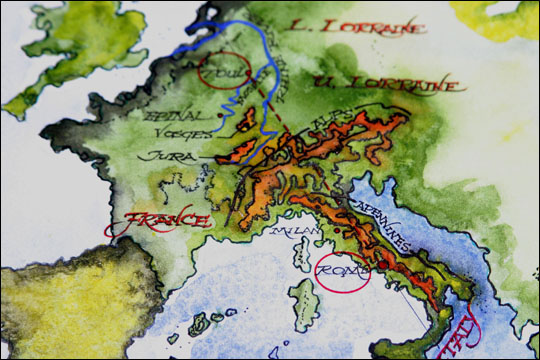
There is an old English Catholic writer who lived in the early 1900’s that you guys should definitely look up in your English lit classes. This guy walked extensively all over Britain and Europe. He even went so far as to walk from central France, across the Alps, and all the way down to Rome and as he walked, he wrote descriptions about the people and places he met along the way, along with drawings of the route, and some humor, poetry, and other reflections here and there. These make up his book titled, The Path to Rome, and the writer I’m talking about is Hilaire Belloc. One of the things he discovered along his walks was the importance of simple good deeds, like having Courtesy. As simple as it may seem, it can have a great affect, even a divine affect. He wrote a poem about Courtesy that I think relates to your lives and to our Gospel today:

Of Courtesy, it is much less
Than Courage of Heart or Holiness,
Yet in my Walks it seems to me
That the Grace of God is in Courtesy.

On Monks I did in Sorrington fall,
They took me straight into their Hall;
I saw Three Pictures on a wall,
And Courtesy was in them all.

The first the Annunciation;
The second the Visitation;
The third the Consolation,
Of God that was Our Lady’s Son.

The first was of Saint Gabriel;
On Wings a-flame from Heaven he fell;
And as he went upon one knee
He shone with Heavenly Courtesy.

Our Lady out of Nazareth rode –
It was Her month of heavy load;
Yet was Her face both great and kind,
For Courtesy was in Her Mind.

The third it was our Little Lord,
Whom all the Kings in arms adored;
He was so small you could not see
His large intent of Courtesy.

Courtesy is small and simple, like the mustard seed in our Gospel today. The typical mustard seed is about a quarter of an inch round, but it can grow to become a huge tree, about 15 feet tall in a matter of weeks! Jesus uses this image to describe what the kingdom of God is like. The kingdom of God is where people experience something heavenly, something divine. All it takes are simple good deeds like courtesy to help someone around us begin to experience the kingdom of God in all its breadth.

What you must ask yourself is this: Will I be an obstacle to the kingdom of God or Will I let God bring it about in me. Which one will it be? You can bring joy to your friends or sadness. You can bring light to your family or darkness. You can help someone come closer to God or to the Church or help him move away from God or the Church. Which will it be? You don’t have to be a Bible-thumper, running around, being obnoxious about your faith. Just start with being courteous, good-mannered, respectful, polite. All the angel Gabriel did when he arrived to Mary to tell her she was to be the Mother of God was bend on one knee to tell her. But this small act of courtesy helps us understand the power and meaning of His message. All Mary did when she visited Elizabeth was enter her house and greet her. But this small act of courtesy caused Elizabeth’s baby, St. John the Baptist, to leap with joy in her womb. And all that Baby Jesus did was lay there in a manger, moving the hearts of the magi to honor the Holy Family with three gifts. But this small act of courtesy continued to his greatest act of all, dying on the Cross for our salvation and offering us his real Body and Blood in Holy Communion. And what a true courtesy that is: A small, round, white host… a chalice of simple wine… that for all their simplicity become none other than Jesus Christ Himself, our Lord, and God.

Not that you all aren’t courteous already, but think about the greatness that a simple act can give. It doesn’t matter how old you are, or what year you’re in, or what family you’re from, or what clique you run with, or what AP class you take – all of you can achieve great holiness. Just start small with acts of courtesy whenever you can make them. Courtesy is small, but like the mustard seed, it can grow and blossom to unimaginable greatness. Just think – the door you open for a woman could be the only kindness she receives from a man that day. The politeness toward your teacher could make right years of misbehavior! One reverent genuflection before you enter your pew, one sign of the cross made slowly and intentionally out of respect for Jesus, could be the one thing that encourages your classmate not to give up his faith. Just like how the Church began with twelve poor fisherman and now spans every corner of the globe, so too can the kingdom of heaven, the experience of holiness, spread throughout your entire family, your entire school, your entire neighborhood… your entire heart… through one small act of courtesy.

Sunday, October 03, 2010

Homily 27th Sun O.T. Year C: Respect Life Sunday

    Only two short days ago, Fri Oct. 1, was a very important day here in the Archdiocese of Baltimore. It marked the three year anniversary of a very important event. I remember vividly where I was on October 1st, 2007. I was sitting right where you are. It was a very exciting day as people packed into the Cathedral. I was sitting in a pew with many other seminarians and I remember thinking how neat it was to see so many different religious orders, many of the faculty from St. Mary's, so many priests and deacons, even a good number of bishops. That wonderful event was the Mass in which Abp. Edwin O'Brien became the 15th Archbishop of Baltimore, at the same time becoming the "first among equals" of the American bishops.

    Not only do I remember vividly the setting that day, I also remember well the homily. With today being Respect Life Sunday, we would do well to recall what Abp. O'Brien proclaimed to Baltimore and to America on his first day as the Archbishop of Baltimore. His words were full of conviction and resolve, full of certainty and hope. Indeed, he was like a modern day St. Paul and we were like his spiritual son, St. Timothy. Paul wrote to Timothy in our second reading, "stir into flame the gift of God that you have"! "For God did not give us a spirit of cowardice but rather of power and love and self-control. So do not be ashamed of your testimony to our Lord"! Like, Paul, Abp. O'Brien instructed us to be courageous in our witness to the Gospel of Life and courageous in our love of women in crisis pregnancies and of the unborn. He said:

I pledge that I shall make every effort possible to continue and intensify the defense of the right to life that has been waged by my predecessors. And I pledge more. No one has to have an abortion. To all those in crisis pregnancies, I pledge our support and our financial help. Come to the Catholic church -- let us walk with you through your time of trouble, let us help you affirm life, let us help you find a new life with your child, let us help you by placing that child in a loving home. But please, I beg you, let us help you affirm life. Abortion need not be an answer in this archdiocese....

    What a rousing call! It certainly stirred up the flame in my fellow seminarians and me to do more spiritually and publicly for the pro-life cause. I remember how we often gathered with students from Johns Hopkins on early Saturday mornings in front of a local abortion clinic to pray the rosary and to offer counseling to women as they entered and left the clinic. We were filled with compassion and zeal. We wanted more than anything to help, to make a difference. But when people would heckle us or mock us, I had moments in which I felt like the prophet Habakkuk in our first reading. He cried out to the Lord, "How long, O LORD? I cry for help but you do not listen! I cry out to you, 'Violence!' but you do not intervene. Why do you let me see ruin; why must I look at misery? Destruction and violence are before me; there is strife, and clamorous discord"!

    Aren't these the cries of so many in the pro-life movement when we consider the magnitude of our mission? When we consider that abortion is allowed throughout the entire nine months of pregnancy! When we consider that over 1 million surgical abortions take place every year in the United States, over 4000 every day, and that they are mostly done for non-medical reasons! How can we move forward, how can we continue to witness to the Gospel of Life, in the face of such a formidable foe?

    After the prophet cried to the Lord for him to intervene, the Lord finally gave him an answer. The Lord cautioned the prophet not to give up hope so easily, for his salvation "still has its time, presses on to fulfillment, and will not disappoint." "If it delays," the Lord said, "wait for it, it will surely come, it will not be late. The rash one has no integrity; but the just one, because of his faith, shall live."

    Faith is the key when we feel discouraged in our work to end abortion, euthanasia, embryonic stem cell research, human cloning, and all other offenses against the life of God in us. What we must remember is that all the faith we will ever need in this life has already been given to us! On the miraculous day of our Christian Baptism, Jesus Christ the High Priest infused into our souls what we call the "theological virtues", the precious gifts of Faith, Hope, and Love. The blessed waters of Baptism became a spring of living water in our souls, a spring of Faith, Hope, and Love flowing throughout our very being. A spring that could very well carry us to heaven if we do not inhibit its flow.

    Often, the source of our discouragement is not the enemy before us, but rather the things we have done to build a damn in the spring of Faith in us. Whenever we let despair overcome us, we place a large rock in this spring. Whenever we have division in the pro-life movement, we place another. Whenever we lash out recklessly against those who are pro-abortion, we place another. Whenever we resign ourselves to idleness or shrink from our responsibility to defend life, we place another, until we have built a damn, blocking the flow of the spring of Faith. When we feel discouraged or unmotivated it is this obstacle that we are feeling.

    What we must do to break down the damn against the spring of Faith is to make an Act of Faith. We have heard of the Act of Contrition, right? It is the prayer we say during the Sacrament of Reconciliation. Remember? It goes, "O my God I am heartily sorry for having offended you…" and so forth. Did you know that there is an Act of Faith as well? It goes:

"O my God, I firmly believe that you are one God in three divine Persons, Father, Son, and Holy Spirit. I believe that your divine Son became man and died for our sins and that he will come to judge the living and the dead. I believe these and all the truths which the Holy Catholic Church teaches because you have revealed them who are eternal truth and wisdom, who can neither deceive nor be deceived. In this faith I intend to live and die. Amen."

    When the apostles realized how demanding Christ's teachings are, they did not become discouraged, instead they made an Act of Faith. Theirs was simple, they said to the Lord, "Increase our faith" and he replied that nothing is impossible if we preserve our Faith in Him. Indeed, "If you have faith the size of a mustard seed," he said, "you would say to this mulberry tree, 'Be uprooted and planted in the sea,' and it would obey you"!

An Act of Faith is the proper response to the pro-abortion forces in our society, not fear. Your Act of Faith could be the formal prayer or it could be an actual act of faith. For example, you could volunteer with the Respect Life group here at the Cathedral. They will celebrate Respect Life month later in October. They also plan a baby shower in May that benefits a local pregnancy resource center and the Gabriel Network, a support system for pregnant women in need. You could pray in front of an abortion clinic or join a national prayer campaign at www.PrayerCampaign.org. There are many prayers and acts of Faith that you can make.

By our faith, the victory that Christ won over sin and death by the power of His Cross can reign in our lives, in our families, our Churches, our neighborhoods. By our faith that victory can reign in Baltimore and everywhere in Maryland that there is an abortion clinic. In fact we have seen that victory recently with the closing of the abortion clinic in Severna Park last week!

    Never lose faith in the victory of life over death that has already been won. Our Lord desires to work through you to apply this victory to our place and time. And he has limitless mercy and forgiveness for those who have been wounded by abortion. Make an Act of Faith! Let the springs of Faith flow like a raging torrent through your heart and soul! Go out with courage and proclaim to all the world that as long as we draw breath, death will not have the final say!

Sunday, August 15, 2010

Homily for Solemn High Mass for the Assumption of the Blessed Virgin Mary

    Some of you may be wondering who I am today. I have attended in choir at this Mass a few times but this is the first time I have Assisted at the altar. My name is Deacon Matthew Hardesty and I am a seminarian for the Archdiocese of Louisville. I was just ordained a Deacon in April. It is a great honor for me to Assist as the Subdeacon alongside my good friends Fr. Paul Beach, the celebrant, and Fr. Fred Klotter, your pastor and the Deacon for today. Add to that, it has been a good while since a Solemn High Mass has been celebrated here at St. Martin's and the Feast of the Assumption of the Blessed Virgin Mary is one of the most beautiful Feast days that Holy Mother Church celebrates. This is truly a monumental occasion.

    After hearing Fr. Klotter chant the Gospel reading, I fondly remembered an inscription on the baldachino standing over the altar at the seminary. It is the first phrase of Mary's canticle of praise to God - Magnificat anima mea Dominum – My soul magnifies the Lord. At every daily Mass at the seminary, going back to when I first entered seminary in August of 2005, I have read that phrase and pondered its meaning. What does it mean for one's very soul to magnify the Lord? What does it mean for all of us today on the Feast of the Assumption of the B.V.M.?

    The answer begins in the Old Testament with the widow Judith, who was the object of the epistle that I chanted. We hear her being praised for her victory over the Assyrians on behalf of the Israelites, but we do not hear exactly what she did. Due to her splendid beauty and surpassing wisdom, she was able to get close to the enemy king. She had great courage and faith in the Lord's protection and strength. When the king was asleep she took his sword and decapitated him, much to the horror of their enemies who fled in fear and were defeated. The Israelites praised her as blessed "above all women upon the earth." They declared that God had magnified her name on that fateful day and that her praise shall come from the mouths of men forever. Judith was considered the glory of Jerusalem, the joy of Israel, the honor of her people.

    The Church presents Judith to us today so that we might turn our eyes to the woman par excellence, most resplendent in beauty, most blessed among women, whom all generations shall call blessed – the Blessed Virgin Mary. She is the glory, the joy, the honor of Israel, too be sure, but also of all mankind. By her courage in saying Yes to becoming the Mother of God and by her faith and hope in God's promises she brought about a victory much greater than one nation over another. As Judith won victory for Israel by a fatal blow to the head of the enemy king, Mary brings about the victory over Satan by bearing our Savior, Jesus Christ, who crushes the head of sin and death underfoot. The Lord God prophesied to the serpent in the Garden of Eden, "I will put enmity between you and the woman, and between your seed and her seed; he shall bruise your head, and you shall bruise his heel." But, Mary does not magnify herself by her virtues. She sings, "my soul magnifies the Lord." What does this mean? It means that her entire life joyfully proclaims to all generations our Lord's conclusive victory over sin and death.

    Due to the fall of our first parents, sin took hold over the beginning and the end of human life. At his conception, man inherits original sin and what we call concupiscence or the tendency toward sin. And at his very end he must suffer the wages of sin which are death and the decomposition of his body. But, the Blessed Virgin Mary shines forth as a beacon from God's heavenly kingdom, showing us even now, before Christ's second coming, that he is completely victorious over sin and death. The Lord, by Mary's Immaculate Conception, saved her from original sin before she could be sullied by it, thus showing his victory over the beginning of life. By freeing her from the snares of concupiscence, he prepared her to live a life free from actual committed sin. And by assuming her body and soul into heaven he showed his victory over the end of life. Mary was saved completely from the dominion and the bonds of sin and death.

    When Pope Pius XII defined the dogma of the Assumption in 1950 he defined the essence of the dogma to be thus: "The Immaculate Virgin, preserved free from all stain of original sin, when the course of her earthly life was finished, was taken up body and soul into heavenly glory, and exalted by the Lord as Queen over all things, so that she might be the more fully conformed to her Son, the Lord of lords and conqueror of sin and death" (Munificentissimus Deus). This is what Catholics must believe. But what does this have to do with us?

    First, Mary's Assumption is the guarantee that those who share in the suffering and death of Jesus Christ, will share in his glory. Even though the Fathers of the Church differ on this point, I believe that Mary did die. But, the key difference between her death and ours is that our death will happen by necessity because we are fallen and sinful. On the other hand, Mary's death was not by necessity because she had no sin, weather that be original sin or committed sin. Her death was a grace from God so that she might be conformed to her Son even in his death. And her death lasted only an instant, in order to serve this purpose and in order that she might continue to be conformed to him in eternal life. Her body was joined to her soul in heaven at the moment of her death, so that it would not know decay, and so that she would not have to wait for her Son's second coming, wherein all of our bodies will be joined to our souls in heaven, hell, or purgatory. Her body and soul were immediately assumed into heaven.

If the kingdom of heaven has a king, that is Jesus Christ, then it must have a queen, the Blessed Virgin Mary. By sharing in Christ's sufferings at the foot of the cross, and by sharing in his death by a singular grace from God, she proved to us that Jesus keeps his promises: she shares in his heavenly glory. If we offer up our sufferings, great and small, to the Father and die to ourselves, our passions, and our own will, each and every day, we too will share in Christ's glory alongside our Blessed Mother who reflects the glory of her Son every time we look to her.

    The Assumption of the Blessed Virgin Mary also teaches us the honor due to our father and mother. Jesus followed the fourth commandment to its ultimate degree by bringing his mother, body and soul, quickly to his side at the moment of her death. He crowned her queen of heaven and earth. As Mary described in her canticle of praise, "He that is mighty, hath done great things to me; … he hath exalted the humble." Fr. Matthias Scheeben, the brilliant German theologian of the mid 1800's, described beautifully the honor that the Son of God showed His Mother: "As He on the third day had raised from the sepulcher that holy and incorrupt body which He had taken from her and had united to His own person, so also this mother was snatched from the grave and conformed to her Son; and as He had descended to her, so she, as being closely united with that greater and more perfect tabernacle, was taken up into heaven." How do we honor our father and mother, especially as they approach old age or death? Do we forget them or abandon them? Do we "honor" them by squabbling over money or inheritance? Jesus Christ is calling us today to honor our father and mother as if they were his Heavenly Father and his Blessed Mother for they have been given to us to lead us to these Holy Parents.

    When I return to seminary next week for my last year, I will again kneel in the chapel and read that inscription over the altar each and every day – Magnificat anima mea Dominum – My soul magnifies the Lord. Oremus pro invicem – Let us pray for each other, today and during this year. Let us pray that through the intercession of our Blessed Mother, Queen of Heaven and Earth, we will not magnify ourselves by our faith and works, but instead always magnify our Lord. Let us pray that through her intercession we will share in his suffering and death and so share in his glory. That through her intercession we will honor our father and mother and give them the crown that they deserve. Finally, let us pray, that through her intercession we too will be brought swiftly to the side of our Lord when we die. In the Name of the Father… Amen.

Sunday, August 01, 2010

Homily 18th Sun O.T. Year C: Rich in What Matters to God

    At the seminary, the accumulation of books is the last acceptable materialism. Seminarians do not make any money. The Archdiocese, using money from various initiatives like the Building a Future of Hope Campaign and other funds, pays for our tuition, room, and board. But for anything outside of that, we rely on donations and a monthly stipend. We often cry, "Woe is me, I'm a poor seminarian" but we have a knack for accumulating books like you wouldn't believe! I think I have four whole bookshelves at the seminary, full of books. And I tell myself that I need them, or that someday I will refer to them. Many of them are in fact very useful, but most of them go unread. And so at the end of each semester, at least at St. Mary's where I study, we have a tradition of leaving things we want to get rid of at the end of the hall so that other seminarians that may need them can freely pick them up. This is a very liberating exercise. Not only does it help practically in packing up to go home, but it also relieves that spiritual and psychological burden that escalates as we – as I – accumulate more and more books and things. One feels like a 50 pound weight has been lifted off of his shoulders as he returns from the end of the hall to his room.

I pray that I don't lose this tradition – the impulse at the end of each semester to pare things down, to unload a bit, to free myself of so many things that distract me from what is most important. We see this impulse especially in the elderly and most especially in those who are preparing for death. Facing death causes one to look back at how well one has lived. "Did I live well? Did I do the right thing? Was I a good husband and father? How well did my children turn out? Will my family be OK?" All of these are questions that I have heard elderly people ask as I have visited them at home or at the hospital. And the point that many make is that the things they thought were most valuable, really aren't that valuable anymore in the grand scheme of things. Many feel a certain disappointment or embarrassment. They fought and worked so hard for so many decades in order to have a wealthy retirement or to finally enjoy all of the things they felt cheated out of as they concentrated on raising their family. Now all they want to do is be free of it all, to have peace and quiet, to see virtuous living among their children, to give and to receive love, to share the stories and the lessons they have learned. And the wisest of the elderly want to die well, detached from all of the things and all of the plans that now have little value before the eternal value of their own soul and their preparedness for eternal life.

In one of the most important encyclicals of our Catholic Social Teaching, Populorum Progressio, On the Development of Peoples, Pope Paul VI wrote, "Increased possession is not the ultimate goal of nations nor of individuals. All growth is ambivalent. It is essential if man is to develop as a man, but in a way it imprisons man if he considers it the supreme good, and it restricts his vision." Our first reading from the Book of Ecclesiastes began by exclaiming "Vanity of vanities! All things are vanity!" The Hebrew word, translated here as "vanity" really means "a breath" or "a vapor" and "vanity of vanities" is the Hebrew way of saying, "the merest breath." The author isn't talking about being "vain", he is emphasizing that the things we work so hard for in life, what Pope Paul VI called our "increased possession," are like "a breath", like "a vapor", they pass away with the wind. Those who are approaching death from sickness or old age readily see how their things will pass away like "a breath", like "a vapor" and the wisest among them are liberated, not embittered by this fact. Why can't most of us, who cannot see our death approaching, have the same liberation?

I often find that once I have finally gotten that rare book from that awesome theologian, I flip through it, put it on the shelf, and then focus on what the next book will be. The fact is, God put into man an insatiable desire for the infinite, but we try to fulfill that desire with finite things. Because we do this, we live in constant frustration, going from one thing to the next, never satisfied. But, our satisfaction will only come, even in this life, when we satisfy our infinite desire with infinite things. Perhaps we need a healthy reminder that death could come for any of us at any minute. This need not cause us to be nervous or anxious. Instead it should cause us to live each day valuing what is most important, what is infinite, what does not pass away. St. Athanasius, in his biography of St. Anthony of the Desert, wrote: "A person who lives as if he were to die every day - given that our life is uncertain by definition - will not sin, for good fear extinguishes most of the disorder of our appetites; whereas he who thinks he has a long life ahead of him will easily let himself be dominated by pleasures."

It is not a sin to be rich. We have many saints in our tradition who were kings or queens. But it is a sin to value finite things over infinite things. Our things should be instrumental toward our salvation. They should not amount too our salvation or be the source that we look to for a sense of salvation here on earth. Our lives should be characterized by an accumulation of infinite things. One should look back on us when we die and say: "Yes, he lived a life accumulating, day after day, year upon year, grace, prayer, charity toward his family and neighbors. He claimed parishioner after parishioner who decided to be a more faithful Catholic because of his example. He accumulated rosaries prayed, confessions humbly given, novenas offered, hours spent before the Blessed Sacrament. And he didn't accumulate these just so he could provide a final tally to God and say, 'Look at all that I did!' No he accumulated these spiritual things because they brought him fulfillment and happiness. They brought others relief from their burdens. They were pleasing to God." Will these things be said of us? Or instead will God say to us what he said to the foolish rich man, "'You fool, this night your life will be demanded of you; and the things you have prepared, to whom will they belong?' Thus will it be for all who store up treasure for themselves but are not rich in what matters to God."

Sunday, July 25, 2010

Homily 17th Sun O.T. Year C: How to Pray

    Why is it that… of all the things that are the most life-giving in our faith, prayer can be the most confounding? The questions that we have when we first learn to pray continue to pop-up when we are most advanced in prayer: When should I pray? How should I pray? What should I say? And the question that troubles us the most: Why should I even try? The good news is we are not left on our own to find the answers to these questions. And we are not alone in asking them. Jesus' disciples, even after his preaching, teaching, and parables; even after his miraculous cures and his miraculous feats; even after he calmed the storm at sea, cast out demons, and multiplied the loaves and fishes; even after the Transfiguration, they still felt the need to ask him how to pray.

    And this we should pay close attention too. This is Jesus Christ, fully divine and fully human. The Father can resist no prayer of his. The very words of the "Our Father" that Jesus gave his disciples were given to Jesus by the Father as he prayed in silence. At the same time, Jesus knows the human heart perfectly. He knows how to put into words exactly what we need. The "Our Father" is the perfect prayer. No matter your experience of prayer it is the surest way to our Father's heart. It should always be a staple of our personal prayer.

    The words of the "Our Father" in St. Matthew's Gospel are the words we are most familiar with. Did you notice in St. Luke's Gospel today that the "Our Father" was a little more succinct? He starts out with, "Father, hallowed be your name." He doesn't say "who art in heaven." St. Luke does this because he doesn't want us to think that God is somehow confined in heaven and distant from us. He leaves this out in order to draw us up to heaven, close to the Father, and to draw us away from earthly things (Theophylus, Catena Aurea, Luke 11). This closeness to him is the reason that we are able to call him "Father." We truly are his children and we should feel like his children. We should feel like we can come to him with whatever needs we may have. And if we pattern our prayer after the "Our Father", he is sure to answer us.

Believe it or not, there is a right and a wrong way to pray. The Letter of St. James, chapter 4, verse 3 says, "You ask, but do not receive, because you ask wrongly, to spend it on your passions." Sometimes children pray for silly things, like when a girl prays for God to make her brother mute so he'll stop picking on her! This is OK because it cultivates a familiarity with God and an impulse to turn to Him regularly. But, when we become adults we should have a child-like faith, not a child-ish faith. We shouldn't pray to win the lottery or for our favorite team to win. Like the "Our Father," we should praise God first, ask for his will to be ours, then pray for only those things which are objectively good for us. We should examine our motives and ask God to purify them. Even a seemingly good prayer, like "God, grant me a deeper understanding of your Church's teaching," could be tinged with the desire for others to praise us for this understanding. And God, who knows our hearts perfectly, will not answer us right away because he does not give what is not good for us. Like the gospel said, he will not "hand his son a snake when he asks for a fish" or "hand him a scorpion when he asks for an egg." This is because no matter how good the fish or the egg might sound, if in his will they are not good for us at the time that we ask for them, then they will be harmful. Underneath the prayer for winning the lottery is really the need for God to help us persevere through financial difficulty – this is a good prayer. Underneath the prayer for our favorite team to win is our desire that the team use their gifts well and fairly and that coaches and officials are just – this is a good prayer. When we pray the "Our Father" or pattern our own prayer after it, asking for good things with pure motives, our Father will surely answer us. He would not encourage us to ask, seek, and knock if he was not willing to give and give abundantly.

Our ancestral father in faith, Abraham, gives us another sure and certain way to our Father's heart: persistence. The Lord in the form of an angel was determined to go to the wicked towns of Sodom and Gomorrah to see if the outrage expressed against them was really true. Abraham knew what the verdict would be if it was: The Lord's justice would prevail over those cities. Moved with hope he concluded that surely there are innocents among them. Then out of love for these unknown innocents he implored the Lord repeatedly to make concession for them. He was humble, he expressed all along his desire not to pester the Lord. But with courage he continued to intercede for the innocent residents of Sodom and Gomorrah. And with patience and generosity the Lord progressively tempered his justice with his mercy at each of Abraham's requests. It was Abraham's persistence that elicited the most generosity from the Lord.

    We should never be afraid to be persistent in prayer. Jesus Christ himself taught us to pray "Give us this day our daily bread". This daily bread is both our temporal, physical, or emotional needs for that day and especially our spiritual need for the Eucharist. These we should pray for every day. But, when we think of praying to God about the same thing over and over we imagine a little child in line at the grocery store who begs and begs for candy until his mother finally buys it. The mother in that case isn't teaching the child about the nobility of persistence or rewarding him for his perseverance. She buys the candy because she can't bear the whining any longer! This is not how God operates and it is not how he sees our relationship with him. From God's point of view, He is unwearied in his love for us. From our point of view, we pray repeatedly for something not because we want to pester God into submission but because we believe that he can provide what we want. It's actually a sign of great faith. If you are one who prays repetitiously, you should be proud of yourself for God has given you a great faith.

God sometimes delays in answering our prayer because he knows that this delay will serve us better in the end. If the man in the parable today had opened the door on the first knock for his friend who needed bread for his guest, then the friend in his hurry would have taken the bread and ran home immediately to his guest. Instead, he delayed, forcing his friend to consider not only his immediate need, but also the late hour of his request and the courtesy due to the family inside who were asleep. The man caused his friend to think more deeply about their friendship, to honor it more, and to think outside of himself toward others. God's delay in answering our prayer should cause us to consider the same things.

Repetitious prayer also develops our reliance on Him and erodes our reliance on ourselves. It helps us to give the proper value to God's gifts and not to take them for granted. One who toils for years for something keeps it safe and secure, he doesn't leave it unguarded to be lost or stolen or forgotten. God's gifts, his graces, virtues, assistance and healing are more precious than gold. He doesn't wish for these things to be taken so trivially. But this doesn't mean that he is stingy in his giving. In fact, He gives much more than we are willing to receive.

When we pray the "Our Father" in a little while say each phrase carefully and think about each phrase as you say it. When we sing "Holy, Holy, Holy" and "Hosanna in the Highest!" praise God from the depths of your heart. When you receive Communion, ask that the Father, through Jesus, unite your will to his. Then spend some quiet time in prayer after Communion, the most fitting time to pray. When you praise him, seek his will, and ask for good things with good intentions at this time, right after Communion, you will not only be praying like Jesus and with Jesus, but you will be praying as Jesus, because the Father will look upon you and see the Body, Blood, Soul, and Divinity of His Son, our Lord, Jesus Christ, living in you. When He sees His Son in you, He will not fail to answer.